
血浆咖啡因对肥胖、2型糖尿病和心血管疾病因果效应的评估:两样本孟德尔随机化研究
Appraisal of the causal effect of plasma caffeine on adiposity, type 2 diabetes, and cardiovascular disease: two sample mendelian randomisation study.
作者信息
Larsson Susanna C, Woolf Benjamin, Gill Dipender
机构信息
Unit of Cardiovascular and Nutritional Epidemiology, Institute of Environmental Medicine, Karolinska Institutet, Stockholm, Sweden.
Department of Surgical Sciences, Uppsala University, Uppsala, Sweden.
出版信息
BMJ Med. 2023 Jan 31;2(1):1-8. doi: 10.1136/bmjmed-2022-000335. eCollection 2023.
OBJECTIVE
To investigate the potential causal effects of long term plasma caffeine concentrations on adiposity, type 2 diabetes, and major cardiovascular diseases.
DESIGN
Two sample mendelian randomisation study.
SETTING
Genome-wide association study summary data for associations of two single nucleotide polymorphisms associated with plasma caffeine at the genome-wide significance threshold (rs2472297 near the gene and rs4410790 near the gene) and their association with the outcomes.
PARTICIPANTS
Primarily individuals of European ancestry participating in cohorts contributing to genome-wide association study consortia.
MAIN OUTCOME MEASURES
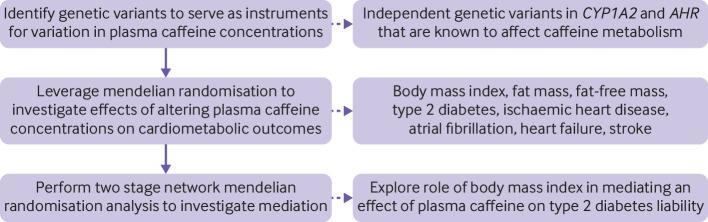
Outcomes studied were body mass index, whole body fat mass, whole body fat-free mass, type 2 diabetes, ischaemic heart disease, atrial fibrillation, heart failure, and stroke.
RESULTS
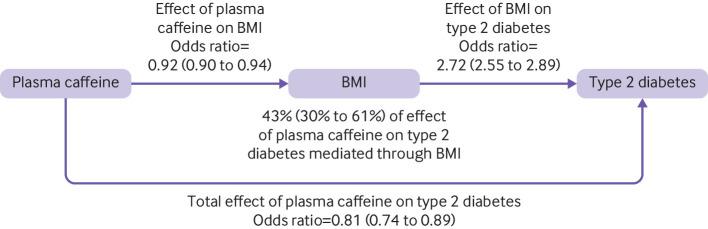
Higher genetically predicted plasma caffeine concentrations were associated with lower body mass index (beta -0.08 standard deviation (SD) (95% confidence interval -0.10 to -0.06), where 1 SD equals about 4.8 kg/m in body mass index, for every standard deviation increase in plasma caffeine) and whole body fat mass (beta -0.06 SD (-0.08 to -0.04), 1 SD equals about 9.5 kg; P<0.001) but not fat-free mass (beta -0.01 SD (-0.02 to -0.00), 1 SD equals about 11.5 kg; P=0.17). Higher genetically predicted plasma caffeine concentrations were associated with a lower risk of type 2 diabetes in two consortia (FinnGen and DIAMANTE), with a combined odds ratio of 0.81 ((95% confidence interval 0.74 to 0.89); P<0.001). Approximately half (43%; 95% confidence interval 30% to 61%) of the effect of caffeine on type 2 diabetes was estimated to be mediated through body mass index reduction. No strong associations were reported between genetically predicted plasma caffeine concentrations and a risk of any of the studied cardiovascular diseases.
CONCLUSIONS
Higher plasma caffeine concentrations might reduce adiposity and risk of type 2 diabetes. Further clinical study is warranted to investigate the translational potential of these findings towards reducing the burden of metabolic disease.
目的
研究长期血浆咖啡因浓度对肥胖、2型糖尿病和主要心血管疾病的潜在因果效应。
设计
两样本孟德尔随机化研究。
设置
全基因组关联研究汇总数据,涉及两个在全基因组显著性阈值下与血浆咖啡因相关的单核苷酸多态性(靠近 基因的rs2472297和靠近 基因的rs4410790)及其与各结局的关联。
参与者
主要是欧洲血统的个体,他们参与了对全基因组关联研究联盟有贡献的队列研究。
主要结局指标
研究的结局包括体重指数、全身脂肪量、全身去脂体重、2型糖尿病、缺血性心脏病、心房颤动、心力衰竭和中风。
结果
遗传预测的血浆咖啡因浓度较高与较低的体重指数相关(β -0.08标准差(SD)(95%置信区间 -0.10至 -0.06),血浆咖啡因每增加1个标准差,体重指数中1个SD约等于4.8kg/m²)和全身脂肪量(β -0.06 SD(-0.08至 -0.04),1个SD约等于9.5kg;P<0.001),但与去脂体重无关(β -0.01 SD(-0.02至 -0.00),1个SD约等于11.5kg;P = 0.17)。在两个联盟(芬兰基因研究和钻石研究)中,遗传预测的血浆咖啡因浓度较高与2型糖尿病风险较低相关,合并比值比为0.81((95%置信区间0.74至0.89);P<0.001)。估计咖啡因对2型糖尿病影响的约一半(43%;95%置信区间30%至61%)是通过体重指数降低介导的。未报告遗传预测的血浆咖啡因浓度与所研究的任何心血管疾病风险之间有强关联。
结论
较高的血浆咖啡因浓度可能会降低肥胖和2型糖尿病风险。有必要进行进一步的临床研究,以调查这些发现对减轻代谢疾病负担的转化潜力。

 Zotero 插件