
美国的非药物干预措施与新冠疫情负担:一项回顾性观察性队列研究
Non-pharmaceutical interventions and covid-19 burden in the United States: retrospective, observational cohort study.
作者信息
Ahlers Michael, Aralis Hilary, Tang Wilson, Sussman Jeremy B, Fonarow Gregg C, Ziaeian Boback
机构信息
Internal Medicine, David Geffen School of Medicine, Los Angeles, CA, USA.
Biostatistics, University of California Los Angeles, Los Angeles, CA, USA.
出版信息
BMJ Med. 2022 Aug 1;1(1):e000030. doi: 10.1136/bmjmed-2021-000030. eCollection 2022.
OBJECTIVE
To evaluate the adoption and discontinuation of four broadly used non-pharmaceutical interventions on shifts in the covid-19 burden among US states.
DESIGN
Retrospective, observational cohort study.
SETTING
US state data on covid-19 between 19 January 2020 and 7 March 2021.
PARTICIPANTS
US population with a diagnosis of covid-19.
MAIN OUTCOME MEASURES
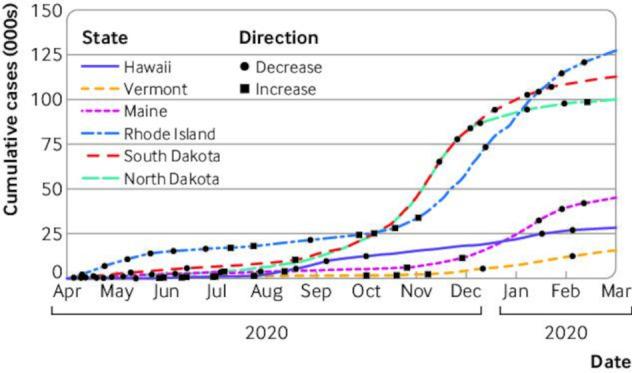
Empirically derived breakpoints in case and mortality velocities (ie, rate of change) were used to identify periods of stable, decreasing, or increasing covid-19 burden. Associations between adoption of non-pharmaceutical interventions and subsequent decreases in case or death rates were estimated by use of generalised linear models accounting for weekly variability across US states. State level case and mortality counts per day were obtained from the Covid-19 Tracking Project. State level policies on non-pharmaceutical interventions included stay-at-home orders, indoor public gathering bans (mild >10 or severe ≤10 people), indoor restaurant dining bans, and public mask mandates. National policies were not included in statistical models.
RESULTS
28 602 830 cases and 511 899 deaths were recorded during the study. Odds of a reduction in covid-19 case velocity increased for stay-at-home orders (odds ratio 2.02, 95% confidence interval 1.63 to 2.52), indoor dining bans (1.62, 1.25 to 2.10), public mask mandates (2.18, 1.47 to 3.23), and severe indoor public gathering bans (1.68, 1.31 to 2.16) in univariate analysis. In mutually adjusted models, odds remained elevated for orders to stay at home (adjusted odds ratio 1.47, 95% confidence interval 1.04 to 2.07) and public mask mandates (2.27, 1.51 to 3.41). Stay-at-home orders (odds ratio 2.00, 95% confidence interval 1.53 to 2.62; adjusted odds ratio 1.89, 95% confidence interval 1.25 to 2.87) was also associated with a greater likelihood of decrease in death velocity in unadjusted and adjusted models.
CONCLUSIONS
State level non-pharmaceutical interventions used in the US during the covid-19 pandemic, in particular stay-at-home orders, were associated with a decreased covid-19 burden.
目的
评估美国各州广泛使用的四种非药物干预措施对新冠疫情负担变化的采用情况及停用情况。
设计
回顾性观察队列研究。
背景
2020年1月19日至2021年3月7日期间美国各州的新冠疫情数据。
参与者
确诊感染新冠病毒的美国人群。
主要观察指标
通过实证得出的病例数和死亡率变化速度(即变化率)的断点,用于确定新冠疫情负担稳定、下降或上升的时期。采用广义线性模型估计非药物干预措施的采用与随后病例数或死亡率下降之间的关联,该模型考虑了美国各州每周的变异性。每日州级病例数和死亡数来自新冠疫情追踪项目。州级非药物干预措施包括居家令、室内公共集会禁令(轻度>10人或重度≤10人)、室内餐厅就餐禁令和公众口罩强制令。国家政策未纳入统计模型。
结果
研究期间记录了28602830例病例和511899例死亡。在单变量分析中,居家令(优势比2.02,95%置信区间1.63至2.52)、室内就餐禁令(1.62,1.25至2.10)、公众口罩强制令(2.18,1.47至3.23)和严格的室内公共集会禁令(1.68,1.31至2.16)使新冠病例数变化速度降低的几率增加。在相互调整的模型中,居家令(调整后优势比1.47,95%置信区间1.04至2.07)和公众口罩强制令(2.27,1.51至3.41)的几率仍然升高。在未调整和调整后的模型中,居家令(优势比2.00,95%置信区间1.53至2.62;调整后优势比1.89,95%置信区间1.25至2.87)也与死亡速度降低的可能性更大相关。
结论
美国在新冠疫情大流行期间使用的州级非药物干预措施,尤其是居家令,与新冠疫情负担减轻相关。

 Zotero 插件