
1990年至2019年全球、区域和国家因高钠摄入导致的慢性肾脏病负担
Global, regional, and national burden of chronic kidney disease attributable to high sodium intake from 1990 to 2019.
作者信息
Liu Wei, Zhou Lingyun, Yin Wenjun, Wang Jianglin, Zuo Xiaocong
机构信息
Department of Pharmacy, The Third Xiangya Hospital, Central South University, Changsha, Hunan, China.
Center of Clinical Pharmacology, The Third Xiangya Hospital, Central South University, Changsha, Hunan, China.
出版信息
Front Nutr. 2023 Mar 2;10:1078371. doi: 10.3389/fnut.2023.1078371. eCollection 2023.
BACKGROUND
High sodium intake is a crucial risk factor for the development and progression of chronic kidney disease (CKD). However, the latest global spatiotemporal patterns of CKD burden attributable to high sodium intake still remain unclear. We aimed to evaluate the level and trends of the CKD burden associated with high sodium intake according to sex, age, socio-demographic index (SDI), region, and country from 1990 to 2019.
METHODS
Data on CKD burden attributable to high sodium intake from 1990 to 2019 were extracted from the Global Burden of Disease (GBD) Study 2019. The CKD-related deaths, disability-adjusted life years (DALYs), age-standardized mortality rate (ASMR), and age-standardized DALYs rate (ASDR) attributable to high sodium intake were estimated by age, sex, SDI, region, and country. The estimated annual percentage change (EAPC) was calculated to evaluate the secular trends of ASMR and ASDR of CKD attributable to high sodium intake from 1990 to 2019. We further explored the associations of SDI with the ASMR and ASDR of CKD attributable to high sodium intake.
RESULTS
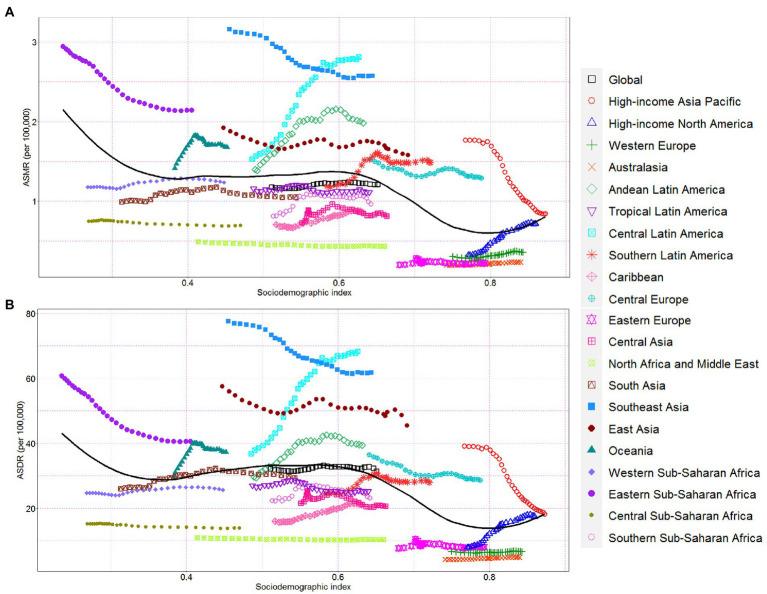
Globally, the number of CKD-related deaths and DALYs attributable to high sodium intake were 45,530 (95% UI: 12,640 to 93,830) and 1.32 million (95% UI: 0.43 to 2.8) in 2019, both twice as many as those in 1990. However, the ASMR and ASDR slightly grew, with an EAPC of 0.22 (95% CI: 0.16 to 0.28) and 0.10 (95% CI: 0.04 to 0.16), respectively. The age-specific numbers and rates of deaths, as well as DALYs of CKD attributable to high sodium intake, rose with age and were greater in males than in females. The rates of deaths and DALYs peaked in the >95 age group for both females and males in 2019. From 1990 to 2019, the trends of both age-specific rates of mortality and DALYs of CKD attributable to high sodium intake were down in people under 60, while in people over 60, the trends were the opposite. The burden of CKD attributable to high sodium intake in 2019 and its temporal trends from 1990 to 2019 varied greatly by SDI quintile and geographic location. The ASMR or ASDR showed a non-linear negative correlation with SDI at the regional level. The EAPC in ASMR or ASDR showed a markedly negative correlation with ASMR or ASDR in 1990, with a coefficient of -0.40. Nevertheless, the EAPC in ASMR rather than ASDR was positively correlated with SDI in 2019, with a coefficient of 0.18.
CONCLUSION
Our findings suggest that there are significant sexual and geographic variations in the burden of CKD attributable to high sodium intake and its temporal trends. Globally, the high sodium intake-caused CKD burden continues to elevate, posing a major challenge to public health. In response to this, strengthened and tailored approaches for CKD prevention and sodium intake management are needed, especially for elderly populations, males, and the population in the middle SDI regions.
背景
高钠摄入是慢性肾脏病(CKD)发生和进展的关键危险因素。然而,高钠摄入所致CKD负担的最新全球时空模式仍不清楚。我们旨在评估1990年至2019年期间,按性别、年龄、社会人口指数(SDI)、地区和国家划分的与高钠摄入相关的CKD负担水平及趋势。
方法
从《2019年全球疾病负担(GBD)研究》中提取1990年至2019年高钠摄入所致CKD负担的数据。按年龄、性别、SDI、地区和国家估算高钠摄入所致的CKD相关死亡数、伤残调整生命年(DALY)、年龄标准化死亡率(ASMR)和年龄标准化DALY率(ASDR)。计算估计年度百分比变化(EAPC),以评估1990年至2019年高钠摄入所致CKD的ASMR和ASDR的长期趋势。我们进一步探讨了SDI与高钠摄入所致CKD的ASMR和ASDR之间的关联。
结果
2019年全球范围内,高钠摄入所致的CKD相关死亡数和DALY数分别为45530例(95%UI:12640至93830例)和132万例(95%UI:43万至280万例),均为1990年的两倍。然而,ASMR和ASDR略有增长,EAPC分别为0.22(95%CI:0.16至0.28)和0.10(95%CI:0.04至0.16)。高钠摄入所致的CKD按年龄划分死亡数、死亡率以及DALY数随年龄增长而上升,且男性高于女性。2019年,女性和男性的死亡和DALY率在95岁以上年龄组达到峰值。1990年至2019年,60岁以下人群中,高钠摄入所致CKD的年龄别死亡率和DALY率呈下降趋势,而60岁以上人群则相反。2019年高钠摄入所致CKD负担及其1990年至2019年的时间趋势因SDI五分位数和地理位置而异。在区域层面,ASMR或ASDR与SDI呈非线性负相关。ASMR或ASDR的EAPC与1990年的ASMR或ASDR呈显著负相关,系数为-0.40。然而,2019年ASMR的EAPC而非ASDR与SDI呈正相关,系数为0.18。
结论
我们的研究结果表明,高钠摄入所致CKD负担及其时间趋势存在显著的性别和地理差异。在全球范围内,高钠摄入所致的CKD负担持续上升,对公共卫生构成重大挑战。对此,需要加强并量身定制CKD预防和钠摄入管理方法,尤其是针对老年人群、男性以及SDI中等地区的人群。


 Zotero 插件