
抗阻运动对阿尔茨海默病认知功能、淀粉样蛋白生成及神经炎症的影响。
The effects of resistance exercise on cognitive function, amyloidogenesis, and neuroinflammation in Alzheimer's disease.
作者信息
Azevedo Caroline Vieira, Hashiguchi Debora, Campos Henrique Correia, Figueiredo Emilly V, Otaviano Sthefanie Ferreira S D, Penitente Arlete Rita, Arida Ricardo Mario, Longo Beatriz Monteiro
机构信息
Department of Physiology, Universidade Federal de São Paulo, São Paulo, Brazil.
Instituto do Cérebro, Universidade Federal do Rio Grande do Norte (UFRN), Natal, Brazil.
出版信息
Front Neurosci. 2023 Mar 2;17:1131214. doi: 10.3389/fnins.2023.1131214. eCollection 2023.
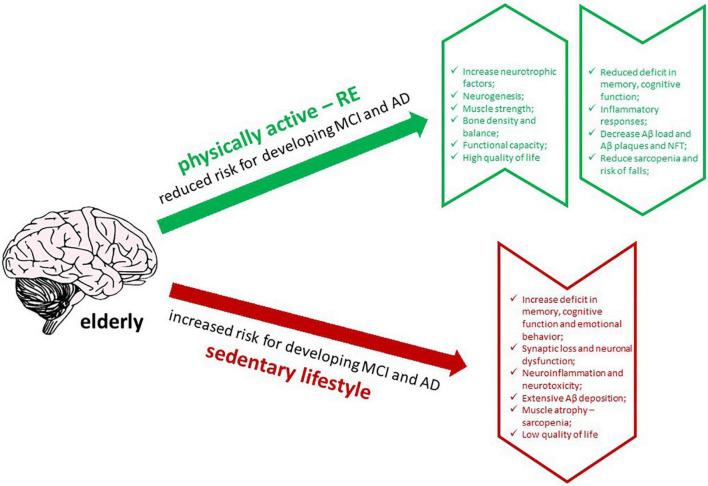
With the increasing prevalence of Alzheimer's disease (AD) and difficulties in finding effective treatments, it is essential to discover alternative therapies through new approaches. In this regard, non-pharmacological therapies, such as physical exercise, have been proposed and explored for the treatment of AD. Recent studies have suggested that resistance exercise (RE) is an effective strategy for promoting benefits in memory and cognitive function, producing neuroprotective and anti-inflammatory effects, and reducing amyloid load and plaques, thereby reducing the risk, and alleviating the neurodegeneration process of AD and other types of dementia in the elderly. In addition, RE is the exercise recommended by the World Health Organization for the elderly due to its benefits in improving muscle strength and balance, and increasing autonomy and functional capacity, favoring improvements in the quality of life of the elderly population, who is more likely to develop AD and other types of dementia. In this mini-review, we discuss the impact of RE on humans affected by MCI and AD, and animal models of AD, and summarize the main findings regarding the effects of RE program on memory and cognitive functions, neurotrophic factors, Aβ deposition and plaque formation, as well as on neuroinflammation. Overall, the present review provides clinical and preclinical evidence that RE plays a role in alleviating AD symptoms and may help to understand the therapeutic potential of RE, thereby continuing the advances in AD therapies.
随着阿尔茨海默病(AD)患病率的不断上升以及寻找有效治疗方法的困难,通过新方法发现替代疗法至关重要。在这方面,非药物疗法,如体育锻炼,已被提出并用于AD的治疗研究。最近的研究表明,抗阻运动(RE)是一种有效的策略,可促进记忆和认知功能的改善,产生神经保护和抗炎作用,减少淀粉样蛋白负荷和斑块,从而降低风险,并减轻老年人AD和其他类型痴呆的神经退行性变过程。此外,由于RE在改善肌肉力量和平衡、增强自主性和功能能力方面的益处,它是世界卫生组织为老年人推荐的运动,有利于提高更易患AD和其他类型痴呆的老年人群的生活质量。在本综述中,我们讨论了RE对受轻度认知障碍(MCI)和AD影响的人类以及AD动物模型的影响,并总结了关于RE方案对记忆和认知功能、神经营养因子、β淀粉样蛋白(Aβ)沉积和斑块形成以及神经炎症影响的主要研究结果。总体而言,本综述提供了临床和临床前证据,表明RE在减轻AD症状方面发挥作用,并可能有助于了解RE的治疗潜力,从而推动AD治疗的进展。
 Zotero 插件