
新冠后综合征对健康相关生活质量的影响及相关因素:一项横断面分析。
What is the impact of post-COVID-19 syndrome on health-related quality of life and associated factors: a cross-sectional analysis.
机构信息
Clinical Department of Infectious Diseases and Research, National Institute for Infectious Diseases Lazzaro Spallanzani IRCCS, Rome, Italy.
National Center for Disease Prevention and Health Promotion, National Institute of Health, Rome, Italy.
出版信息
Health Qual Life Outcomes. 2023 Mar 22;21(1):28. doi: 10.1186/s12955-023-02107-z.
BACKGROUND
After the acute phase, symptoms or sequelae related to post-COVID-19 syndrome may persist for months. In a population of patients, previously hospitalized and not, followed up to 12 months after the acute infection, we aim to assess whether and to what extent post-COVID-19 syndrome may have an impact on health-related quality of life (HRQoL) and to investigate influencing factors.
METHODS
We present the cross-sectional analysis of a prospective study, including patients referred to the post-COVID-19 service. Questionnaires and scales administered at 3, 6, 12 months were: Short-Form 36-item questionnaire (SF-36); Visual Analogue Scale of the EQ5D (EQ-VAS); in a subgroup, Beck Anxiety Inventory (BAI), Beck Depression Inventory (BDI-II) and Pittsburgh Sleep Quality Index (PSQI). Linear regression models were fitted to identify factors associated with HRQoL.
RESULTS
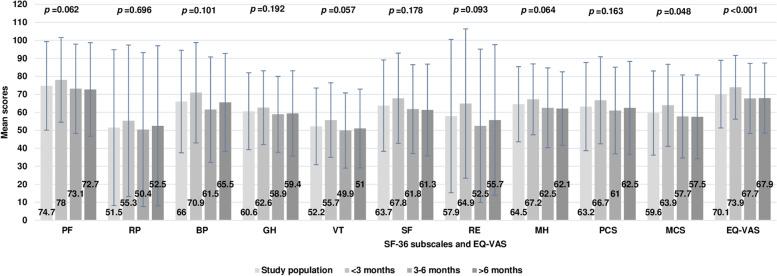
We considered the first assessment of each participant (n = 572). The mean scores in SF-36 and in EQ-VAS were significantly lower than the Italian normative values and remained stable over time, except the mental components score (MCS) of the SF-36 and EQ-VAS which resulted in lower ratings at the last observations. Female gender, presence of comorbidities, and corticosteroids treatment during acute COVID-19, were associated with lower scores in SF-36 and EQ-VAS; patients previously hospitalized (54%) reported higher MCS. Alterations in BAI, BDI-II, and PSQI (n = 265)were associated with lower ratings in SF-36 and EQ-VAS.
CONCLUSIONS
This study provides evidence of a significantly bad perception of health status among persons with post-COVID-19 syndrome, associated with female gender and, indirectly, with disease severity. In case of anxious-depressive symptoms and sleep disorders, a worse HRQoL was also reported. A systematic monitoring of these aspects is recommended to properly manage the post-COVID-19 period.
背景
在急性阶段后,与新冠后综合征相关的症状或后遗症可能会持续数月。在一组先前住院和未住院的患者中,我们在急性感染后 12 个月进行随访,旨在评估新冠后综合征是否以及在何种程度上会对健康相关生活质量(HRQoL)产生影响,并探讨影响因素。
方法
我们展示了一项前瞻性研究的横断面分析,该研究纳入了转诊至新冠后服务的患者。在 3、6、12 个月时,患者接受了以下问卷和量表的评估:简短 36 项健康调查量表(SF-36);欧洲五维健康量表(EQ5D)视觉模拟量表(EQ-VAS);在亚组中,还评估了贝克焦虑量表(BAI)、贝克抑郁量表第二版(BDI-II)和匹兹堡睡眠质量指数(PSQI)。拟合线性回归模型以确定与 HRQoL 相关的因素。
结果
我们考虑了每位参与者的首次评估(n=572)。SF-36 和 EQ-VAS 的平均得分明显低于意大利的常模值,且随着时间的推移保持稳定,除了 SF-36 的心理成分评分(MCS)和 EQ-VAS 的评分在最后一次观察时较低。女性、合并症和急性 COVID-19 期间的皮质类固醇治疗与 SF-36 和 EQ-VAS 的评分较低相关;54%的既往住院患者报告 MCS 更高。BAI、BDI-II 和 PSQI 的改变(n=265)与 SF-36 和 EQ-VAS 的评分较低相关。
结论
本研究提供了证据表明,新冠后综合征患者的健康状况感知明显较差,与女性有关,间接与疾病严重程度有关。如果出现焦虑抑郁症状和睡眠障碍,HRQoL 也会更差。建议对这些方面进行系统监测,以妥善管理新冠后时期。
 Zotero 插件