
联合流式细胞术自然杀伤细胞免疫表型分析和杀伤细胞免疫球蛋白样受体/人类白细胞抗原-C基因分型揭示了急性髓系白血病患者之间存在显著差异,但提示自然杀伤细胞反应总体受损。
Combined flow cytometry natural killer immunophenotyping and KIR/HLA-C genotyping reveal remarkable differences in acute myeloid leukemia patients, but suggest an overall impairment of the natural killer response.
作者信息
Cianga Vlad Andrei, Rusu Cristina, Pavel-Tanasa Mariana, Dascalescu Angela, Danaila Catalin, Harnau Sebastian, Aanei Carmen-Mariana, Cianga Petru
机构信息
Department of Hematology, University of Medicine and Pharmacy "Grigore T. Popa", Iasi, Romania.
Department of Clinical Hematology, Regional Institute of Oncology, Iasi, Romania.
出版信息
Front Med (Lausanne). 2023 Mar 7;10:1148748. doi: 10.3389/fmed.2023.1148748. eCollection 2023.
INTRODUCTION
Natural killer (NK) cells are key anti-tumor effectors of the innate immunity. Phenotypic differences allow us to discriminate in between three functional stages of maturation, named immature, mature and hypermature that are distinctive in terms of receptor expression, cytokine secretion, cytotoxic properties and organ trafficking. NKs display an impressive repertoire of highly polymorphic germline encoded receptors that can be either activating, triggering the effector's function, or inhibitory, limiting the immune response. In our study, we have investigated peripheral blood NK cells of acute myeloid leukemia (AML) patients.
METHODS
The Killer Immunoglobulin-like receptors (KIRs) and the HLA-C genotypes were assessed, as HLA-C molecules are cognate antigens for inhibitory KIRs.
RESULTS
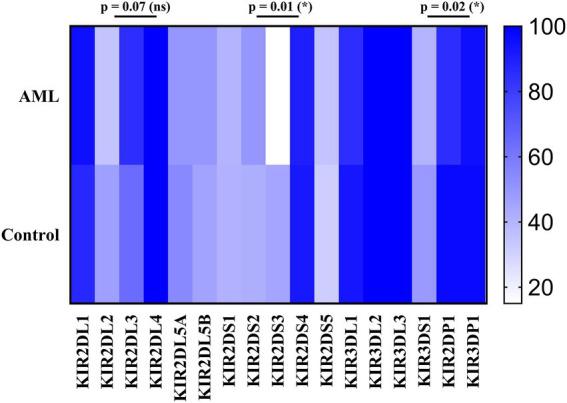
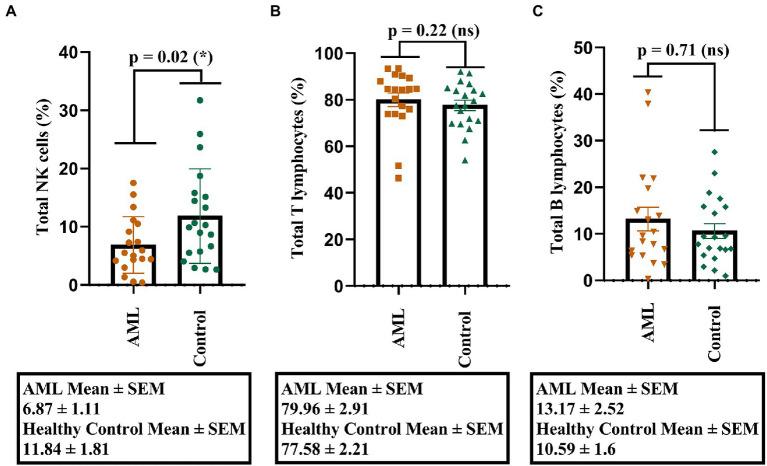
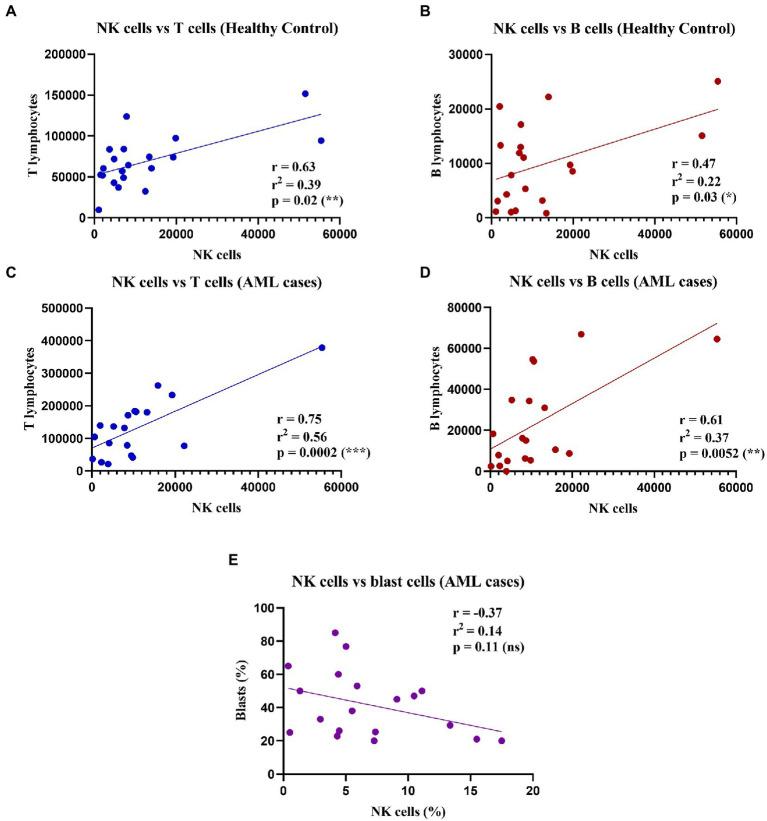
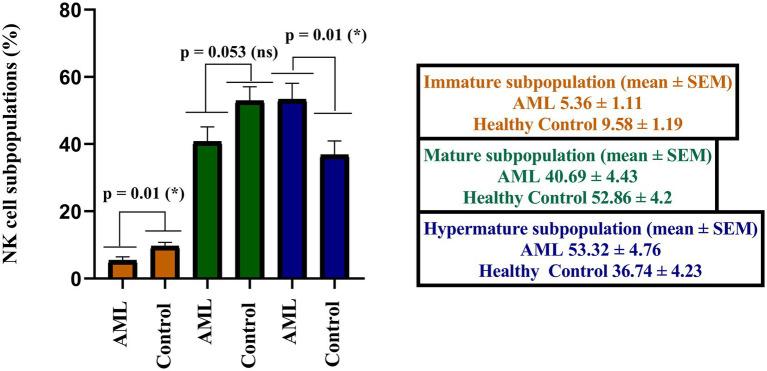
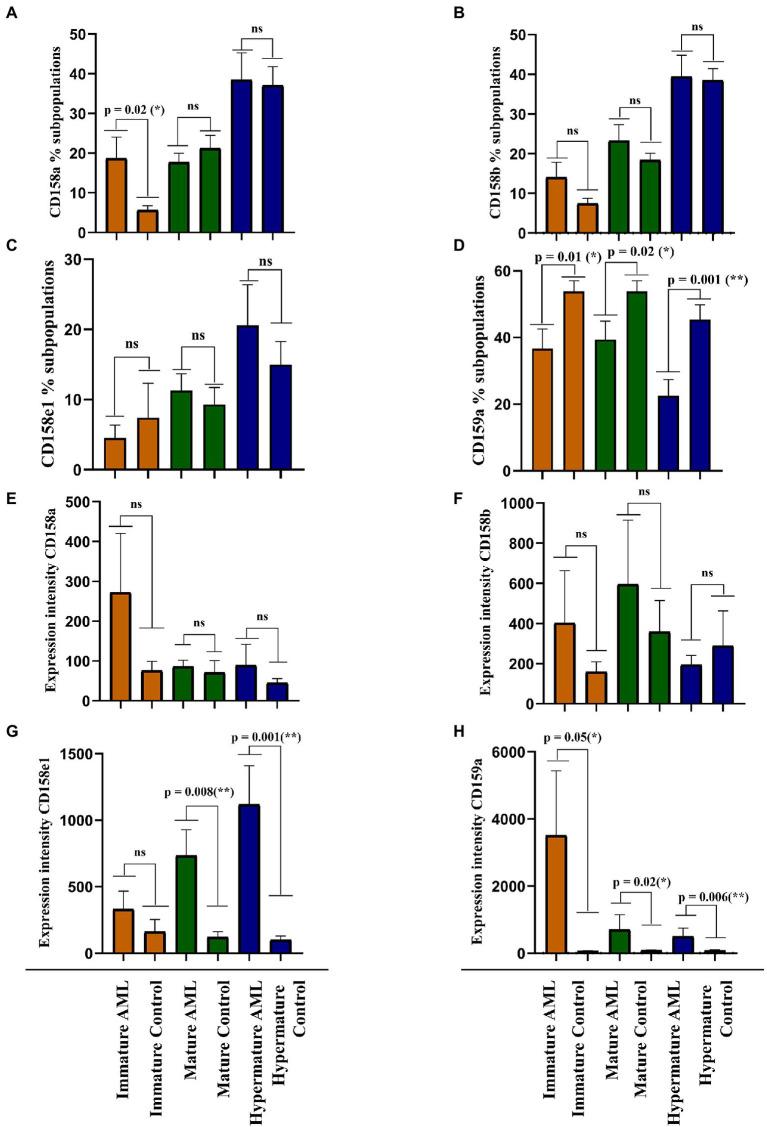
The AA mainly inhibitory KIR haplotype was found in a higher proportion in AML, while a striking low frequency of the 2DS3 characterized the mainly activating Bx haplotype. Flow cytometry immunophenotyping evidenced a lower overall count of NK cells in AML versus healthy controls, with lower percentages of the immature and mature subpopulations, but with a markedly increase of the hypermature NKs. The analysis of the KIR2DL1, KIR2DL2, KIR2DL3, KIR3DL1, and NKG2A inhibitory receptors surface expression revealed a remarkable heterogeneity. However, an overall trend for a higher expression in AML patients could be noticed in all maturation subpopulations. Some of the AML patients with complex karyotypes or displaying a FLT3 gene mutation proved to be extreme outliers in terms of NK cells percentages or inhibitory receptors expression.
DISCUSSION
We conclude that while the genetic background investigation in AML offers important pieces of information regarding susceptibility to disease or prognosis, it is flow cytometry that is able to offer details of finesse in terms of NK numbers and phenotypes, necessary for an adequate individual evaluation of these patients.
引言
自然杀伤(NK)细胞是先天免疫的关键抗肿瘤效应细胞。表型差异使我们能够区分NK细胞成熟的三个功能阶段,即未成熟、成熟和过度成熟阶段,这些阶段在受体表达、细胞因子分泌、细胞毒性特性和器官运输方面各有特点。NK细胞具有一系列令人印象深刻的高度多态性种系编码受体,这些受体可以是激活型的,触发效应细胞功能,也可以是抑制型的,限制免疫反应。在我们的研究中,我们调查了急性髓系白血病(AML)患者的外周血NK细胞。
方法
评估杀伤细胞免疫球蛋白样受体(KIR)和HLA-C基因型,因为HLA-C分子是抑制性KIR的同源抗原。
结果
在AML患者中发现主要为抑制性的KIR AA单倍型比例较高,而主要为激活型的Bx单倍型中2DS3的频率极低。流式细胞术免疫表型分析表明,与健康对照相比,AML患者的NK细胞总数较低,未成熟和成熟亚群的百分比也较低,但过度成熟的NK细胞明显增加。对KIR2DL1、KIR2DL2、KIR2DL3、KIR3DL1和NKG2A抑制性受体表面表达的分析显示出显著的异质性。然而,在所有成熟亚群中都可以注意到AML患者中表达较高的总体趋势。一些具有复杂核型或显示FLT3基因突变的AML患者在NK细胞百分比或抑制性受体表达方面被证明是极端异常值。
讨论
我们得出结论,虽然对AML的遗传背景调查提供了有关疾病易感性或预后的重要信息,但流式细胞术能够提供关于NK细胞数量和表型的精细细节,这对于对这些患者进行充分的个体评估是必要的。



 Zotero 插件