
在中国 2 型糖尿病患者中,血红蛋白糖化指数与糖尿病肾病的相关性:一项横断面住院患者研究。
Association between hemoglobin glycation index and diabetic kidney disease in type 2 diabetes mellitus in China: A cross- sectional inpatient study.
机构信息
Department of Endocrinology, International Hospital, Peking University, Beijing, China.
Department of Nephrology, International Hospital, Peking University, Beijing, China.
出版信息
Front Endocrinol (Lausanne). 2023 Mar 8;14:1108061. doi: 10.3389/fendo.2023.1108061. eCollection 2023.
OBJECTIVE
To investigate the association between Hemoglobin Glycation Index (HGI) and Diabetic Kidney Disease (DKD) in Chinese type 2 diabetic individuals and to construct a risk score based on HGI to predict a person's risk of DKD.
METHODS
We retrospectively analyzed 1622 patients with type 2 diabetes mellitus (T2DM). HGI was obtained by calculating the fasting plasma glucose (FPG) level into the formula, and they were grouped into low HGI group (L-HGI), medium HGI group (H-HGI) and high HGI group (H-HGI) according to tri-sectional quantile of HGI. The occurrence of DKD was analyzed in patients with different levels of HGI. Multivariate logistics regression analysis was used to analyze the risk factors of DKD in patients with T2DM.
RESULTS
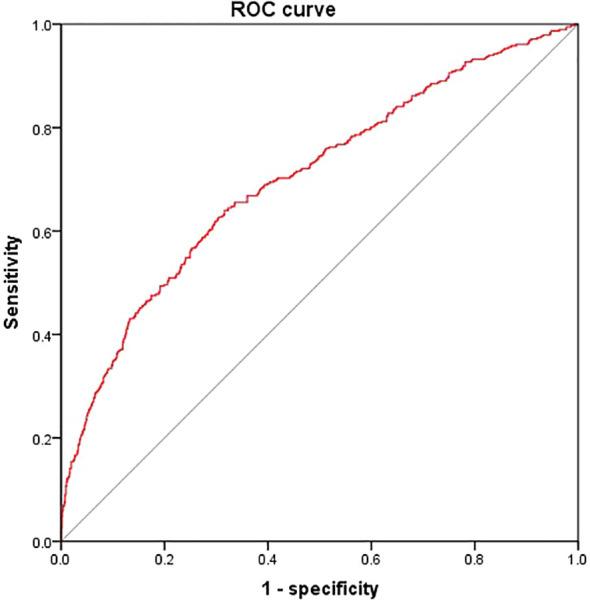
A total of 1622 patients with T2DM were enrolled in the study. Among them, 390 cases were DKD. The prevalence of DKD among the three groups was 16.6%, 24.2% and 31.3%. The difference was statistically significant (P = 0.000). There were significant differences in age (P=0.033), T2DM duration (P=0.005), systolic blood pressure (SBP) (P=0.003), glycosylated hemoglobin (HbA1c) (P=0.000), FPG (P=0.032), 2-hour postprandial plasma glucose (2h-PPG) (P=0.000), fasting C-peptide FCP (P=0.000), 2-hour postprandial C-peptide (2h-CP) (P=0.000), total cholesterol (TC) (P=0.003), low density lipoprotein cholesterol (LDL-C) (P=0.000), serum creatinine (sCr) (P=0.001), estimated glomerular filtration rate (eGFR) (P=0.000) among the three groups. Mantel-Haenszel chi-square test showed that there was a linear relationship between HGI and DKD (x2=177.469, p < 0.001). Pearson correlation analysis showed that with the increase of HGI level the prevalence of DKD was increasing (R= 0.445, P=0.000). It was indicated by univariate logistic regression analysis that individuals in H-HGI was more likely to develop DKD (OR: 2.283, 95% CI: 1.708~ 3.052) when compared with L-HGI. Adjusted to multiple factors, this trend still remained significant (OR: 2.660, 95% CI: 1.935~ 3.657). The combined DKD risk score based on HGI resulted in an area under the receiver operator characteristic curve (AUROC) of 0.702.
CONCLUSIONS
High HGI is associated with an increased risk of DKD. DKD risk score may be used as one of the risk predictors of DKD in type 2 diabetic population.
目的
探讨糖化血红蛋白指数(HGI)与中国 2 型糖尿病患者糖尿病肾脏疾病(DKD)的关系,并构建基于 HGI 的风险评分来预测个体发生 DKD 的风险。
方法
我们回顾性分析了 1622 例 2 型糖尿病患者。通过将空腹血糖(FPG)水平代入公式计算 HGI,并根据 HGI 的三分位数将患者分为低 HGI 组(L-HGI)、中 HGI 组(H-HGI)和高 HGI 组(H-HGI)。分析不同 HGI 水平患者的 DKD 发生情况。采用多因素 logistic 回归分析 2 型糖尿病患者 DKD 的危险因素。
结果
共纳入 1622 例 2 型糖尿病患者,其中 390 例患有 DKD。三组的 DKD 患病率分别为 16.6%、24.2%和 31.3%,差异有统计学意义(P=0.000)。三组间年龄(P=0.033)、糖尿病病程(P=0.005)、收缩压(SBP)(P=0.003)、糖化血红蛋白(HbA1c)(P=0.000)、FPG(P=0.032)、餐后 2 小时血糖(2h-PPG)(P=0.000)、空腹 C 肽(FCP)(P=0.000)、餐后 2 小时 C 肽(2h-CP)(P=0.000)、总胆固醇(TC)(P=0.003)、低密度脂蛋白胆固醇(LDL-C)(P=0.000)、血肌酐(sCr)(P=0.001)、估算肾小球滤过率(eGFR)(P=0.000)差异均有统计学意义。Mantel-Haenszel χ2 检验显示 HGI 与 DKD 呈线性关系(x2=177.469,p<0.001)。Pearson 相关分析显示,随着 HGI 水平的升高,DKD 的患病率呈上升趋势(R=0.445,P=0.000)。单因素 logistic 回归分析表明,与 L-HGI 相比,H-HGI 个体发生 DKD 的可能性更高(OR:2.283,95%CI:1.7083.052)。调整多个因素后,这种趋势仍然显著(OR:2.660,95%CI:1.9353.657)。基于 HGI 的联合 DKD 风险评分得出的受试者工作特征曲线(ROC)下面积(AUROC)为 0.702。
结论
高 HGI 与 DKD 风险增加相关。DKD 风险评分可作为 2 型糖尿病患者 DKD 的风险预测指标之一。


 Zotero 插件