
药物制剂中用于中和抗菌防腐剂的新配方的评估。
Evaluation of new formulations for neutralizing antimicrobial preservatives in pharmaceutical preparations.
作者信息
Katerji Aya, Trefi Saleh, Bitar Yaser, Ibrahim Ali
机构信息
Department of Pharmaceutical Chemistry and Quality Control, University of Aleppo, Aleppo, Syria.
Biochemistry and Microbiology Department, University of Aleppo, Aleppo, Syria.
出版信息
Heliyon. 2023 Mar 14;9(3):e14555. doi: 10.1016/j.heliyon.2023.e14555. eCollection 2023 Mar.
BACKGROUND
Neutralization of preservative systems is essential to obtain reliable results when testing samples containing preservatives such as nutritional, cosmetic and pharmaceutical products. Therefore, the aim of this study was to prepare and investigate the neutralization ability of in-house neutralizing systems made of available cost-effective materials in the inactivation of preserved pharmaceutical suspensions. Ibuprofen and Cefpodoxime proxetil preserved suspensions were chosen as the quenching model since subsequent microbiological studies will be conducted on their local pharmaceutical formulations available in the Syrian market.
METHODS
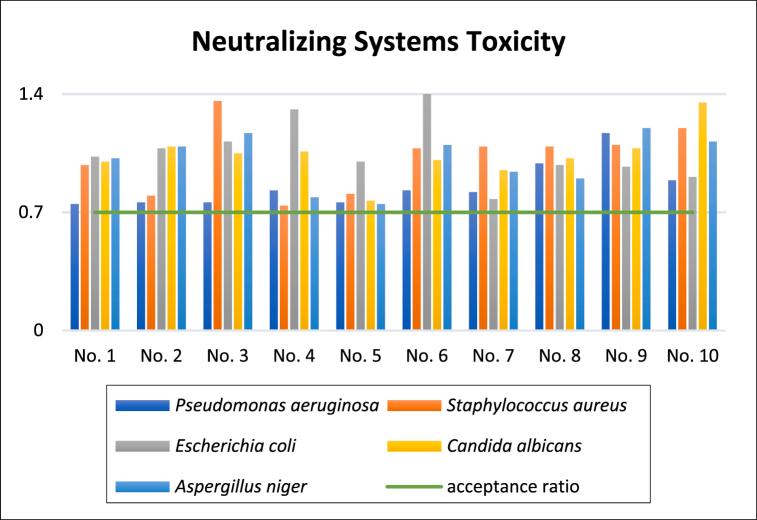
We reported toxicity and efficacy ratios of ten neutralizing systems (No.1 to No.10) containing polysorbate 80, cetomacrogol 1000 and polyoxyl 40 hydrogenated castor oil with various concentrations dedicated to the inactivation of Ibuprofen and Cefpodoxime proxetil preserved suspensions, methyl paraben/propyl paraben mixture and sodium benzoate controls against low inoculum ranging between 1 × 10-1.2 × 10 CFU of five challenged bacteria and fungi; and another environmental isolate of . Neutralizing systems validation was conducted according to USP chapter 1227 criteria to assess the acceptance of recovery comparisons for both "Neutralizing systems toxicity test" and "Neutralizing systems efficacy test" which enabled determining the appropriate neutralizing formula for both neutralization of preservative system of a specified product and being non-toxic towards the challenged microorganism additions.
RESULTS
Most neutralizing formulas used in the study were non-toxic for all tested microorganisms. According to "Neutralizing systems efficacy test", No. 3 (polysorbate 80 (3%)) and No. 10 (polysorbate 80 (1%), cetomacrogol 1000 (1%) and polyoxyl 40 hydrogenated castor oil (1%)) effectively recovered at least three microorganisms when used in the neutralization of samples. Most limitations were observed when neutralizing ibuprofen suspension. However, we found neutralizing system No. 10 against , No. 3 and No. 5 against and No. 8 and No. 10 against were effective in the neutralization of ibuprofen suspension. All neutralizing systems effectively inactivated the preservative system of cefpodoxime proxetil suspension using all microorganisms while several neutralizing systems failed in quenching cefpodoxime proxetil suspension against .
CONCLUSION
Due to the variation in the neutralization efficacy relative to the product sample and challenged microorganism, neutralization validation procedure must be undertaken before microbiological testing of pharmaceuticals which makes the development and validation of neutralizing systems an essential procedure.
背景
在检测含有防腐剂的样品(如营养产品、化妆品和药品)时,中和防腐剂系统对于获得可靠结果至关重要。因此,本研究的目的是制备并研究由成本效益高的现有材料制成的内部中和系统对保存的药物混悬液的灭活中和能力。选择布洛芬和头孢泊肟酯保存的混悬液作为淬灭模型,因为后续将对叙利亚市场上可得的其局部药物制剂进行微生物学研究。
方法
我们报告了十种中和系统(1号至10号)的毒性和效力比,这些系统含有不同浓度的聚山梨酯80、十六十八醇和聚氧乙烯40氢化蓖麻油,用于灭活布洛芬和头孢泊肟酯保存的混悬液、对羟基苯甲酸甲酯/对羟基苯甲酸丙酯混合物以及苯甲酸钠对照,以对抗五种受试细菌和真菌的低接种量(1×10⁻¹.²×10 CFU);以及另一种环境分离株。根据美国药典第1227章标准进行中和系统验证,以评估“中和系统毒性试验”和“中和系统效力试验”中回收比较的可接受性,这能够确定用于特定产品防腐剂系统中和且对受试微生物添加物无毒的合适中和配方。
结果
研究中使用的大多数中和配方对所有受试微生物均无毒。根据“中和系统效力试验”,3号(聚山梨酯80(3%))和10号(聚山梨酯80(1%)、十六十八醇(1%)和聚氧乙烯40氢化蓖麻油(1%))在用于样品中和时能有效回收至少三种微生物。在中和布洛芬混悬液时观察到的限制最多。然而,我们发现10号中和系统对[某种菌]有效,3号和5号对[某种菌]有效,8号和10号对[某种菌]有效,可用于中和布洛芬混悬液。所有中和系统使用所有微生物均能有效灭活头孢泊肟酯混悬液的防腐剂系统,而几种中和系统在淬灭头孢泊肟酯混悬液对抗[某种菌]时失败。
结论
由于相对于产品样品和受试微生物,中和效力存在差异,在对药品进行微生物检测之前必须进行中和验证程序,这使得中和系统的开发和验证成为一个必不可少的程序。

 Zotero 插件