
2019冠状病毒病病例激增对日本神户创伤患者院前紧急医疗服务的影响。
Influence of coronavirus disease 2019 case surges on prehospital emergency medical service for patients with trauma in Kobe, Japan.
作者信息
Nishimura Takeshi, Suga Masafumi, Ishihara Satoshi, Nakayama Shinichi, Nakao Atsunori, Naito Hiromichi
机构信息
Department of Emergency and Critical Care Medicine Okayama University Graduate School of Medicine, Dentistry, and Pharmaceutical Sciences Okayama Japan.
Department of Emergency and Critical Care Medicine Hyogo Emergency Medical Center Kobe Japan.
出版信息
Acute Med Surg. 2023 Mar 23;10(1):e829. doi: 10.1002/ams2.829. eCollection 2023 Jan-Dec.
AIM
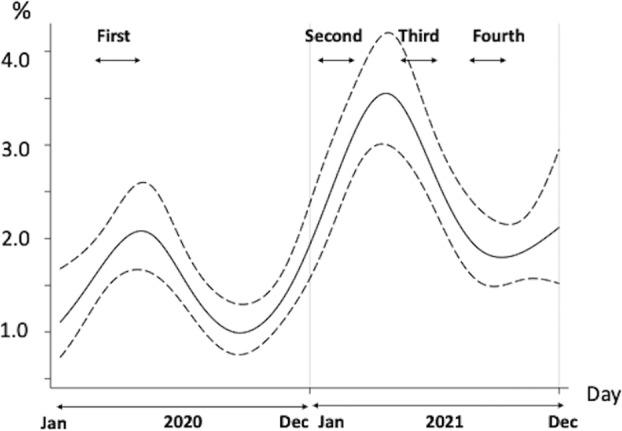
In the current era of the coronavirus disease 2019 (COVID-19) pandemic, the responsiveness of emergency medical service (EMS) transport for patients with internal illness is often delayed. However, the influence of the COVID-19 pandemic on prehospital transport for patients with trauma has not yet been fully elucidated. This study aims to examine the effect of COVID-19 case surges on EMS transport for patients with trauma during the COVID-19 states of emergency in Kobe, Japan.
METHODS
EMS data during the states of emergency were compared with those in the 2019 prepandemic period. The incidence of difficulty securing hospital acceptance (four or more calls to medical institutions and ambulance staying at the scene for 30 min or more) was evaluated as a primary outcome. Secondary outcomes were the time spent at the trauma scene and the number of calls requesting hospital acceptance. The time spent at the trauma scene was stratified by trauma severity.
RESULTS
The incidence of difficulty securing hospital acceptance increased (1.2% versus 3.2%, < 0.01). Logistic regression analysis revealed that the duration of the states of emergency was associated with difficulty securing hospital acceptance (odds ratio [OR] 2.08, 95% confidence interval 1.77-2.45; < 0.01). Although the mean time spent at the trauma scene among the less severe, moderately severe, and severe trauma groups was prolonged, the time for the life-threatening group did not change. The number of request calls increased during the states of emergency.
CONCLUSION
Difficulty securing hospital acceptance increased; however, the time spent at the trauma scene did not significantly change for the life-threatening group.
目的
在2019冠状病毒病(COVID-19)大流行的当前时代,内科疾病患者的紧急医疗服务(EMS)转运响应常常延迟。然而,COVID-19大流行对创伤患者院前转运的影响尚未完全阐明。本研究旨在探讨COVID-19病例激增对日本神户市COVID-19紧急状态期间创伤患者EMS转运的影响。
方法
将紧急状态期间的EMS数据与2019年大流行前时期的数据进行比较。将难以获得医院接收的发生率(向医疗机构呼叫四次或更多次且救护车在现场停留30分钟或更长时间)作为主要结局进行评估。次要结局为在创伤现场花费的时间以及请求医院接收的呼叫次数。在创伤现场花费的时间按创伤严重程度进行分层。
结果
难以获得医院接收的发生率增加(1.2%对3.2%,<0.01)。逻辑回归分析显示,紧急状态的持续时间与难以获得医院接收有关(优势比[OR]2.08,95%置信区间1.77 - 2.45;<0.01)。尽管轻度、中度和重度创伤组在创伤现场花费的平均时间延长,但危及生命组的时间没有变化。紧急状态期间请求呼叫的次数增加。
结论
难以获得医院接收的情况增加;然而,危及生命组在创伤现场花费的时间没有显著变化。


 Zotero 插件