
生命在于运动:果蝇需要更活跃且睡眠更少以适应更长或更艰苦的生命。
Motus Vita Est: Fruit Flies Need to Be More Active and Sleep Less to Adapt to Either a Longer or Harder Life.
作者信息
Zakharenko Lyudmila P, Petrovskii Dmitrii V, Bobrovskikh Margarita A, Gruntenko Nataly E, Yakovleva Ekaterina Y, Markov Alexander V, Putilov Arcady A
机构信息
Department of Insect Genetics, Institute of Cytology and Genetics of the Siberian Branch, The Russian Academy of Sciences, Novosibirsk 630000, Russia.
Department of Biological Evolution, The Moscow State University, Moscow 101000, Russia.
出版信息
Clocks Sleep. 2023 Mar 3;5(1):98-115. doi: 10.3390/clockssleep5010011.
BACKGROUND
Activity plays a very important role in keeping bodies strong and healthy, slowing senescence, and decreasing morbidity and mortality. models of evolution under various selective pressures can be used to examine whether increased activity and decreased sleep duration are associated with the adaptation of this nonhuman species to longer or harder lives.
METHODS
For several years, descendants of wild flies were reared in a laboratory without and with selection pressure. To maintain the "salt" and "starch" strains, flies from the wild population (called "control") were reared on two adverse food substrates. The "long-lived" strain was maintained through artificial selection for late reproduction. The 24 h patterns of locomotor activity and sleep in flies from the selected and unselected strains (902 flies in total) were studied in constant darkness for at least, 5 days.
RESULTS
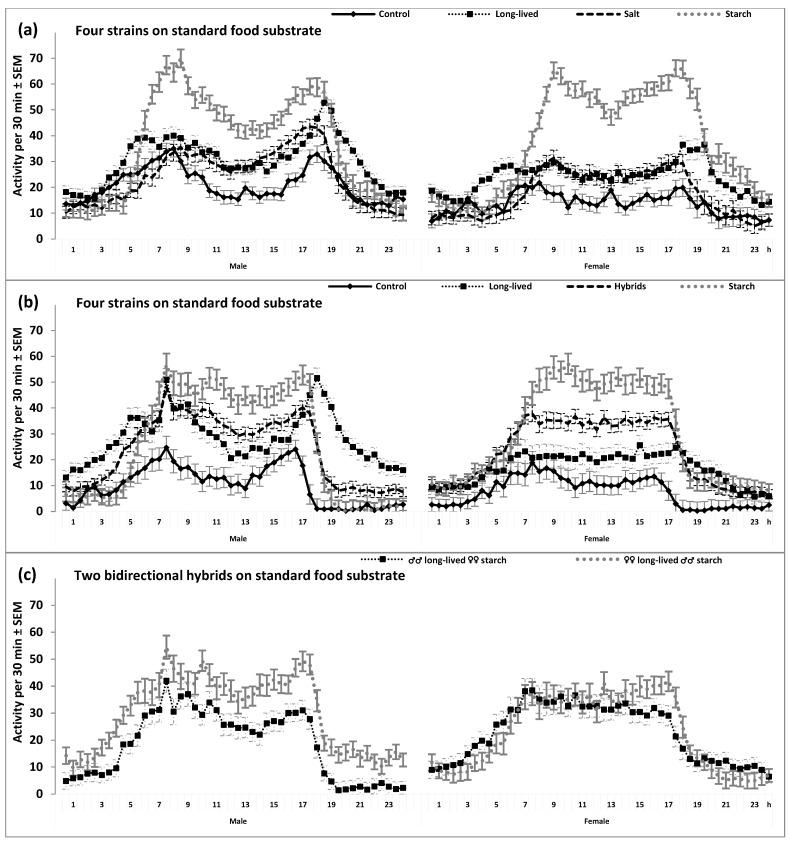
Compared to the control flies, flies from the selected strains demonstrated enhanced locomotor activity and reduced sleep duration. The most profound increase in locomotor activity was observed in flies from the starch (short-lived) strain. Additionally, the selection changed the 24 h patterns of locomotor activity and sleep. For instance, the morning and evening peaks of locomotor activity were advanced and delayed, respectively, in flies from the long-lived strain.
CONCLUSION
Flies become more active and sleep less in response to various selection pressures. These beneficial changes in trait values might be relevant to trade-offs among fitness-related traits, such as body weight, fecundity, and longevity.
背景
活动在保持身体健康强壮、延缓衰老以及降低发病率和死亡率方面起着非常重要的作用。在各种选择压力下的进化模型可用于检验活动增加和睡眠时间减少是否与这种非人类物种适应更长或更艰苦的生活有关。
方法
数年来,野生果蝇的后代在有无选择压力的实验室环境中饲养。为维持“盐”和“淀粉”品系,从野生种群中选取的果蝇(称为“对照”)在两种不利的食物底物上饲养。“长寿”品系通过对晚期繁殖进行人工选择来维持。在持续黑暗环境中对选取和未选取品系的果蝇(共902只)的24小时运动活动和睡眠模式进行了至少5天的研究。
结果
与对照果蝇相比,选取品系的果蝇表现出增强的运动活动和缩短的睡眠时间。在淀粉(短寿命)品系的果蝇中观察到运动活动增加最为显著。此外,选择改变了运动活动和睡眠的24小时模式。例如,长寿品系果蝇的运动活动早晚高峰分别提前和推迟。
结论
果蝇在各种选择压力下变得更加活跃且睡眠减少。这些性状值的有益变化可能与体重、繁殖力和寿命等与适应性相关的性状之间的权衡有关。

 Zotero 插件