
美国心脏协会新的“生命必需 8 项”与全因和心血管疾病特异性死亡率的关联:前瞻性队列研究。
Association of the American Heart Association's new "Life's Essential 8" with all-cause and cardiovascular disease-specific mortality: prospective cohort study.
机构信息
Department of Epidemiology/Shandong Provincial Clinical Research Center for Emergency and Critical Care Medicine, School of Public Health/Qilu Hospital, Cheeloo College of Medicine, Shandong University, 44 Wen Hua Xi Road, Jinan, 250012, China.
Department of Medical Statistics and Epidemiology, School of Public Health, Sun Yat-Sen University, Guangzhou, China.
出版信息
BMC Med. 2023 Mar 29;21(1):116. doi: 10.1186/s12916-023-02824-8.
BACKGROUND
The American Heart Association recently updated its construct of what constitutes cardiovascular health (CVH), called Life's Essential 8. We examined the association of total and individual CVH metrics according to Life's Essential 8 with all-cause and cardiovascular disease (CVD)-specific mortality later in life.
METHODS
Data were from the National Health and Nutrition Examination Survey (NHANES) 2005-2018 at baseline linked to the 2019 National Death Index records. Total and individual CVH metric scores including diet, physical activity, nicotine exposure, sleep health, body mass index, blood lipids, blood glucose, and blood pressure were classified as 0-49 (low level), 50-74 (intermediate level), and 75-100 (high level) points. The total CVH metric score (the average of the 8 metrics) as a continuous variable was also used for dose-response analysis. The main outcomes included all-cause and CVD-specific mortality.
RESULTS
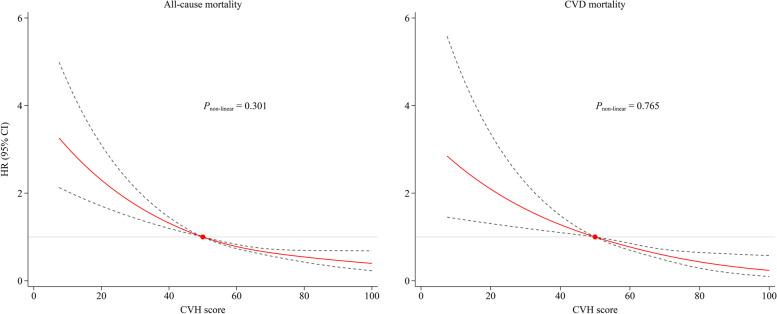
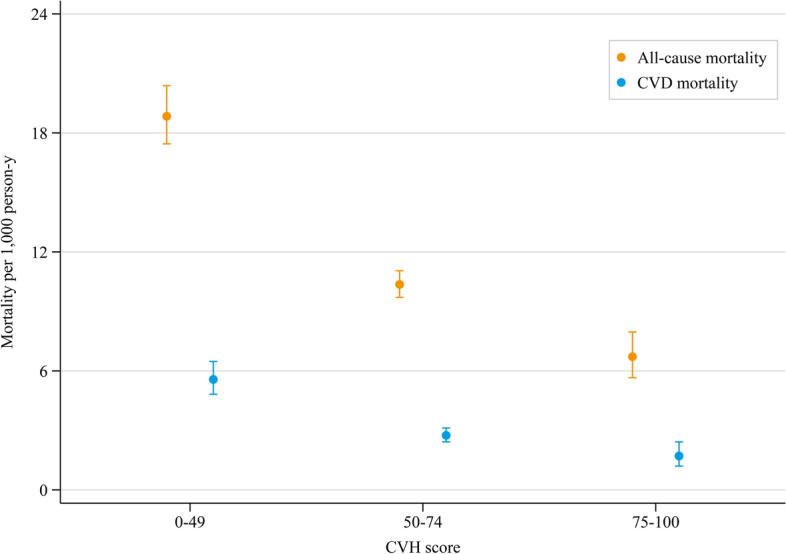
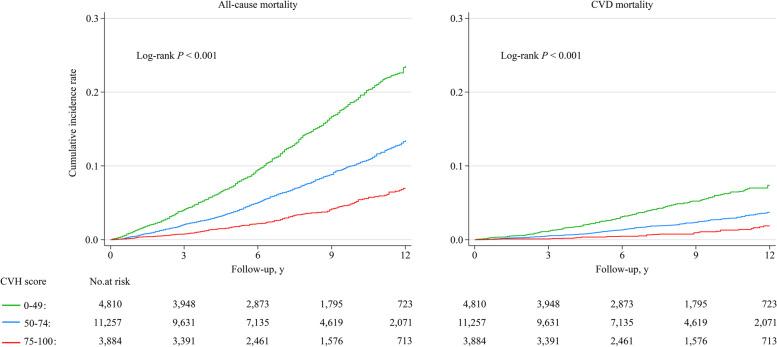
A total of 19,951 US adults aged 30-79 years were included in this study. Only 19.5% of adults achieved a high total CVH score, whereas 24.1% had a low score. During a median follow-up of 7.6 years, compared with adults with a low total CVH score, those with an intermediate or high total CVH score had 40% (adjusted hazard ratio [HR] 0.60, 95% confidence interval [CI] 0.51-0.71) and 58% (adjusted HR 0.42, 95% CI 0.32-0.56) reduced risk of all-cause mortality. The corresponding adjusted HRs (95%CIs) were 0.62 (0.46-0.83) and 0.36 (0.21-0.59) for CVD-specific mortality. The population-attributable fractions for high (score ≥ 75 points) vs. low or intermediate (score < 75 points) CVH scores were 33.4% for all-cause mortality and 42.9% for CVD-specific mortality. Among all 8 individual CVH metrics, physical activity, nicotine exposure, and diet accounted for a large proportion of the population-attributable risks for all-cause mortality, whereas physical activity, blood pressure, and blood glucose accounted for a large proportion of CVD-specific mortality. There were approximately linear dose-response associations of total CVH score (as a continuous variable) with all-cause and CVD-specific mortality.
CONCLUSIONS
Achieving a higher CVH score according to the new Life's Essential 8 was associated with a reduced risk of all-cause and CVD-specific mortality. Public health and healthcare efforts targeting the promotion of higher CVH scores could provide considerable benefits to reduce the mortality burden later in life.
背景
美国心脏协会最近更新了其心血管健康(CVH)的构成概念,称为生命的八大要素。我们研究了根据生命的八大要素的总体和各个 CVH 指标与全因和心血管疾病(CVD)特异性死亡率之间的关系。
方法
数据来自于 2005 年至 2018 年的国家健康和营养检查调查(NHANES)基线,与 2019 年国家死亡指数记录相关联。总体和各个 CVH 指标评分包括饮食、身体活动、尼古丁暴露、睡眠健康、体重指数、血脂、血糖和血压,分为 0-49(低水平)、50-74(中水平)和 75-100(高水平)分。总 CVH 指标评分(8 项指标的平均值)也作为连续变量用于剂量-反应分析。主要结局包括全因和 CVD 特异性死亡率。
结果
本研究共纳入 19951 名年龄在 30-79 岁的美国成年人。只有 19.5%的成年人达到了高总 CVH 评分,而 24.1%的成年人得分较低。在中位随访 7.6 年期间,与低总 CVH 评分的成年人相比,中或高总 CVH 评分的成年人全因死亡率降低了 40%(调整后的危险比[HR]0.60,95%置信区间[CI]0.51-0.71)和 58%(调整后的 HR 0.42,95%CI 0.32-0.56)。CVD 特异性死亡率的相应调整后的 HR(95%CI)分别为 0.62(0.46-0.83)和 0.36(0.21-0.59)。高(得分≥75 分)与低或中(得分<75 分)CVH 评分相比,高(得分≥75 分)的人群归因分数为 33.4%的全因死亡率和 42.9%的 CVD 特异性死亡率。在所有 8 项单独的 CVH 指标中,身体活动、尼古丁暴露和饮食占全因死亡率归因风险的很大比例,而身体活动、血压和血糖占 CVD 特异性死亡率的很大比例。总 CVH 评分(作为连续变量)与全因和 CVD 特异性死亡率之间存在近似线性剂量-反应关系。
结论
根据新的生命八大要素达到更高的 CVH 评分与全因和 CVD 特异性死亡率降低相关。针对促进更高 CVH 评分的公共卫生和医疗保健努力可能会为减轻晚年的死亡负担带来相当大的好处。
 Zotero 插件