
导致尿路感染产超广谱β-内酰胺酶(ESBL)菌株临床分离株对氟氧头孢敏感性的基因型和表型特征
The Genotypic and Phenotypic Characteristics Contributing to Flomoxef Sensitivity in Clinical Isolates of ESBL-Producing Strains from Urinary Tract Infections.
作者信息
Sakaeda Kazuma, Sadahira Takuya, Maruyama Yuki, Iwata Takehiro, Watanabe Masami, Wada Koichiro, Araki Motoo
机构信息
Department of Urology, Graduate School of Medicine, Dentistry and Pharmaceutical Sciences, Okayama University, 2-5-1, Shikata-cho, Kita-ku, Okayama 700-8558, Japan.
Koichiro Wada Department of Urology, School of Medicine, Shimane University, 89-1, Enya-cho, Izumo 693-8501, Japan.
出版信息
Antibiotics (Basel). 2023 Mar 6;12(3):522. doi: 10.3390/antibiotics12030522.
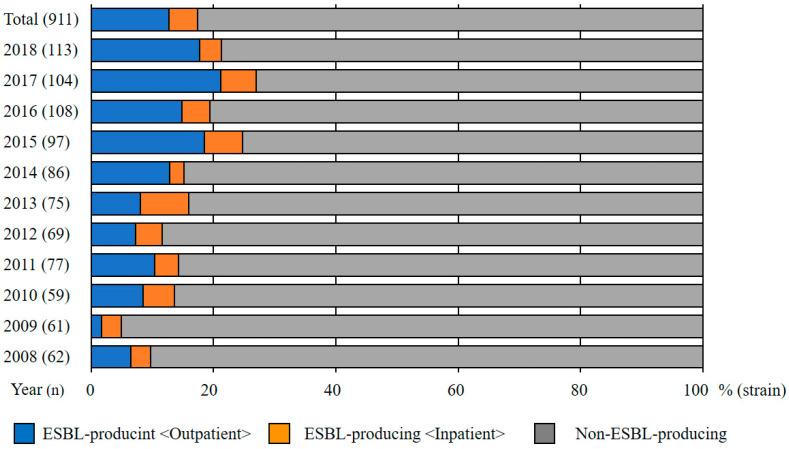
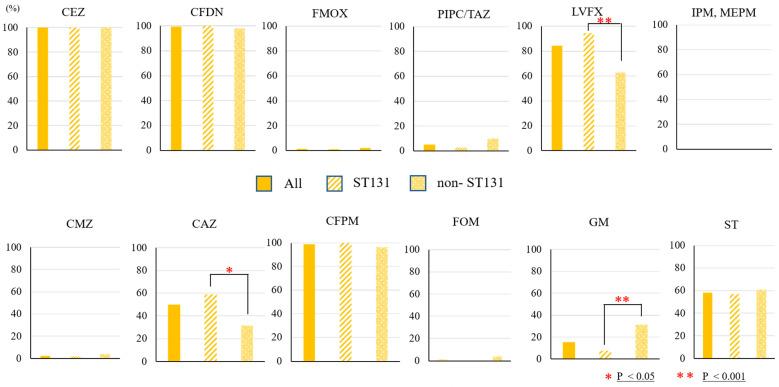
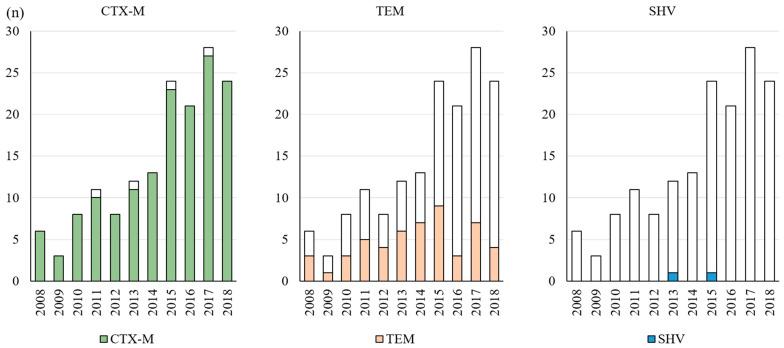
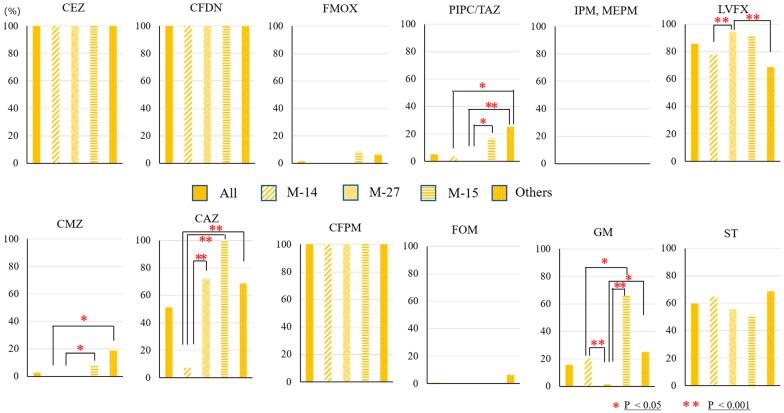
We carried out a molecular biological analysis of extended-spectrum β-lactamase (ESBL)-producing strains and their sensitivity to flomoxef (FMOX). Sequence type (ST) analysis by multilocus sequence typing (MLST) and classification of ESBL genotypes by multiplex PCR were performed on ESBL-producing strains isolated from urine samples collected from patients treated at our institution between 2008 and 2018. These sequences were compared with results for antimicrobial drug susceptibility determined using a micro-liquid dilution method. We also analyzed cases treated with FMOX at our institution to examine its clinical efficacy. Of the 911 strains identified, 158 (17.3%) were ESBL-producing. Of these, 67.7% (107/158) were strain ST-131 in ST analysis. Nearly all (154/158; 97.5%) were CTX-M genotypes, with M-14 and M-27 predominating. The isolated strains were sensitive to FMOX in drug susceptibility tests. Among the patient samples, 33 cases received FMOX, and of these, 5 had ESBL-producing . Among these five cases, three received FMOX for surgical prophylaxis as urinary carriers of ESBL-producing , and postoperative infections were prevented in all three patients. The other two patients received FMOX treatment for urinary tract infections. FMOX treatment was successful for one, and the other was switched to carbapenem. Our results suggest that FMOX has efficacy for perioperative prophylactic administration in urologic surgery involving carriers of ESBL-producing bacteria and for therapeutic administration for urinary tract infections. Use of FMOX avoids over-reliance on carbapenems or β-lactamase inhibitors and thus is an effective antimicrobial countermeasure.
我们对产超广谱β-内酰胺酶(ESBL)菌株进行了分子生物学分析,并研究了它们对氟氧头孢(FMOX)的敏感性。通过多位点序列分型(MLST)对序列类型(ST)进行分析,并采用多重聚合酶链反应(PCR)对ESBL基因型进行分类,这些分析是针对2008年至2018年期间在我们机构接受治疗的患者尿液样本中分离出的产ESBL菌株进行的。将这些序列与使用微量液体稀释法测定的抗菌药物敏感性结果进行比较。我们还分析了在我们机构接受FMOX治疗的病例,以考察其临床疗效。在鉴定出的911株菌株中,158株(17.3%)为产ESBL菌株。其中,在ST分析中67.7%(107/158)为ST-131菌株。几乎所有菌株(154/158;97.5%)为CTX-M基因型,以M-14和M-27为主。在药敏试验中,分离出的菌株对FMOX敏感。在患者样本中,33例接受了FMOX治疗,其中5例为产ESBL菌株。在这5例患者中,3例作为产ESBL菌株的尿液携带者接受FMOX进行手术预防,所有3例患者术后感染均得到预防。另外2例患者因尿路感染接受FMOX治疗。FMOX治疗对1例有效,另1例改用碳青霉烯类药物。我们的结果表明,FMOX对于涉及产ESBL细菌携带者的泌尿外科手术围手术期预防性给药以及尿路感染的治疗性给药均有效。使用FMOX可避免过度依赖碳青霉烯类药物或β-内酰胺酶抑制剂,因此是一种有效的抗菌对策。



 Zotero 插件