
Keap1-Nrf2异二聚体:改善镰状细胞病的治疗靶点。
Keap1-Nrf2 Heterodimer: A Therapeutic Target to Ameliorate Sickle Cell Disease.
作者信息
Chauhan Waseem, Zennadi Rahima
机构信息
Division of Hematology, Duke Comprehensive Sickle Cell Center, Department of Medicine, Duke University School of Medicine, Research Drive, Durham, NC 27710, USA.
出版信息
Antioxidants (Basel). 2023 Mar 17;12(3):740. doi: 10.3390/antiox12030740.
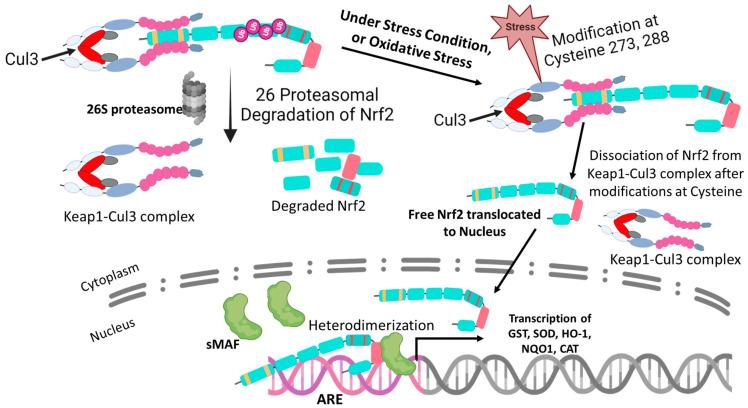
Sickle cell disease (SCD) is a monogenic inheritable disease characterized by severe anemia, increased hemolysis, and recurrent, painful vaso-occlusive crises due to the polymerization of hemoglobin S (HbS)-generated oxidative stress. Up until now, only four drugs are approved for SCD in the US. However, each of these drugs affects only a limited array of SCD pathologies. Importantly, curative therapies, such as gene therapy, or hematopoietic stem cell transplantation are not available for every patient because of their high costs, availability of donor matching, and their serious adverse effects. Therefore, there is an unmet medical need for novel therapeutic strategies that target broader SCD sequelae. SCD phenotypic severity can be alleviated by increasing fetal hemoglobin (HbF) expression. This results in the inhibition of HbS polymerization and thus sickling, and a reduction in oxidative stress. The efficacy of HbF is due to its ability to dilute HbS levels below the threshold required for polymerization and to influence HbS polymer stability in RBCs. Nuclear factor-E2-related factor 2 (Nrf2)/Kelch-like ECH-associated protein-1 (Keap1)-complex signaling is one of the most important cytoprotective signaling controlling oxidative stress. Nrf2 is present in most organs and, after dissociation from Keap1, it accumulates in the cytoplasm, then translocates to the nucleus where it binds to the antioxidant response element (ARE) sequences and increases the expression of various cytoprotective antioxidant genes. Keeping this in mind, various researchers have proposed a role of multiple agents, more importantly tert-Butylhydroquinone (tBHQ), curcumin, etc., (having electrophilic properties) in inhibiting keap1 activity, so that Nrf2 can translocate to the nucleus to activate the gamma globin gene, thus maintaining alpha-hemoglobin-stabilizing protein (AHSP) and HbF levels. This leads to reduced oxidative stress, consequently minimizing SCD-associated complications. In this review, we will discuss the role of the Keap-1-Nrf2 complex in hemoglobinopathies, especially in SCD, and how this complex might represent a better target for more effective treatment options.
镰状细胞病(SCD)是一种单基因遗传性疾病,其特征为严重贫血、溶血增加,以及由于血红蛋白S(HbS)聚合产生氧化应激而导致的反复疼痛性血管阻塞危象。截至目前,美国仅批准了四种用于治疗SCD的药物。然而,这些药物中的每一种仅能影响有限的一系列SCD病理状况。重要的是,诸如基因疗法或造血干细胞移植等治愈性疗法并非适用于每一位患者,因为它们成本高昂、供体匹配困难且存在严重的不良反应。因此,对于针对更广泛SCD后遗症的新型治疗策略存在未满足的医疗需求。通过增加胎儿血红蛋白(HbF)的表达可减轻SCD的表型严重程度。这会抑制HbS聚合,从而抑制镰变,并降低氧化应激。HbF的功效归因于其能够将HbS水平稀释至低于聚合所需阈值,并影响红细胞中HbS聚合物的稳定性。核因子E2相关因子2(Nrf2)/ Kelch样ECH相关蛋白1(Keap1)复合物信号传导是控制氧化应激的最重要细胞保护信号传导之一。Nrf2存在于大多数器官中,从Keap1解离后,它在细胞质中积累,然后转运至细胞核,在细胞核中它与抗氧化反应元件(ARE)序列结合并增加各种细胞保护抗氧化基因的表达。考虑到这一点,众多研究人员提出多种药物,更重要的是叔丁基对苯二酚(tBHQ)、姜黄素等(具有亲电特性)在抑制Keap1活性方面的作用,以便Nrf2能够转运至细胞核以激活γ珠蛋白基因,从而维持α - 血红蛋白稳定蛋白(AHSP)和HbF水平。这会导致氧化应激降低,从而将SCD相关并发症降至最低。在本综述中,我们将讨论Keap - 1 - Nrf2复合物在血红蛋白病中的作用,尤其是在SCD中的作用,以及该复合物如何可能成为更有效治疗选择的更好靶点。




 Zotero 插件