
联合摄入鱼油和D-法戈明通过调节肾脏中的脂毒性和蛋白质羰基化来预防高脂高糖饮食诱导的糖尿病前期。
Combined Intake of Fish Oil and D-Fagomine Prevents High-Fat High-Sucrose Diet-Induced Prediabetes by Modulating Lipotoxicity and Protein Carbonylation in the Kidney.
作者信息
Méndez Lucía, Muñoz Silvia, Barros Lorena, Miralles-Pérez Bernat, Romeu Marta, Ramos-Romero Sara, Torres Josep Lluís, Medina Isabel
机构信息
Instituto de Investigaciones Marinas-Consejo Superior de Investigaciones Científicas (IIM-CSIC), Eduardo Cabello 6, E-36208 Vigo, Spain.
Unidad de Farmacología, Facultad de Medicina y Ciencias de la Salud, Universidad Rovira i Virgili, Sant Llorenç 21, E-43201 Reus, Spain.
出版信息
Antioxidants (Basel). 2023 Mar 19;12(3):751. doi: 10.3390/antiox12030751.
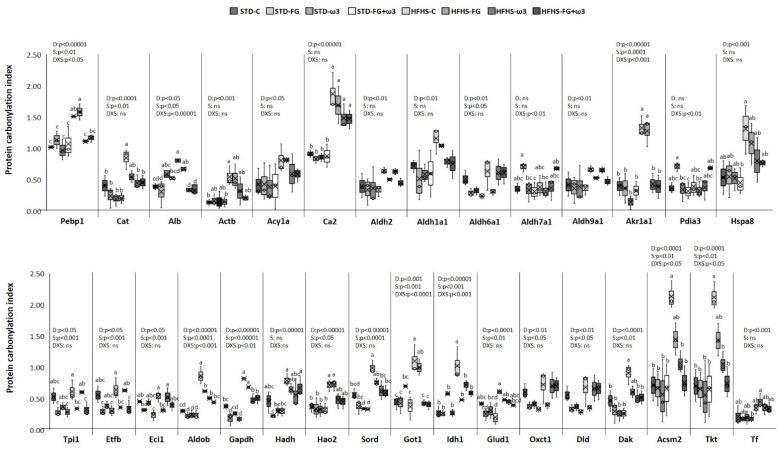
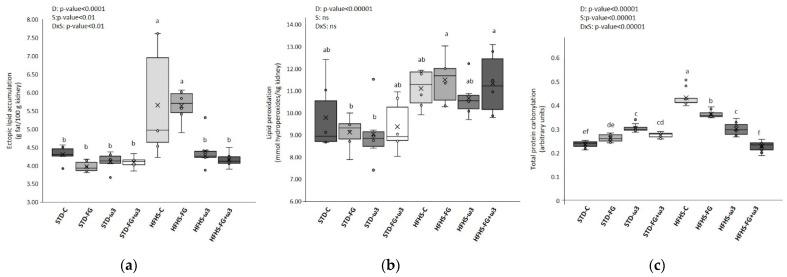
Obesity has been recognized as a major risk factor for chronic kidney disease, insulin resistance being an early common metabolic feature in patients suffering from this syndrome. This study aims to investigate the mechanism underlying the induction of kidney dysfunction and the concomitant onset of insulin resistance by long-term high-fat and sucrose diet feeding in Sprague Dawley rats. To achieve this goal, our study analyzed renal carbonylated protein patterns, ectopic lipid accumulation and fatty acid profiles and correlated them with biometrical and biochemical measurements and other body redox status parameters. Rats fed the obesogenic diet developed a prediabetic state and incipient kidney dysfunction manifested in increased plasma urea concentration and superior levels of renal fat deposition and protein carbonylation. An obesogenic diet increased renal fat by preferentially promoting the accumulation of saturated fat, arachidonic, and docosahexaenoic fatty acids while decreasing oleic acid. Renal lipotoxicity was accompanied by selectively higher carbonylation of proteins involved in the blood pH regulation, i.e., bicarbonate reclamation and synthesis, amino acid, and glucose metabolisms, directly related to the onset of insulin resistance. This study also tested the combination of antioxidant properties of fish oil with the anti-diabetic properties of buckwheat D-Fagomine to counteract diet-induced renal alterations. Results demonstrated that bioactive compounds combined attenuated lipotoxicity, induced more favorable lipid profiles and counteracted the excessive carbonylation of proteins associated with pH regulation in the kidneys, resulting in an inhibition of the progression of the prediabetes state and kidney disease.
肥胖已被公认为慢性肾脏病的主要危险因素,胰岛素抵抗是患有该综合征患者早期常见的代谢特征。本研究旨在探讨长期高脂和高蔗糖饮食喂养斯普拉格-道利大鼠导致肾功能障碍及伴随的胰岛素抵抗发生的潜在机制。为实现这一目标,我们的研究分析了肾脏羰基化蛋白模式、异位脂质蓄积和脂肪酸谱,并将它们与生物测量和生化指标以及其他身体氧化还原状态参数相关联。喂食致肥胖饮食的大鼠出现了糖尿病前期状态和早期肾功能障碍,表现为血浆尿素浓度升高、肾脏脂肪沉积水平升高和蛋白质羰基化增加。致肥胖饮食通过优先促进饱和脂肪、花生四烯酸和二十二碳六烯酸的蓄积,同时减少油酸,从而增加了肾脏脂肪。肾脏脂毒性伴随着参与血液pH调节的蛋白质选择性地更高程度的羰基化,即碳酸氢盐回收与合成、氨基酸和葡萄糖代谢,这与胰岛素抵抗的发生直接相关。本研究还测试了鱼油的抗氧化特性与荞麦D-法戈明的抗糖尿病特性的组合,以对抗饮食诱导的肾脏改变。结果表明,生物活性化合物的组合减轻了脂毒性,诱导了更有利的脂质谱,并抵消了与肾脏pH调节相关的蛋白质过度羰基化,从而抑制了糖尿病前期状态和肾脏疾病的进展。

 Zotero 插件