
肝实质细胞 Toll 样受体 4 介导酒精诱导的小鼠胰岛素抵抗。
Hepatocyte Toll-Like Receptor 4 Mediates Alcohol-Induced Insulin Resistance in Mice.
机构信息
Department of Biological Sciences, The University of Texas at Dallas, Richardson, TX 75080, USA.
Center for Hypothalamic Research, Department of Internal Medicine, University of Texas Southwestern Medical Center, Dallas, TX 75390, USA.
出版信息
Biomolecules. 2023 Mar 1;13(3):454. doi: 10.3390/biom13030454.
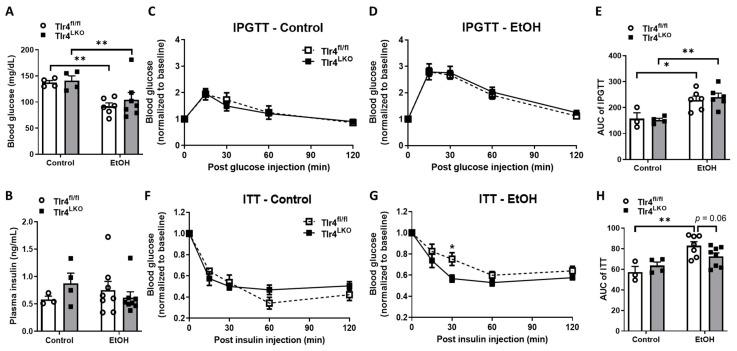
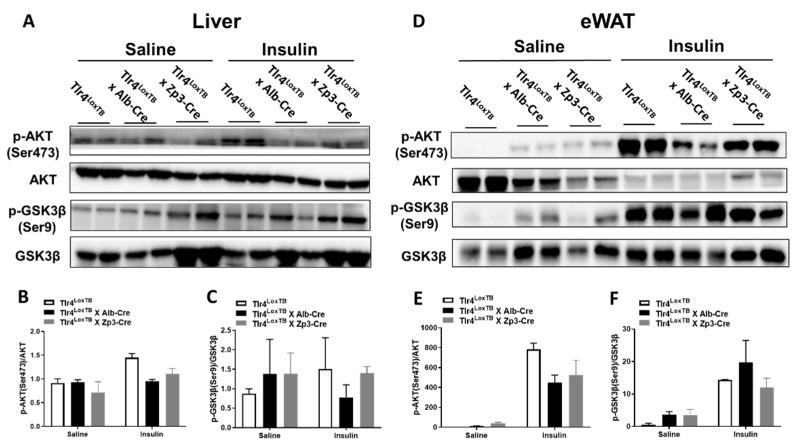
Accumulating evidence has demonstrated the association between alcohol overconsumption and the development of insulin resistance. However, the underlying mechanisms are not completely understood. To investigate the requirement and sufficiency of hepatocyte toll-like receptor 4 (TLR4) in alcohol-induced insulin resistance, we used two mouse models (Tlr4 and Tlr4) that allow ablation of TLR4 only in hepatocytes (Tlr4) and restoration of endogenous TLR4 expression in hepatocytes on a TLR4-null background (Tlr4 × Alb-Cre), respectively. A Lieber-DeCarli feeding model was used to induce glucose intolerance and insulin resistance in mice. Glucose tolerance test, insulin tolerance test, and insulin signaling experiments were performed to examine systemic and tissue-specific insulin sensitivity. We found that alcohol-fed hepatocyte TLR4 deficient mice (Tlr4) had lower blood glucose levels in response to intraperitoneal injection of insulin. Moreover, increased phosphorylation of glycogen synthase kinase-3β (GSK3β) was observed in the liver of Tlr4 mice after chronic alcohol intake. In contrast, when hepatic TLR4 was reactivated in mice (Tlr4 × Alb-Cre), alcohol feeding caused glucose intolerance in these mice compared with littermate controls (Tlr4). In addition, AKT phosphorylation was dramatically reduced in the liver and epididymal white adipose tissue (eWAT) of alcohol-fed Tlr4 × Alb-Cre mice, which was similar to that of mice with whole-body TLR4 reactivation (Tlr4 × Zp3-Cre). Collectively, these findings suggest that hepatocyte TLR4 is both required and sufficient in the development of insulin resistance induced by alcohol overconsumption.
越来越多的证据表明,酒精过度摄入与胰岛素抵抗的发展之间存在关联。然而,其潜在机制尚不完全清楚。为了研究肝细胞 Toll 样受体 4(TLR4)在酒精诱导的胰岛素抵抗中的需求和充分性,我们分别使用了两种小鼠模型(Tlr4 和 Tlr4),这两种模型分别允许仅在肝细胞中敲除 TLR4(Tlr4),以及在 TLR4 缺失背景下在肝细胞中恢复内源性 TLR4 表达(Tlr4×Alb-Cre)。采用 Lieber-DeCarli 喂养模型诱导小鼠葡萄糖不耐受和胰岛素抵抗。进行葡萄糖耐量试验、胰岛素耐量试验和胰岛素信号转导实验,以检查全身和组织特异性胰岛素敏感性。我们发现,酒精喂养的肝细胞 TLR4 缺失小鼠(Tlr4)在腹腔内注射胰岛素后血糖水平较低。此外,在慢性酒精摄入后,Tlr4 小鼠肝脏中观察到糖原合酶激酶-3β(GSK3β)的磷酸化增加。相比之下,当在小鼠中重新激活肝 TLR4(Tlr4×Alb-Cre)时,与同窝对照(Tlr4)相比,酒精喂养导致这些小鼠出现葡萄糖不耐受。此外,酒精喂养的 Tlr4×Alb-Cre 小鼠肝脏和附睾白色脂肪组织(eWAT)中的 AKT 磷酸化明显降低,这与全身 TLR4 重新激活(Tlr4×Zp3-Cre)的小鼠相似。综上所述,这些发现表明,肝细胞 TLR4 是酒精过度摄入引起的胰岛素抵抗发展所必需和充分的。



 Zotero 插件