
基于物理信息的神经网络的蛋白质设计。
Protein Design Using Physics Informed Neural Networks.
机构信息
Proteic Bioscience Inc., Vancouver, BC V7T 1C0, Canada.
Department of Computer Science, Ben Gurion University of the Negev, Be'er Sheva 84105, Israel.
出版信息
Biomolecules. 2023 Mar 1;13(3):457. doi: 10.3390/biom13030457.
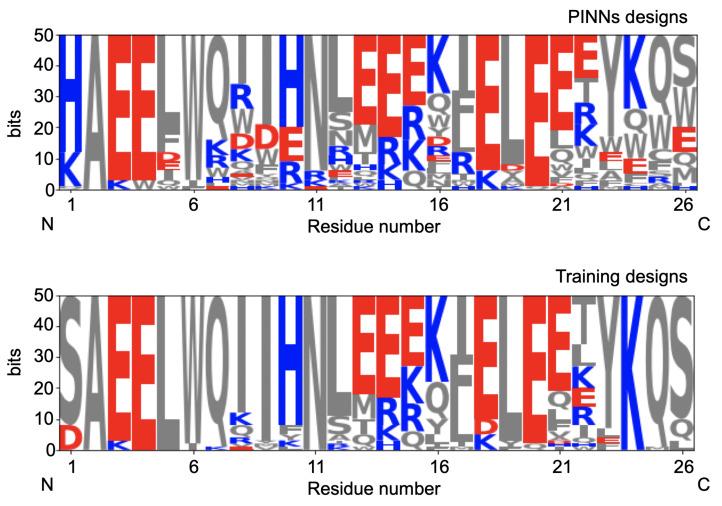
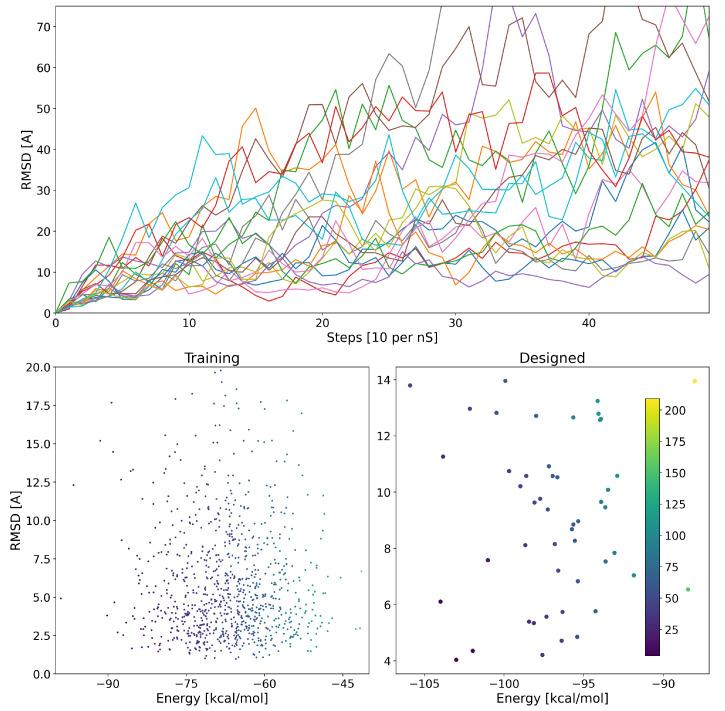
The inverse protein folding problem, also known as protein sequence design, seeks to predict an amino acid sequence that folds into a specific structure and performs a specific function. Recent advancements in machine learning techniques have been successful in generating functional sequences, outperforming previous energy function-based methods. However, these machine learning methods are limited in their interoperability and robustness, especially when designing proteins that must function under non-ambient conditions, such as high temperature, extreme pH, or in various ionic solvents. To address this issue, we propose a new Physics-Informed Neural Networks (PINNs)-based protein sequence design approach. Our approach combines all-atom molecular dynamics simulations, a PINNs MD surrogate model, and a relaxation of binary programming to solve the protein design task while optimizing both energy and the structural stability of proteins. We demonstrate the effectiveness of our design framework in designing proteins that can function under non-ambient conditions.
逆蛋白折叠问题,也称为蛋白质序列设计,旨在预测一个氨基酸序列,使其折叠成特定的结构并执行特定的功能。最近,机器学习技术的进步成功地生成了具有功能的序列,其性能优于以前基于能量函数的方法。然而,这些机器学习方法在互操作性和鲁棒性方面存在局限性,特别是在设计必须在非环境条件下(如高温、极端 pH 值或各种离子溶剂)发挥功能的蛋白质时。为了解决这个问题,我们提出了一种基于物理信息神经网络(PINNs)的蛋白质序列设计方法。我们的方法结合了全原子分子动力学模拟、PINNs MD 替代模型和二进制编程的松弛,以解决蛋白质设计任务,同时优化蛋白质的能量和结构稳定性。我们证明了我们的设计框架在设计能够在非环境条件下发挥功能的蛋白质方面的有效性。



 Zotero 插件