
唑来膦酸阻断 Cantú 综合征小鼠模型中成骨细胞和骨骼肌中过度活跃的 Kir6.1/SUR2 依赖性 K 通道。
Zoledronic Acid Blocks Overactive Kir6.1/SUR2-Dependent K Channels in Skeletal Muscle and Osteoblasts in a Murine Model of Cantú Syndrome.
机构信息
Sections of Pharmacology, Medicinal Chemistry, Department of Pharmacy-Pharmaceutical Sciences, University of Bari "Aldo Moro", 70125 Bari, Italy.
Center for the Investigation of Membrane Excitability Diseases, Department of Cell Biology and Physiology, Washington University School of Medicine, St. Louis, MO 63110-1010, USA.
出版信息
Cells. 2023 Mar 17;12(6):928. doi: 10.3390/cells12060928.
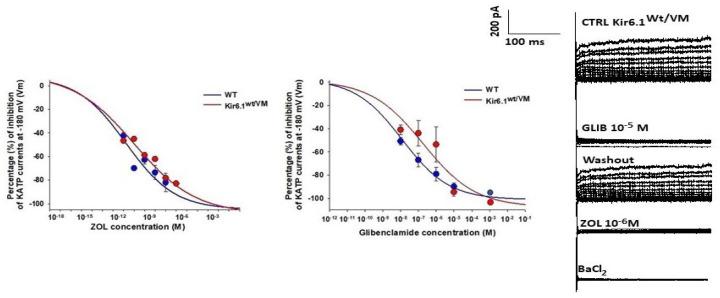
Cantú syndrome (CS) is caused by the gain of function mutations in the and genes encoding, respectively, for the sulfonylureas receptor type 2 (SUR2) and the inwardly rectifier potassium channel 6.1 (Kir6.1) of the ATP-sensitive potassium (KATP) channels. CS is a multi-organ condition with a cardiovascular phenotype, neuromuscular symptoms, and skeletal malformations. Glibenclamide has been proposed for use in CS, but even in animals, the drug is incompletely effective against severe mutations, including the Kir6.1. Patch-clamp experiments showed that zoledronic acid (ZOL) fully reduced the whole-cell KATP currents in bone calvaria cells from wild type (WT/WT) and heterozygous Kir6.1CS mice, with IC for ZOL block < 1 nM in each case. ZOL fully reduced KATP current in excised patches in skeletal muscle fibers in WT/WT and CS mice, with IC of 100 nM in each case. Interestingly, KATP currents in the bone of heterozygous SUR2 mice were less sensitive to ZOL inhibition, showing an IC of ~500 nM and a slope of ~0.3. In homozygous SUR2 cells, ZOL failed to fully inhibit the KATP currents, causing only ~35% inhibition at 100 μM, but was responsive to glibenclamide. ZOL reduced the KATP currents in Kir6.1CS mice in both skeletal muscle and bone cells but was not effective in the SUR2 mice fibers. These data indicate a subunit specificity of ZOL action that is important for appropriate CS therapies.
坎图综合征(CS)是由编码磺酰脲受体 2(SUR2)和三磷酸腺苷敏感性钾(KATP)通道内向整流钾通道 6.1(Kir6.1)的基因突变引起的。CS 是一种多器官疾病,具有心血管表型、神经肌肉症状和骨骼畸形。已提出使用格列本脲治疗 CS,但即使在动物中,该药物对包括 Kir6.1 在内的严重突变也不完全有效。膜片钳实验表明,唑来膦酸(ZOL)完全降低了来自野生型(WT/WT)和杂合子 Kir6.1CS 小鼠颅骨骨细胞的全细胞 KATP 电流,每种情况下 ZOL 阻断的 IC 均<1 nM。ZOL 完全降低了 WT/WT 和 CS 小鼠骨骼肌纤维中分离的斑块中的 KATP 电流,每种情况下的 IC 均为 100 nM。有趣的是,杂合子 SUR2 小鼠骨中的 KATP 电流对 ZOL 抑制的敏感性较低,IC 约为 500 nM,斜率约为 0.3。在纯合子 SUR2 细胞中,ZOL 未能完全抑制 KATP 电流,在 100 μM 时仅引起约 35%的抑制,但对格列本脲有反应。ZOL 降低了 Kir6.1CS 小鼠在骨骼肌和骨细胞中的 KATP 电流,但在 SUR2 小鼠纤维中无效。这些数据表明 ZOL 作用具有亚基特异性,这对于适当的 CS 治疗很重要。


 Zotero 插件