
多功能抗菌纳米网通过选择性捕获内毒素和促炎细胞因子来减轻炎症反应。
Multifunctional Antibacterial Nanonets Attenuate Inflammatory Responses through Selective Trapping of Endotoxins and Pro-Inflammatory Cytokines.
机构信息
National University of Singapore, Department of Pharmacy, 18 Science Drive 4, Singapore, 117543, Singapore.
National University Health System, Department of Pharmacology, Yong Loo Lin School of Medicine, 16 Medical Drive MD3, Singapore, 117600, Singapore.
出版信息
Adv Healthc Mater. 2023 Aug;12(20):e2203232. doi: 10.1002/adhm.202203232. Epub 2023 Apr 25.
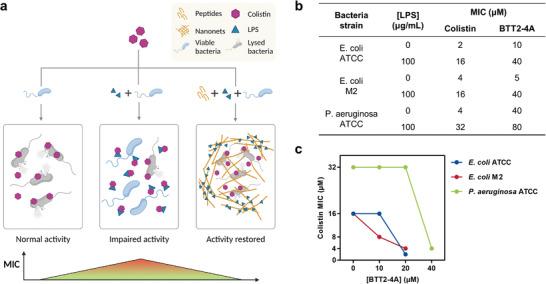
Extracellular lipopolysaccharide (LPS) released from bacteria cells can enter the bloodstream and cause septic complications with excessive host inflammatory responses. Target-specific strategies to inactivate inflammation mediators have largely failed to improve the prognosis of septic patients in clinical trials. By utilizing their high density of positive charges, de novo designed peptide nanonets are shown to selectively entrap the negatively charged LPS and pro-inflammatory cytokines tumor necrosis factor-α (TNF-α) and interleukin-6 (IL-6). This in turn enables the nanonets to suppress LPS-induced cytokine production by murine macrophage cell line and rescue the antimicrobial activity of the last-resort antibiotic, colistin, from LPS binding. Using an acute lung injury model in mice, it is demonstrated that intratracheal administration of the fibrillating peptides is effective at lowering local release of TNF-α and IL-6. Together with previously shown ability to simultaneously trap and kill pathogenic bacteria, the peptide nanonets display remarkable potential as a holistic, multifunctional anti-infective, and anti-septic biomaterial.
细胞外脂多糖(LPS)从细菌细胞中释放出来后可以进入血液,并引发过度的宿主炎症反应,导致败血症并发症。在临床试验中,针对特定靶点的策略来使炎症介质失活,在改善败血症患者的预后方面收效甚微。通过利用其高密度的正电荷,新设计的肽纳米网被证明可以选择性地捕获带负电荷的 LPS 和促炎细胞因子肿瘤坏死因子-α(TNF-α)和白细胞介素-6(IL-6)。这反过来又使纳米网能够抑制 LPS 诱导的鼠巨噬细胞系细胞因子的产生,并从 LPS 结合中拯救最后一线抗生素,粘菌素的抗菌活性。在小鼠急性肺损伤模型中,经气管内给予纤维状肽可有效降低局部 TNF-α和 IL-6 的释放。与先前显示的同时捕获和杀死病原菌的能力相结合,肽纳米网作为一种整体的、多功能的抗感染和抗败血症生物材料具有显著的潜力。



 Zotero 插件