
免疫 PET 成功鉴定了糖蛋白 3 表达肝癌的位点特异性偶联单域抗体。
Site-Specifically Conjugated Single-Domain Antibody Successfully Identifies Glypican-3-Expressing Liver Cancer by Immuno-PET.
机构信息
Molecular Imaging Branch, Center for Cancer Research, National Cancer Institute, National Institutes of Health, Bethesda, Maryland.
Antibody Engineering Program, Center for Cancer Research, National Cancer Institute, National Institutes of Health, Bethesda, Maryland.
出版信息
J Nucl Med. 2023 Jul;64(7):1017-1023. doi: 10.2967/jnumed.122.265171. Epub 2023 Mar 30.
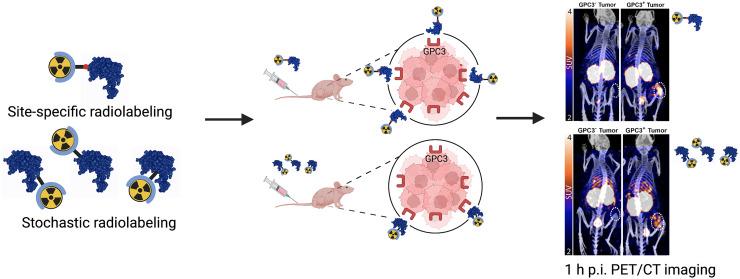
Primary liver cancer is the third leading cause of cancer-related deaths, and its incidence and mortality are increasing worldwide. Hepatocellular carcinoma (HCC) accounts for 80% of primary liver cancer cases. Glypican-3 (GPC3) is a heparan sulfate proteoglycan that histopathologically defines HCC and represents an attractive tumor-selective marker for radiopharmaceutical imaging and therapy for this disease. Single-domain antibodies are a promising scaffold for imaging because of their favorable pharmacokinetic properties, good tumor penetration, and renal clearance. Although conventional lysine-directed bioconjugation can be used to yield conjugates for radiolabeling full-length antibodies, this stochastic approach risks negatively affecting target binding of the smaller single-domain antibodies. To address this challenge, site-specific approaches have been explored. Here, we used conventional and sortase-based site-specific conjugation methods to engineer GPC3-specific human single-domain antibody (HN3) PET probes. Bifunctional deferoxamine (DFO) isothiocyanate was used to synthesize native HN3 (nHN3)-DFO. Site-specifically modified HN3 (ssHN3)-DFO was engineered using sortase-mediated conjugation of triglycine-DFO chelator and HN3 containing an LPETG C-terminal tag. Both conjugates were radiolabeled with Zr, and their binding affinity in vitro and target engagement of GPC3-positive (GPC3) tumors in vivo were determined. Both Zr-ssHN3 and Zr-nHN3 displayed nanomolar affinity for GPC3 in vitro. Biodistribution and PET/CT image analysis in mice bearing isogenic A431 and A431-GPC3 xenografts, as well as in HepG2 liver cancer xenografts, showed that both conjugates specifically identify GPC3 tumors. Zr-ssHN3 exhibited more favorable biodistribution and pharmacokinetic properties, including higher tumor uptake and lower liver accumulation. Comparative PET/CT studies on mice imaged with both F-FDG and Zr-ssHN3 showed more consistent tumor accumulation for the single-domain antibody conjugate, further establishing its potential for PET imaging. Zr-ssHN3 showed clear advantages in tumor uptake and tumor-to-liver signal ratio over the conventionally modified Zr-nHN3 in xenograft models. Our results establish the potential of HN3-based single-domain antibody probes for GPC3-directed PET imaging of liver cancers.
原发性肝癌是癌症相关死亡的第三大主要原因,其发病率和死亡率在全球范围内呈上升趋势。肝细胞癌 (HCC) 占原发性肝癌病例的 80%。磷脂酰聚糖-3 (GPC3) 是一种硫酸乙酰肝素蛋白聚糖,在组织病理学上定义 HCC,并代表用于该疾病放射性药物成像和治疗的有吸引力的肿瘤选择性标志物。单域抗体因其良好的药代动力学特性、良好的肿瘤穿透性和肾脏清除率而成为成像的有前途的支架。尽管可以使用常规赖氨酸定向生物偶联来产生用于放射性标记全长抗体的缀合物,但这种随机方法有可能对较小的单域抗体的靶结合产生负面影响。为了解决这一挑战,已经探索了位点特异性方法。在这里,我们使用常规和基于 sortase 的位点特异性缀合方法来设计 GPC3 特异性人单域抗体 (HN3) PET 探针。双功能去铁胺 (DFO) 异硫氰酸酯用于合成天然 HN3 (nHN3)-DFO。使用 sortase 介导的三肽-DFO 螯合剂和含有 LPETG C 末端标签的 HN3 的缀合,工程化了位点特异性修饰的 HN3 (ssHN3)-DFO。两者均用 Zr 标记,并在体外测定其与 GPC3 阳性 (GPC3) 肿瘤的结合亲和力以及体内靶标结合。Zr-ssHN3 和 Zr-nHN3 在体外对 GPC3 均显示出纳摩尔亲和力。在携带同基因 A431 和 A431-GPC3 异种移植瘤以及 HepG2 肝癌异种移植瘤的小鼠中进行的生物分布和 PET/CT 图像分析表明,两种缀合物均可特异性识别 GPC3 肿瘤。Zr-ssHN3 表现出更有利的生物分布和药代动力学特性,包括更高的肿瘤摄取和更低的肝脏积累。对用 F-FDG 和 Zr-ssHN3 成像的小鼠进行的比较 PET/CT 研究表明,单域抗体缀合物的肿瘤积聚更一致,进一步确立了其用于 PET 成像的潜力。Zr-ssHN3 在异种移植模型中,与常规修饰的 Zr-nHN3 相比,在肿瘤摄取和肿瘤与肝脏信号比方面表现出明显优势。我们的结果确立了基于 HN3 的单域抗体探针用于 GPC3 指导的肝癌 PET 成像的潜力。
 Zotero 插件