
衰老肿瘤细胞常出现在侵袭前沿:改善局部晚期前列腺癌患者疾病控制的意义。
Senescent Tumor Cells Are Frequently Present at the Invasion Front: Implications for Improving Disease Control in Patients with Locally Advanced Prostate Cancer.
机构信息
Molecular Urooncology, Department of Urology, University Hospital Heidelberg, Heidelberg, Germany.
Department of Medical Oncology, University Hospital Heidelberg and National Center for Tumor Diseases (NCT), Heidelberg, Germany.
出版信息
Pathobiology. 2023;90(5):312-321. doi: 10.1159/000530430. Epub 2023 Mar 31.
INTRODUCTION
Local tumor invasion is a critical factor for the outcome of men with prostate cancer. In particular, seminal vesicle invasion (SVI) has been reported to be associated with a more unfavorable prognosis. A better understanding of the functional state of invading prostate cancer cells is crucial to develop novel therapeutic strategies for patients with locally advanced disease.
METHODS
The prognostic impact of local tumor progression was ascertained in over 1,000 men with prostate cancer. Prostate cancer specimens were stained by double-immunohistochemistry for the proliferation marker Ki-67 and the senescence marker p16INK4A. The migratory properties of senescent prostate cancer cells were analyzed in vitro using a wound healing assay and immunofluorescence microscopy for p16INK4A.
RESULTS
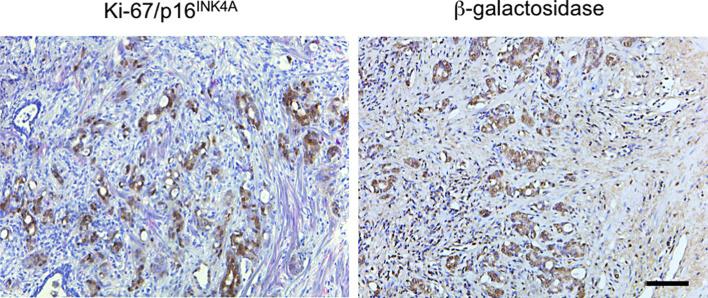
We confirm the notion that patients with SVI have a more unfavorable prognosis than patients with extraprostatic extension alone. Surprisingly, we found that the tumor invasion front frequently harbors p16INK4A-positive and Ki-67-negative, i.e., senescent, tumor cells. While the intraprostatic tumor periphery was a hotspot for both proliferation and expression of p16INK4A, the area of SVI showed less proliferative activity but was at the same time a hotspot of cells with increased nuclear p16INK4A expression. Senescence was associated with an accelerated migration of prostate cancer cells in vitro.
CONCLUSION
This proof-of-concept study shows that invading prostate cancer cells frequently show signs of cellular senescence. This finding may open new avenues for neoadjuvant and adjuvant treatment concepts in men with locally advanced prostate cancer.
简介
局部肿瘤侵袭是前列腺癌患者预后的关键因素。特别是,精囊侵犯(SVI)已被报道与更不利的预后相关。更好地了解侵袭性前列腺癌细胞的功能状态对于开发局部进展性疾病患者的新治疗策略至关重要。
方法
通过对超过 1000 名前列腺癌患者进行双免疫组化染色,确定局部肿瘤进展的预后影响。Ki-67 作为增殖标志物,p16INK4A 作为衰老标志物,对前列腺癌标本进行双重免疫组化染色。通过划痕愈合试验和 p16INK4A 的免疫荧光显微镜分析衰老前列腺癌细胞的迁移特性。
结果
我们证实了这样一种观点,即 SVI 患者的预后比单纯前列腺外侵犯患者更不利。令人惊讶的是,我们发现肿瘤侵袭前沿经常存在 p16INK4A 阳性和 Ki-67 阴性,即衰老的肿瘤细胞。虽然前列腺内肿瘤周围是增殖和 p16INK4A 表达的热点,但 SVI 区域的增殖活性较低,但同时也是核 p16INK4A 表达增加的细胞热点。衰老与前列腺癌细胞在体外的迁移加速有关。
结论
这项概念验证研究表明,侵袭性前列腺癌细胞经常出现细胞衰老的迹象。这一发现可能为局部进展性前列腺癌患者的新辅助和辅助治疗概念开辟新途径。




 Zotero 插件