
一种用于肿瘤靶向的多模态适配体靶向长循环聚合物的定量评估
Quantitative Evaluation of a Multimodal Aptamer-Targeted Long-Circulating Polymer for Tumor Targeting.
作者信息
Bohrmann Lennart, Burghardt Tobias, Rodríguez-Rodríguez Cristina, Herth Matthias M, Saatchi Katayoun, Häfeli Urs O
机构信息
Faculty of Pharmaceutical Sciences, University of British Columbia, Vancouver, British Columbia V6T 1Z3, Canada.
Department of Pharmacy, Faculty of Health and Medical Sciences, University of Copenhagen, Universitetsparken 2, 2100 Copenhagen, Denmark.
出版信息
ACS Omega. 2023 Mar 16;8(12):11003-11020. doi: 10.1021/acsomega.2c07762. eCollection 2023 Mar 28.
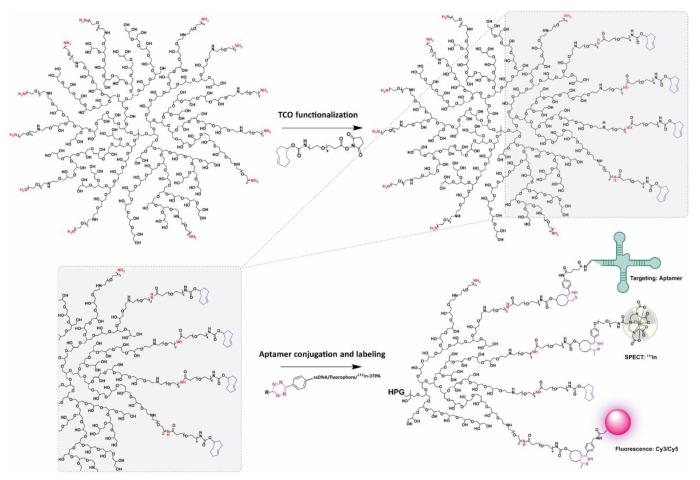
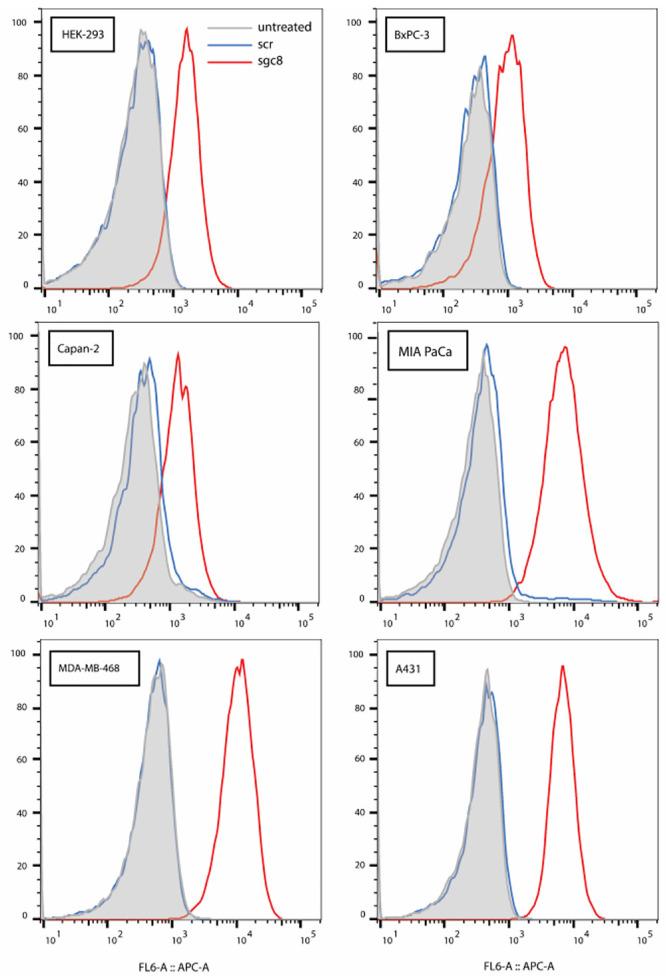
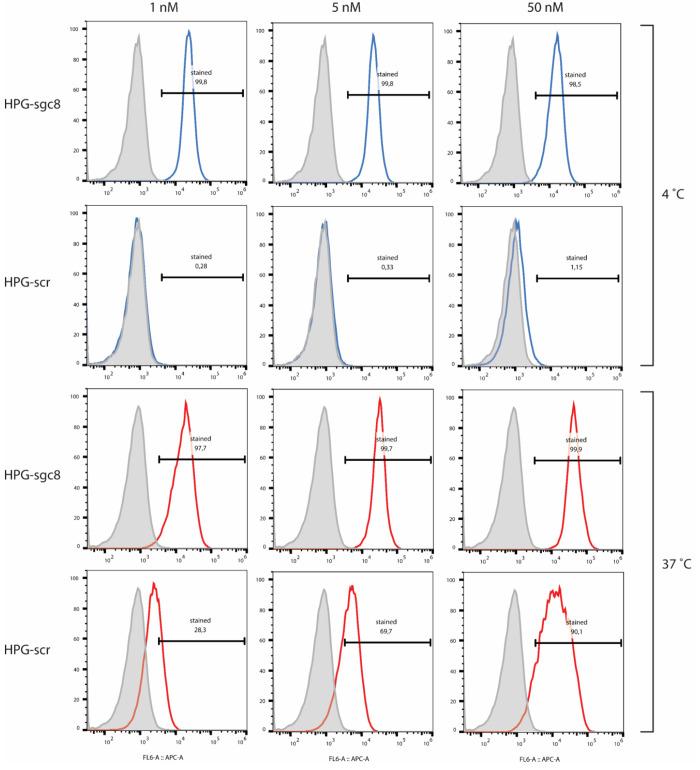
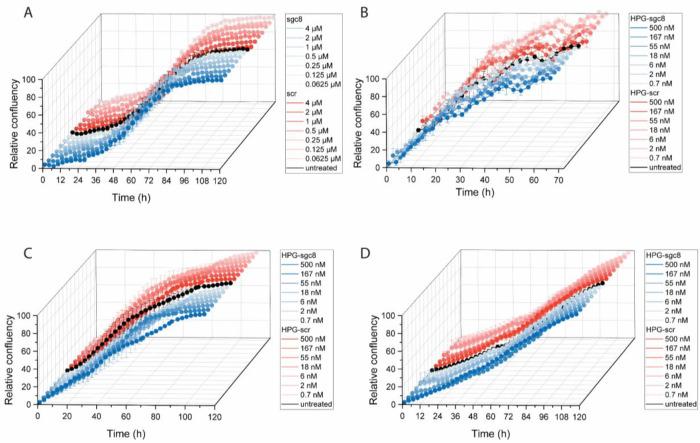
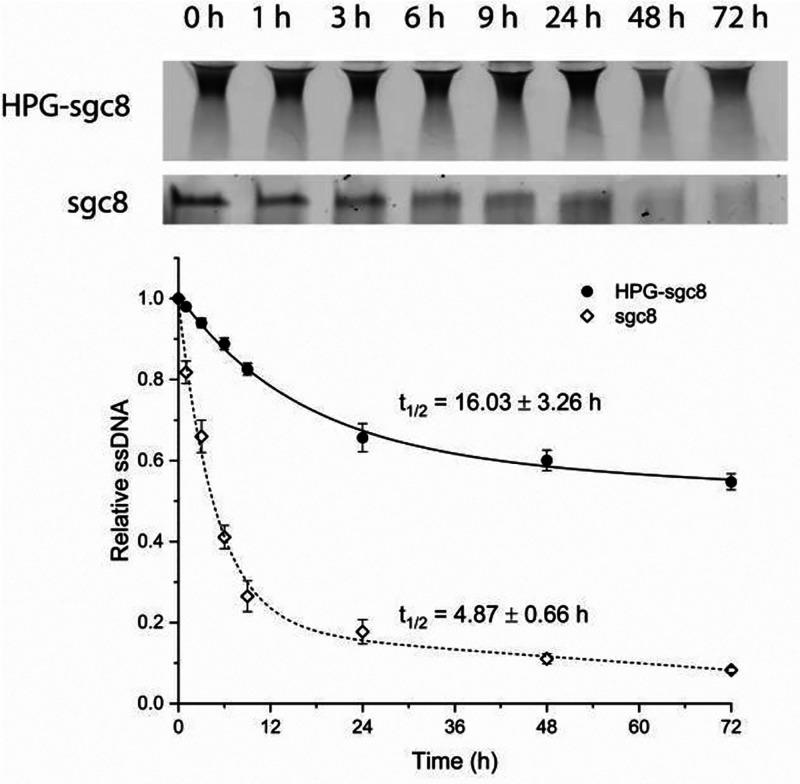
Aptamers are promising targeting agents for imaging and therapy of numerous diseases, including cancer. However, a significant shortcoming of aptamers is their poor stability and fast excretion, limiting their application in vivo. Common strategies to overcome these challenges is to chemically modify aptamers in order to increase their stability and/or to apply formulation technologies such as conjugating them to polymers or nanocarriers in order to increase their circulation half-life. This is expected to result in improved cellular uptake or retention to passively targeted nanomedicines. Herein, we report a modular conjugation strategy based on click chemistry between functionalized tetrazines and -cyclooctene (TCO), for the modification of high molecular weight hyperbranched polyglycerol (HPG) with sgc8 aptamer, fluorescent dyes, and In. Our data indicate strong affinity of sgc8 against a range of solid tumor-derived cell lines that have previously not been tested with this aptamer. Nevertheless, nonspecific uptake of scrambled ssDNA-functionalized HPG in cells highlights inherent challenges of aptamer-targeted probes that remain to be solved for clinical translation. We validate HPG-sgc8 as a nontoxic nanoprobe with high affinity against MDA-MB-468 breast and A431 lung cancer cells and show significantly increased plasma stability compared to free sgc8. In vivo quantitative SPECT/CT imaging indicates EPR-mediated tumor uptake of HPG-sgc8 and nontargeted or scrambled ssDNA-conjugated HPG but no statistically significant difference between these formulations in terms of total tumor uptake or retention. Our study emphasizes the need for stringent controls and quantification in the evaluation of aptamer-targeted probes. For this purpose, our versatile synthesis strategy provides a simple approach for the design and evaluation of long-circulating aptamer-conjugated nanoformulations.
适体是用于多种疾病(包括癌症)成像和治疗的有前景的靶向剂。然而,适体的一个显著缺点是其稳定性差和快速排泄,这限制了它们在体内的应用。克服这些挑战的常见策略是对适体进行化学修饰以提高其稳定性和/或应用制剂技术,例如将它们与聚合物或纳米载体缀合以增加其循环半衰期。这有望导致被动靶向纳米药物的细胞摄取或保留得到改善。在此,我们报告了一种基于功能化四嗪与环辛烯(TCO)之间的点击化学的模块化缀合策略,用于用sgc8适体、荧光染料和铟修饰高分子量超支化聚甘油(HPG)。我们的数据表明sgc8对一系列先前未用该适体测试过的实体瘤来源细胞系具有强亲和力。然而,细胞中乱序单链DNA功能化HPG的非特异性摄取突出了适体靶向探针在临床转化中仍有待解决的固有挑战。我们验证了HPG-sgc8作为一种对MDA-MB-468乳腺癌细胞和A431肺癌细胞具有高亲和力的无毒纳米探针,并表明与游离sgc8相比,其血浆稳定性显著提高。体内定量SPECT/CT成像表明EPR介导的HPG-sgc8在肿瘤中的摄取以及非靶向或乱序单链DNA缀合的HPG在肿瘤中的摄取,但这些制剂在总肿瘤摄取或保留方面没有统计学上的显著差异。我们的研究强调了在评估适体靶向探针时进行严格对照和定量的必要性。为此,我们通用的合成策略为设计和评估长循环适体缀合纳米制剂提供了一种简单方法。





 Zotero 插件