
疟原虫减少率(PRR)检测版本2:体外抗疟治疗后活力的标准化评估
The Parasite Reduction Ratio (PRR) Assay Version 2: Standardized Assessment of Viability after Antimalarial Treatment In Vitro.
作者信息
Walz Annabelle, Duffey Maëlle, Aljayyoussi Ghaith, Sax Sibylle, Leroy Didier, Besson Dominique, Burrows Jeremy N, Cherkaoui-Rbati Mohammed H, Gobeau Nathalie, Westwood Marie-Anne, Siethoff Christoph, Gamo Francisco-Javier, Mäser Pascal, Wittlin Sergio
机构信息
Swiss Tropical and Public Health Institute, 4123 Allschwil, Switzerland.
University of Basel, 4001 Basel, Switzerland.
出版信息
Pharmaceuticals (Basel). 2023 Jan 23;16(2):163. doi: 10.3390/ph16020163.
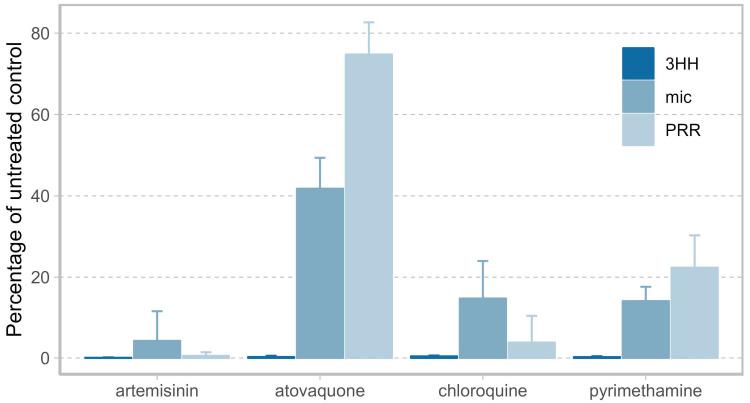
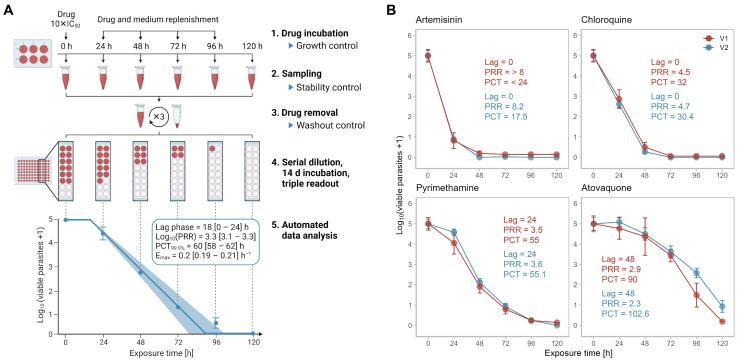
With artemisinin-resistant parasites emerging in Africa, the need for new antimalarial chemotypes is persistently high. The ideal pharmacodynamic parameters of a candidate drug are a rapid onset of action and a fast rate of parasite killing or clearance. To determine these parameters, it is essential to discriminate viable from nonviable parasites, which is complicated by the fact that viable parasites can be metabolically inactive, whilst dying parasites can still be metabolically active and morphologically unaffected. Standard growth inhibition assays, read out via microscopy or [H] hypoxanthine incorporation, cannot reliably discriminate between viable and nonviable parasites. Conversely, the in vitro parasite reduction ratio (PRR) assay is able to measure viable parasites with high sensitivity. It provides valuable pharmacodynamic parameters, such as PRR, 99.9% parasite clearance time (PCT) and lag phase. Here we report the development of the PRR assay version 2 (V2), which comes with a shorter assay duration, optimized quality controls and an objective, automated analysis pipeline that systematically estimates PRR, PCT and lag time and returns meaningful secondary parameters such as the maximal killing rate of a drug (E) at the assayed concentration. These parameters can be fed directly into pharmacokinetic/pharmacodynamic models, hence aiding and standardizing lead selection, optimization, and dose prediction.
随着非洲出现对青蒿素耐药的疟原虫,对新型抗疟化学类型的需求一直居高不下。候选药物理想的药效学参数是起效迅速以及寄生虫杀灭或清除速率快。为了确定这些参数,区分存活与非存活的疟原虫至关重要,而这一过程因以下事实而变得复杂:存活的疟原虫可能代谢不活跃,而即将死亡的疟原虫可能仍具有代谢活性且形态未受影响。通过显微镜检查或[H]次黄嘌呤掺入进行读数的标准生长抑制试验无法可靠地区分存活与非存活的疟原虫。相反,体外寄生虫减少率(PRR)试验能够高灵敏度地检测存活的疟原虫。它提供了有价值的药效学参数,如PRR、99.9%寄生虫清除时间(PCT)和滞后期。在此,我们报告了PRR试验版本2(V2)的开发情况,该版本试验持续时间更短,质量控制得到优化,并且有一个客观的自动化分析流程,可系统地估计PRR、PCT和滞后时间,并返回有意义的次要参数,如在测定浓度下药物的最大杀灭率(E)。这些参数可直接输入药代动力学/药效学模型,从而有助于并规范先导化合物的筛选、优化和剂量预测。


 Zotero 插件