
异丙酚全凭静脉麻醉与吸入麻醉用于肝切除术后急性疼痛的镇痛效果:一项随机对照试验。
The analgesic effect of total intravenous anaesthesia with propofol versus inhalational anaesthesia for acute postoperative pain after hepatectomy: a randomized controlled trial.
机构信息
Department of Anaesthesiology, School of Clinical Medicine, Li Ka Shing Faculty of Medicine, The University of Hong Kong, Hong Kong, China.
Department of Anaesthesiology, Queen Mary Hospital, Hong Kong, China.
出版信息
BMC Anesthesiol. 2023 Apr 3;23(1):112. doi: 10.1186/s12871-023-02063-7.
BACKGROUND
Postoperative pain control can be challenging in patients undergoing hepatectomy. A previous retrospective study on hepatobiliary/ pancreatic surgeries showed better postoperative pain control in patients who received propofol TIVA. The aim of this study was to determine the analgesic effect of propofol TIVA for hepatectomy. This clinical study has been registered at ClinicalTrials.gov (NCT03597997).
METHODS
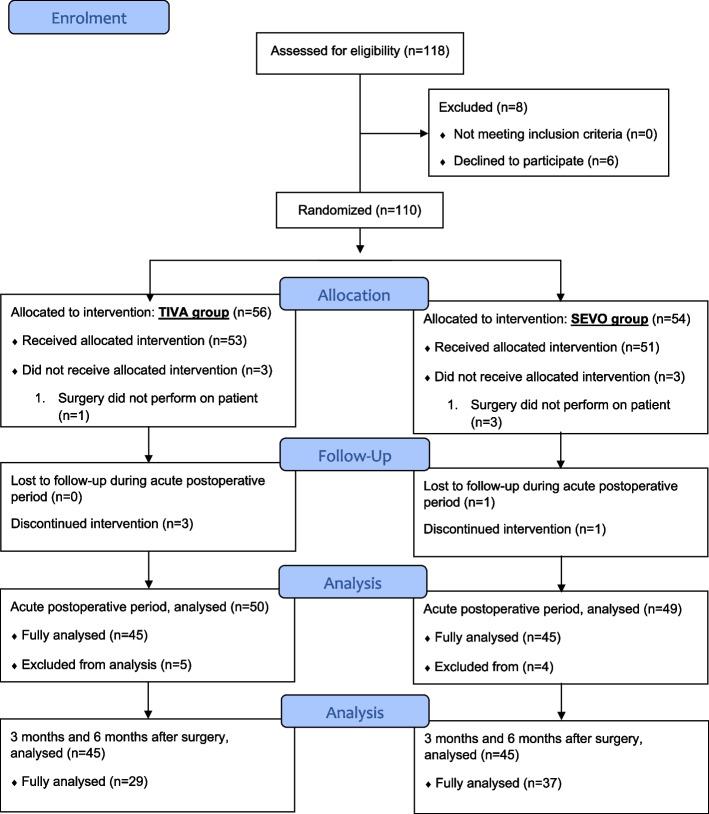
A prospective randomized controlled trial was performed to compare the analgesic effect of propofol TIVA versus inhalational anaesthesia. Patients aged between 18 and 80 years old with an American Society of Anesthesiologist (ASA) physical status of I-III scheduled for elective hepatectomy were recruited. Ninety patients were randomly allocated to receive either propofol TIVA (TIVA group) or inhalational anaesthesia with sevoflurane (SEVO group). Perioperative anaesthetic/analgesic management was the same for both groups. Numerical rating scale (NRS) pain scores, postoperative morphine consumption, quality of recovery, patient satisfaction and adverse effects were evaluated during the acute postoperative period and at 3 and 6 months after surgery.
RESULTS
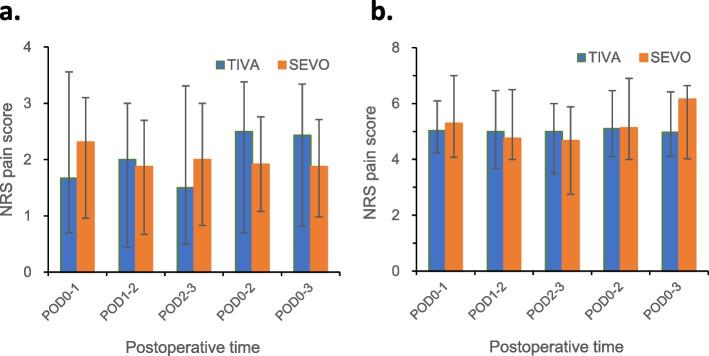
No significant differences were found for acute postoperative pain scores (both at rest and during coughing) and postoperative morphine consumption between TIVA and SEVO groups. Patients given TIVA had lower pain scores with coughing at 3 months after surgery (p = 0.014, and FDR < 0.1). TIVA group was associated with better quality of recovery on postoperative day (POD) 3 (p = 0.038, and FDR < 0.1), less nausea (p = 0.011, and FDR < 0.1 on POD 2; p = 0.013, and FDR < 0.1 on POD 3) and constipation (p = 0.013, and FDR < 0.1 on POD 3).
CONCLUSION
Propofol TIVA did not improve acute postoperative pain control compared to inhalational anaesthesia in patients who underwent hepatectomy. Our results do not support the use of propofol TIVA for reducing acute postoperative pain after hepatectomy.
背景
接受肝切除术的患者术后疼痛控制可能具有挑战性。先前针对肝胆胰手术的回顾性研究表明,接受异丙酚 TIVA 的患者术后疼痛控制更好。本研究旨在确定异丙酚 TIVA 用于肝切除术的镇痛效果。这项临床研究已在 ClinicalTrials.gov 注册(NCT03597997)。
方法
进行了一项前瞻性随机对照试验,比较异丙酚 TIVA 与吸入麻醉的镇痛效果。招募年龄在 18 至 80 岁之间、ASA 身体状况 I-III 级、择期行肝切除术的患者。90 名患者被随机分配接受异丙酚 TIVA(TIVA 组)或七氟醚吸入麻醉(SEVO 组)。两组的围手术期麻醉/镇痛管理相同。在急性术后期间和术后 3 个月和 6 个月评估数字评分量表(NRS)疼痛评分、术后吗啡消耗量、恢复质量、患者满意度和不良反应。
结果
TIVA 和 SEVO 组之间在急性术后疼痛评分(休息时和咳嗽时)和术后吗啡消耗量方面没有显著差异。接受 TIVA 的患者在术后 3 个月咳嗽时疼痛评分较低(p=0.014,FDR<0.1)。TIVA 组在术后第 3 天(p=0.038,FDR<0.1)恢复质量更好,恶心(p=0.011,FDR<0.1,术后第 2 天;p=0.013,FDR<0.1,术后第 3 天)和便秘(p=0.013,FDR<0.1,术后第 3 天)较少。
结论
与吸入麻醉相比,异丙酚 TIVA 并未改善肝切除术后患者的急性术后疼痛控制。我们的结果不支持使用异丙酚 TIVA 来减轻肝切除术后的急性术后疼痛。
 Zotero 插件