
靶向线粒体能量代谢可逆转帕比司他和马利司他诱导的儿科和成人高级别脑胶质瘤耐药。
Targeting mitochondrial energetics reverses panobinostat- and marizomib-induced resistance in pediatric and adult high-grade gliomas.
机构信息
Department of Neurosurgery, University of Pittsburgh School of Medicine, PA, USA.
John G. Rangos Sr. Research Center, Children's Hospital of Pittsburgh, PA, USA.
出版信息
Mol Oncol. 2023 Sep;17(9):1821-1843. doi: 10.1002/1878-0261.13427. Epub 2023 May 12.
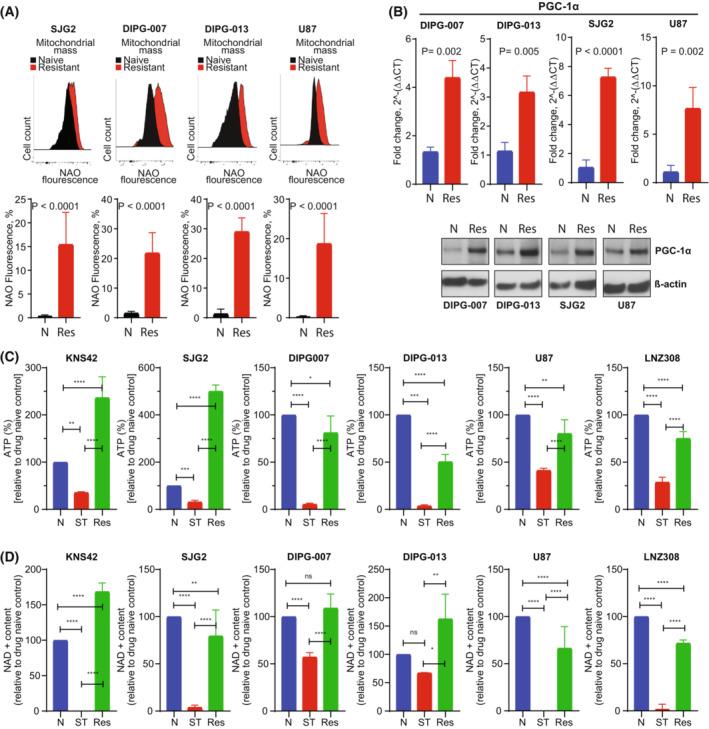
In previous studies, we demonstrated that panobinostat, a histone deacetylase inhibitor, and bortezomib, a proteasomal inhibitor, displayed synergistic therapeutic activity against pediatric and adult high-grade gliomas. Despite the remarkable initial response to this combination, resistance emerged. Here, in this study, we aimed to investigate the molecular mechanisms underlying the anticancer effects of panobinostat and marizomib, a brain-penetrant proteasomal inhibitor, and the potential for exploitable vulnerabilities associated with acquired resistance. RNA sequencing followed by gene set enrichment analysis (GSEA) was employed to compare the molecular signatures enriched in resistant compared with drug-naïve cells. The levels of adenosine 5'-triphosphate (ATP), nicotinamide adenine dinucleotide (NAD) content, hexokinase activity, and tricarboxylic acid (TCA) cycle metabolites required for oxidative phosphorylation to meet their bioenergetic needs were analyzed. Here, we report that panobinostat and marizomib significantly depleted ATP and NAD content, increased mitochondrial permeability and reactive oxygen species generation, and promoted apoptosis in pediatric and adult glioma cell lines at initial treatment. However, resistant cells exhibited increased levels of TCA cycle metabolites, which required for oxidative phosphorylation to meet their bioenergetic needs. Therefore, we targeted glycolysis and the electron transport chain (ETC) with small molecule inhibitors, which displayed substantial efficacy, suggesting that resistant cell survival is dependent on glycolytic and ETC complexes. To verify these observations in vivo, lonidamine, an inhibitor of glycolysis and mitochondrial function, was chosen. We produced two diffuse intrinsic pontine glioma (DIPG) models, and lonidamine treatment significantly increased median survival in both models, with particularly dramatic effects in panobinostat- and marizomib-resistant cells. These data provide new insights into mechanisms of treatment resistance in gliomas.
在之前的研究中,我们证明了 panobinostat(一种组蛋白去乙酰化酶抑制剂)和 bortezomib(一种蛋白酶体抑制剂)对儿科和成人高级别神经胶质瘤具有协同的治疗活性。尽管对这种组合的初始反应非常显著,但仍出现了耐药性。在这里,我们旨在研究 panobinostat 和 marizomib(一种可穿透大脑的蛋白酶体抑制剂)的抗癌作用背后的分子机制,以及与获得性耐药相关的潜在可利用的弱点。我们采用 RNA 测序和基因集富集分析(GSEA)来比较耐药细胞与药物未处理细胞中富集的分子特征。分析了用于氧化磷酸化以满足其生物能量需求的三磷酸腺苷(ATP)、烟酰胺腺嘌呤二核苷酸(NAD)含量、己糖激酶活性和三羧酸(TCA)循环代谢物的水平。在这里,我们报告 panobinostat 和 marizomib 最初治疗时可显著耗尽 ATP 和 NAD 含量,增加线粒体通透性和活性氧生成,并促进儿科和成人神经胶质瘤细胞系的凋亡。然而,耐药细胞显示出 TCA 循环代谢物水平增加,这些代谢物需要氧化磷酸化来满足其生物能量需求。因此,我们用小分子抑制剂靶向糖酵解和电子传递链(ETC),显示出显著的疗效,这表明耐药细胞的存活依赖于糖酵解和 ETC 复合物。为了在体内验证这些观察结果,我们选择了 lonidamine,一种糖酵解和线粒体功能的抑制剂。我们产生了两种弥漫性内在脑桥胶质瘤(DIPG)模型,lonidamine 治疗在两种模型中均显著增加了中位生存期,在 panobinostat 和 marizomib 耐药细胞中效果更为显著。这些数据为胶质瘤治疗耐药的机制提供了新的见解。


 Zotero 插件