
人类的 mRNA 解码在动力学和结构上与细菌不同。
mRNA decoding in human is kinetically and structurally distinct from bacteria.
机构信息
Department of Structural Biology, St Jude Children's Research Hospital, Memphis, TN, USA.
Tri-Institutional PhD Program in Chemical Biology, Weill Cornell Medicine, New York, NY, USA.
出版信息
Nature. 2023 May;617(7959):200-207. doi: 10.1038/s41586-023-05908-w. Epub 2023 Apr 5.
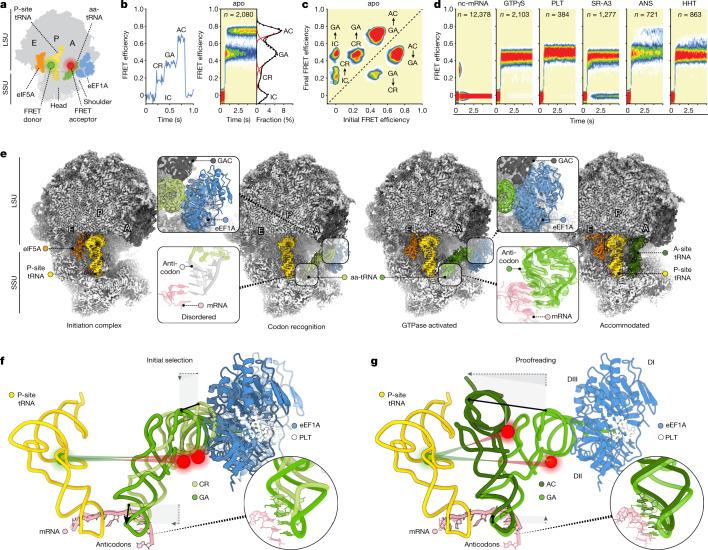
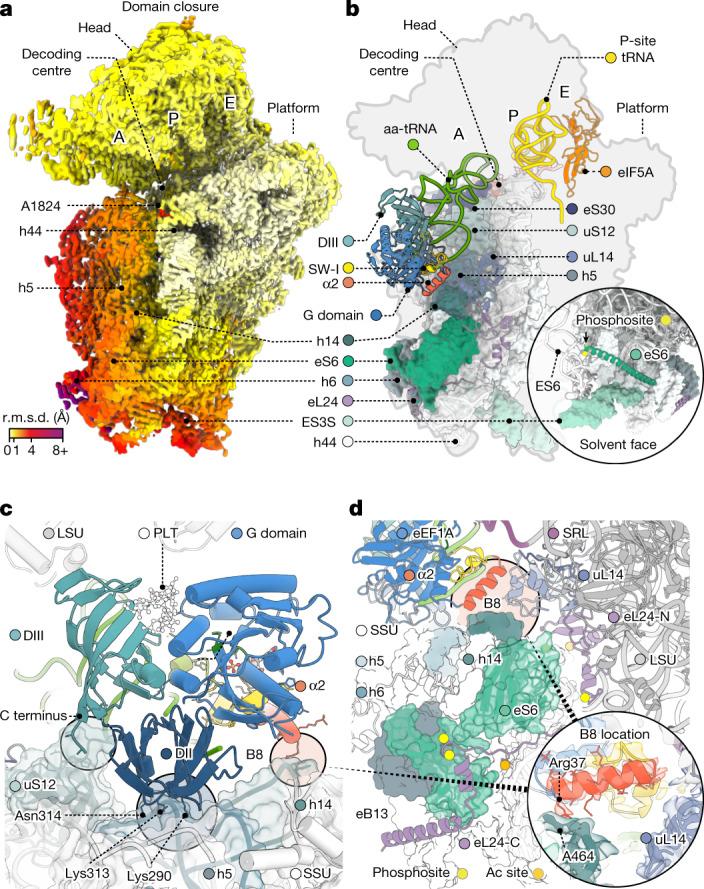
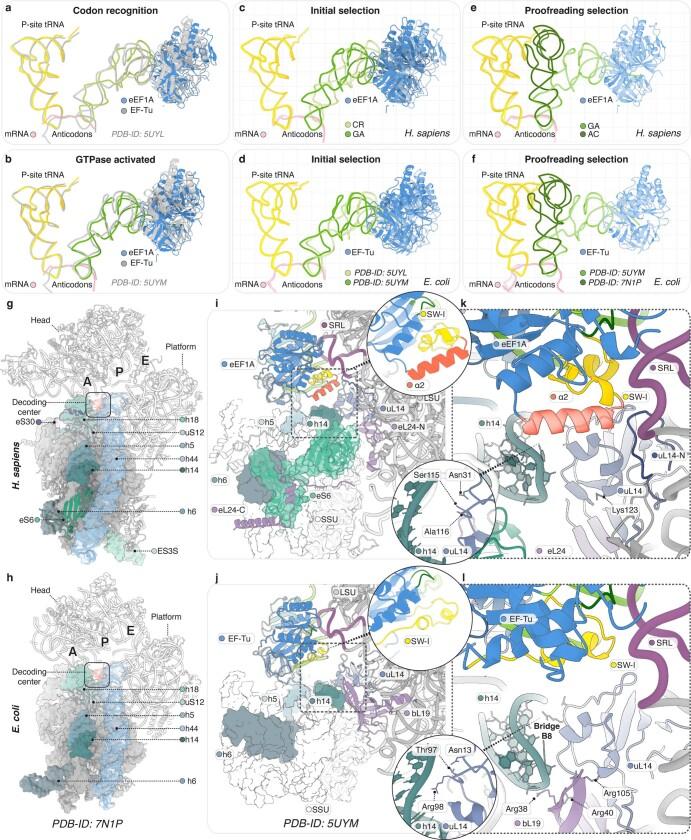
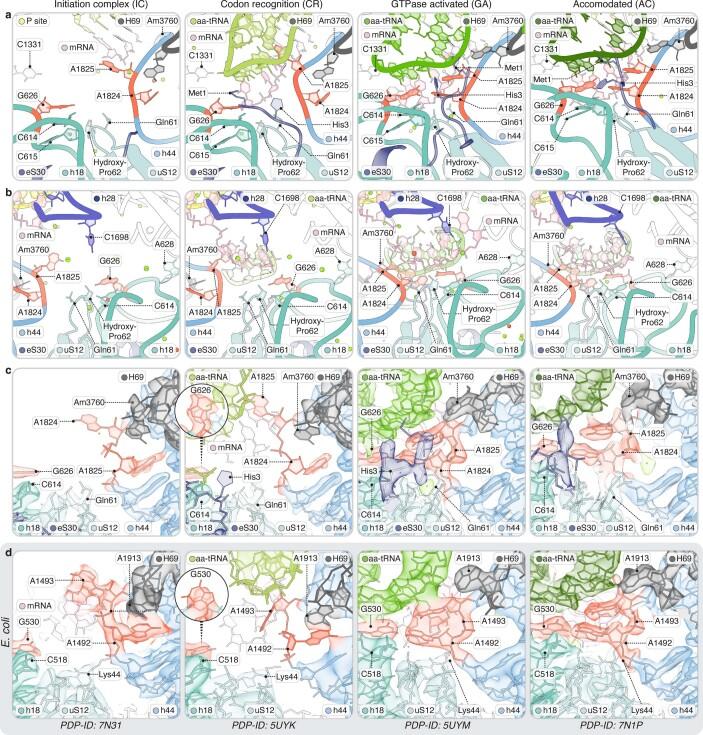
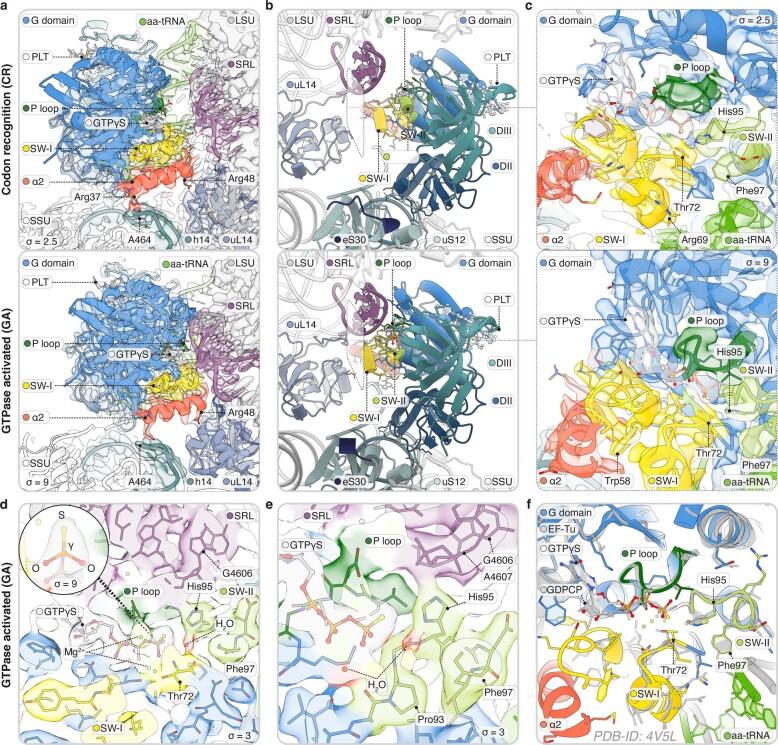
In all species, ribosomes synthesize proteins by faithfully decoding messenger RNA (mRNA) nucleotide sequences using aminoacyl-tRNA substrates. Current knowledge of the decoding mechanism derives principally from studies on bacterial systems. Although key features are conserved across evolution, eukaryotes achieve higher-fidelity mRNA decoding than bacteria. In human, changes in decoding fidelity are linked to ageing and disease and represent a potential point of therapeutic intervention in both viral and cancer treatment. Here we combine single-molecule imaging and cryogenic electron microscopy methods to examine the molecular basis of human ribosome fidelity to reveal that the decoding mechanism is both kinetically and structurally distinct from that of bacteria. Although decoding is globally analogous in both species, the reaction coordinate of aminoacyl-tRNA movement is altered on the human ribosome and the process is an order of magnitude slower. These distinctions arise from eukaryote-specific structural elements in the human ribosome and in the elongation factor eukaryotic elongation factor 1A (eEF1A) that together coordinate faithful tRNA incorporation at each mRNA codon. The distinct nature and timing of conformational changes within the ribosome and eEF1A rationalize how increased decoding fidelity is achieved and potentially regulated in eukaryotic species.
在所有物种中,核糖体通过使用氨酰基-tRNA 底物忠实解码信使 RNA(mRNA)核苷酸序列来合成蛋白质。目前对解码机制的了解主要来自于对细菌系统的研究。尽管关键特征在进化中是保守的,但真核生物实现了比细菌更高的 mRNA 解码保真度。在人类中,解码保真度的变化与衰老和疾病有关,并且代表了病毒和癌症治疗中潜在的治疗干预点。在这里,我们结合单分子成像和低温电子显微镜方法来研究人类核糖体保真度的分子基础,以揭示解码机制在动力学和结构上都与细菌不同。尽管在这两个物种中,解码在全局上是类似的,但氨酰基-tRNA 运动的反应坐标在人类核糖体上发生了改变,并且该过程的速度慢了一个数量级。这些区别来自于人类核糖体和伸长因子真核延伸因子 1A(eEF1A)中的真核特异性结构元件,它们共同协调每个 mRNA 密码子处的忠实 tRNA 掺入。核糖体和 eEF1A 内构象变化的独特性质和时间解释了如何在真核物种中实现并可能调节增加的解码保真度。





 Zotero 插件