
腺病毒核心蛋白 V 增强衣壳并促进从破损颗粒中释放基因组。
Adenovirus core protein V reinforces the capsid and enhances genome release from disrupted particles.
机构信息
Departament of Condensed Matter Physics, Universidad Autónoma de Madrid and Institute of Condensed Matter Physics (IFIMAC), 28049 Madrid, Spain.
Department of Molecular Life Sciences, University of Zurich, CH-8057 Zurich, Switzerland.
出版信息
Sci Adv. 2023 Apr 7;9(14):eade9910. doi: 10.1126/sciadv.ade9910.
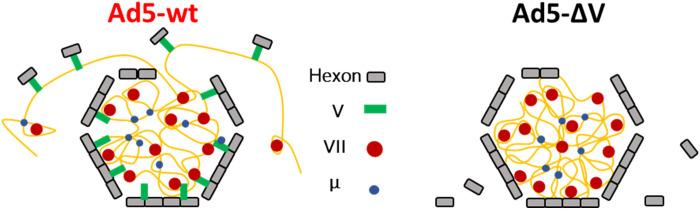
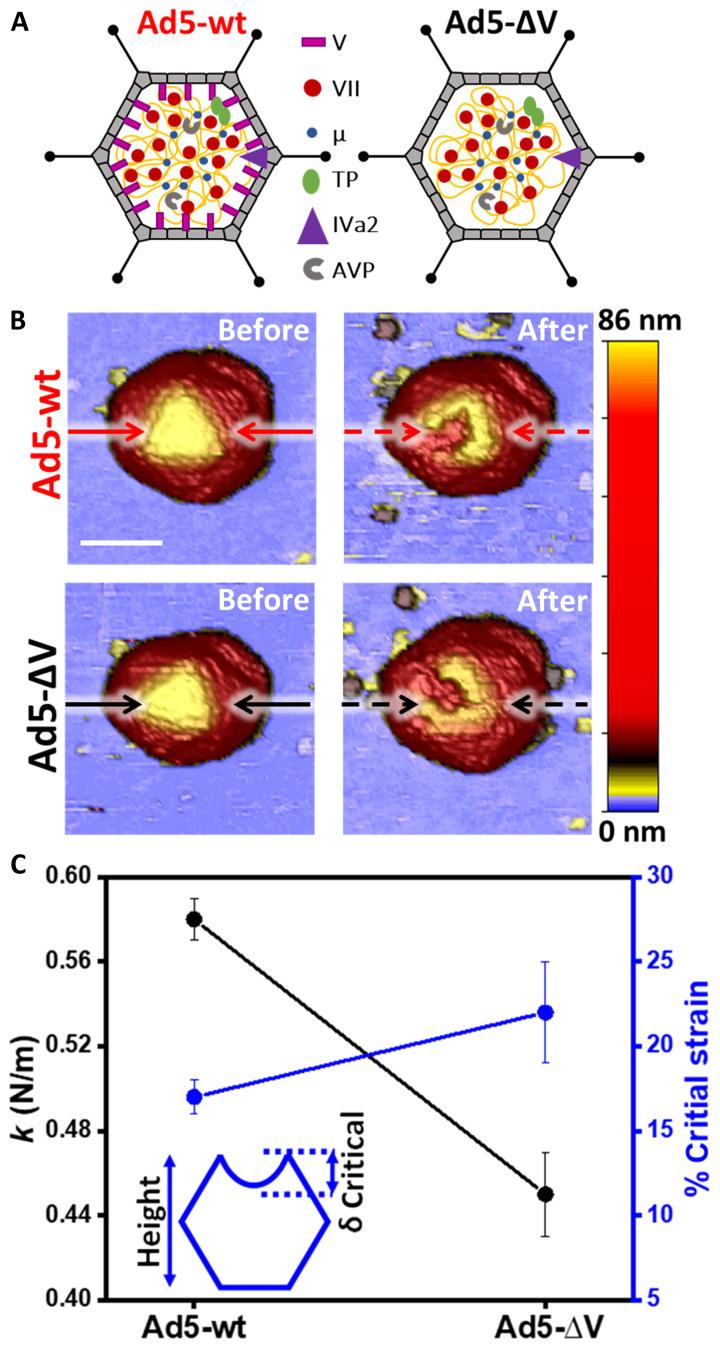
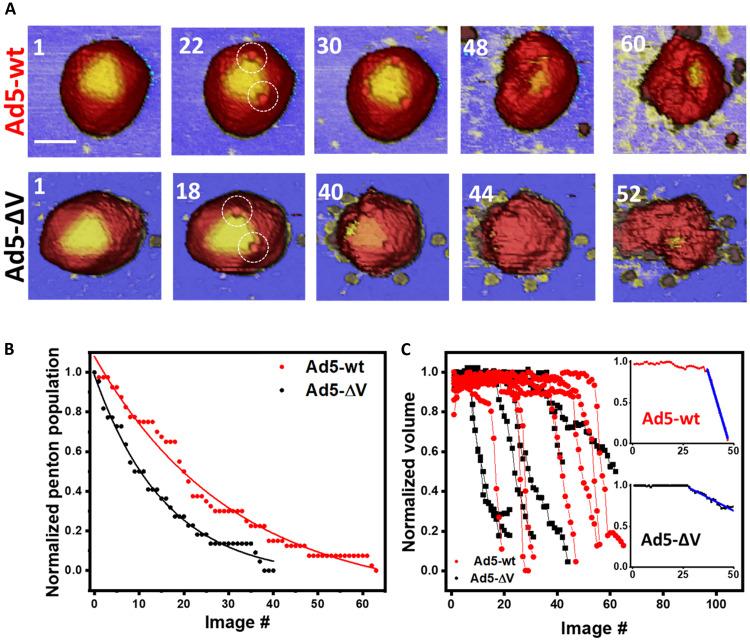
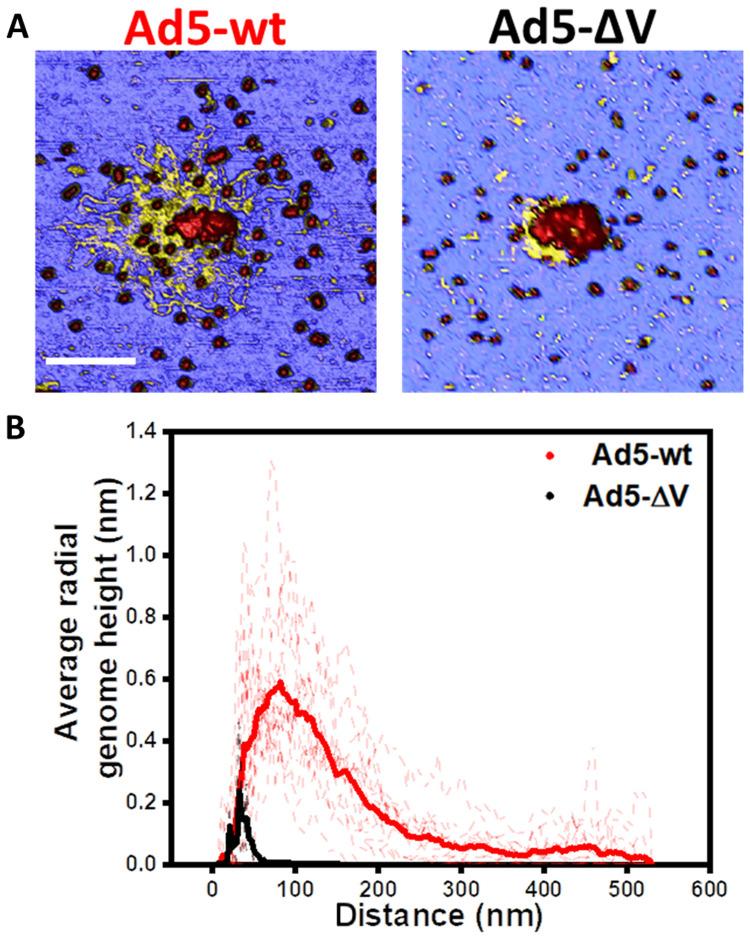
Out of the three core proteins in human adenovirus, protein V is believed to connect the inner capsid surface to the outer genome layer. Here, we explored mechanical properties and in vitro disassembly of particles lacking protein V (Ad5-ΔV). Ad5-ΔV particles were softer and less brittle than the wild-type ones (Ad5-wt), but they were more prone to release pentons under mechanical fatigue. In Ad5-ΔV, core components did not readily diffuse out of partially disrupted capsids, and the core appeared more condensed than in Ad5-wt. These observations suggest that instead of condensing the genome, protein V antagonizes the condensing action of the other core proteins. Protein V provides mechanical reinforcement and facilitates genome release by keeping DNA connected to capsid fragments that detach during disruption. This scenario is in line with the location of protein V in the virion and its role in Ad5 cell entry.
在人类腺病毒的三种核心蛋白中,蛋白 V 被认为将内壳表面与外壳层的基因组连接起来。在这里,我们探索了缺乏蛋白 V(Ad5-ΔV)的颗粒的机械性能和体外解体。与野生型(Ad5-wt)相比,Ad5-ΔV 颗粒更柔软,更不易脆,但在机械疲劳下更容易释放五邻体。在 Ad5-ΔV 中,核心成分不易从部分破坏的衣壳中扩散出来,并且核心比 Ad5-wt 更浓缩。这些观察结果表明,蛋白 V 没有使基因组浓缩,而是拮抗了其他核心蛋白的浓缩作用。蛋白 V 通过将 DNA 连接到在破坏过程中分离的衣壳片段上,提供机械加固并促进基因组的释放。这种情况与蛋白 V 在病毒粒子中的位置及其在 Ad5 细胞进入中的作用一致。


 Zotero 插件