
非阿片类镇痛药预防慢性术后疼痛的系统评价和网络荟萃分析。
Non-opioid analgesics for the prevention of chronic postsurgical pain: a systematic review and network meta-analysis.
机构信息
Department of Anaesthesia and Surgery, Graduate Entry Medicine, University of Nottingham, Royal Derby Hospital, Nottingham, UK.
Department of Clinical Medicine, University of Copenhagen, Copenhagen, Denmark; Department of Anaesthesia, Zealand University Hospital, Køge, Denmark.
出版信息
Br J Anaesth. 2023 Jun;130(6):719-728. doi: 10.1016/j.bja.2023.02.041. Epub 2023 Apr 12.
BACKGROUND
Chronic postsurgical pain is common after surgery. Identification of non-opioid analgesics with potential for preventing chronic postsurgical pain is important, although trials are often underpowered. Network meta-analysis offers an opportunity to improve power and to identify the most promising therapy for clinical use and future studies.
METHODS
We conducted a PRISMA-NMA-compliant systematic review and network meta-analysis of randomised controlled trials of non-opioid analgesics for chronic postsurgical pain. Outcomes included incidence and severity of chronic postsurgical pain, serious adverse events, and chronic opioid use.
RESULTS
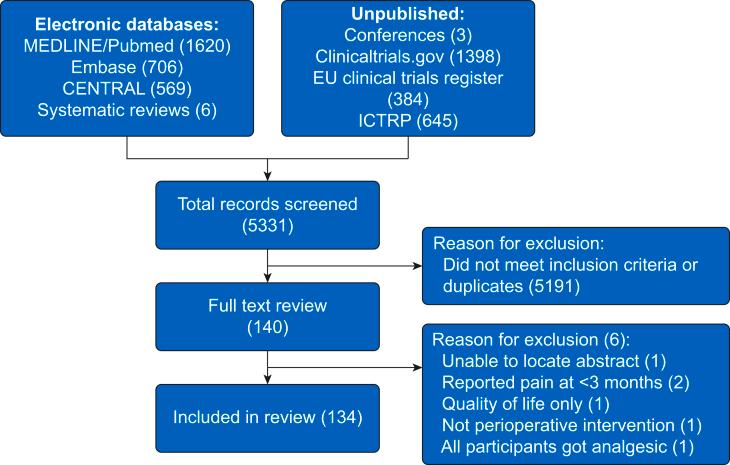
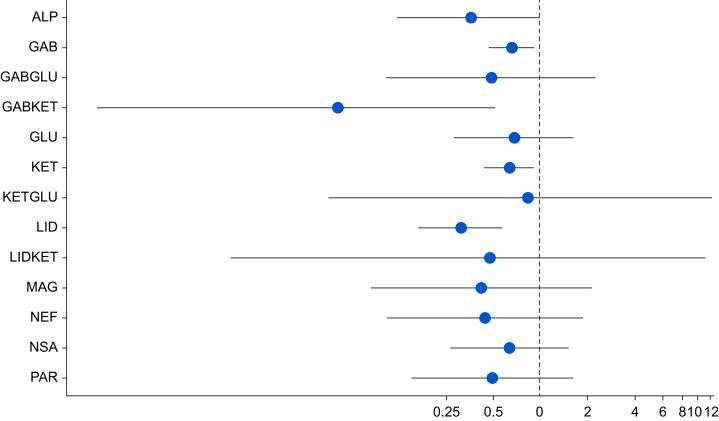
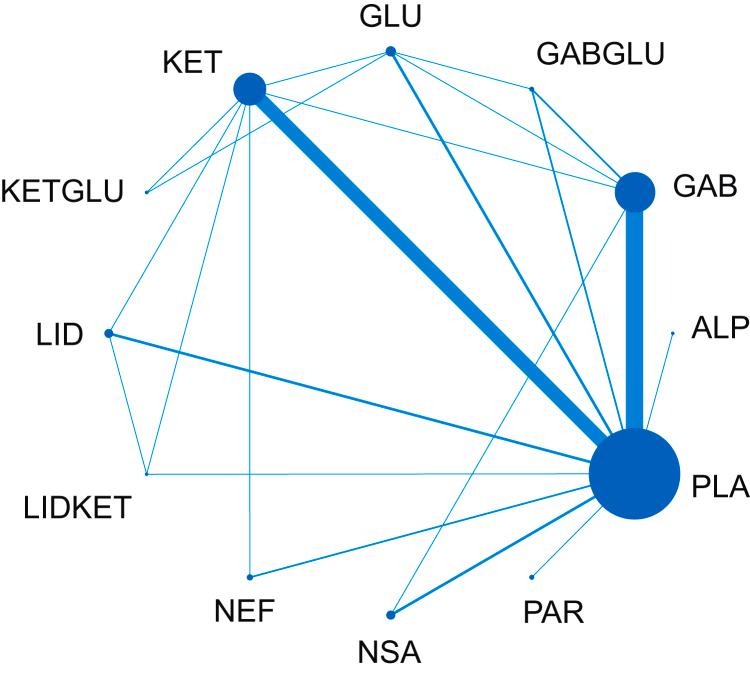
We included 132 randomised controlled trials with 23 902 participants. In order of efficacy, i.v. lidocaine (odds ratio [OR] 0.32; 95% credible interval [CrI] 0.17-0.58), ketamine (OR 0.64; 95% CrI 0.44-0.92), gabapentinoids (OR 0.67; 95% CrI 0.47-0.92), and possibly dexmedetomidine (OR 0.36; 95% CrI 0.12-1.00) reduced the incidence of chronic postsurgical pain at ≤6 months. There was little available evidence for chronic postsurgical pain at >6 months, combinations agents, chronic opioid use, and serious adverse events. Variable baseline risk was identified as a potential violation to the network meta-analysis transitivity assumption, so results are reported from a fixed value of this, with analgesics more effective at higher baseline risk. The confidence in these findings was low because of problems with risk of bias and imprecision.
CONCLUSIONS
Lidocaine (most effective), ketamine, and gabapentinoids could be effective in reducing chronic postsurgical pain ≤6 months although confidence is low. Moreover, variable baseline risk might violate transitivity in network meta-analysis of analgesics; this recommends use of our methods in future network meta-analyses.
SYSTEMATIC REVIEW PROTOCOL
PROSPERO CRD42021269642.
背景
手术后慢性术后疼痛很常见。确定具有预防慢性术后疼痛潜力的非阿片类镇痛药很重要,尽管试验通常效力不足。网络荟萃分析提供了提高效力的机会,并确定了最有前途的治疗方法,用于临床应用和未来的研究。
方法
我们进行了一项符合 PRISMA-NMA 标准的系统评价和网络荟萃分析,研究了用于慢性术后疼痛的非阿片类镇痛药的随机对照试验。结果包括慢性术后疼痛的发生率和严重程度、严重不良事件和慢性阿片类药物的使用。
结果
我们纳入了 132 项随机对照试验,共 23902 名参与者。按疗效顺序,静脉内利多卡因(比值比 [OR] 0.32;95%可信区间 [CrI] 0.17-0.58)、氯胺酮(OR 0.64;95% CrI 0.44-0.92)、加巴喷丁类药物(OR 0.67;95% CrI 0.47-0.92)和可能的右美托咪定(OR 0.36;95% CrI 0.12-1.00)可降低 6 个月内慢性术后疼痛的发生率。对于 >6 个月的慢性术后疼痛、联合用药、慢性阿片类药物使用和严重不良事件,几乎没有可用的证据。确定了可变的基线风险,这可能违反了网络荟萃分析的传递性假设,因此报告了该固定值的结果,并且在基线风险较高的情况下,镇痛药更有效。由于存在偏倚风险和不精确性问题,因此对这些发现的置信度较低。
结论
利多卡因(最有效)、氯胺酮和加巴喷丁类药物可能有效降低 6 个月内的慢性术后疼痛,尽管置信度较低。此外,可变的基线风险可能违反网络荟萃分析中镇痛药的传递性;这建议在未来的网络荟萃分析中使用我们的方法。
系统评价方案
PROSPERO CRD42021269642。


 Zotero 插件