
静脉注射利多卡因和氯胺酮对全身麻醉下腹部手术后疼痛影响的比较。
Comparison of the effects of intravenous lignocaine and ketamine on postoperative pain after lower abdominal surgeries under general anaesthesia.
作者信息
Singariya Geeta, Sharma Jyoti, Kumari Kamlesh, Kamal Manoj, Khatri Chanda, Selvin Caren Candace
机构信息
Department of Anaesthesiology and Critical Care, Dr S N Medical College, Jodhpur, Rajasthan, India.
Department of Anaesthesiology and Critical Care, All India Institute of Medical Sciences, Jodhpur, Rajasthan, India.
出版信息
Indian J Anaesth. 2023 Feb;67(Suppl 1):S41-S47. doi: 10.4103/ija.ija_691_22. Epub 2023 Feb 10.
BACKGROUND AND AIMS
As a component of multimodal analgesia, the administration of systemic lignocaine and ketamine is a well-known technique. This study was designed to compare the effect of intravenous lignocaine and ketamine on postoperative pain in the patients undergoing lower abdominal surgeries under general anaesthesia.
METHODS
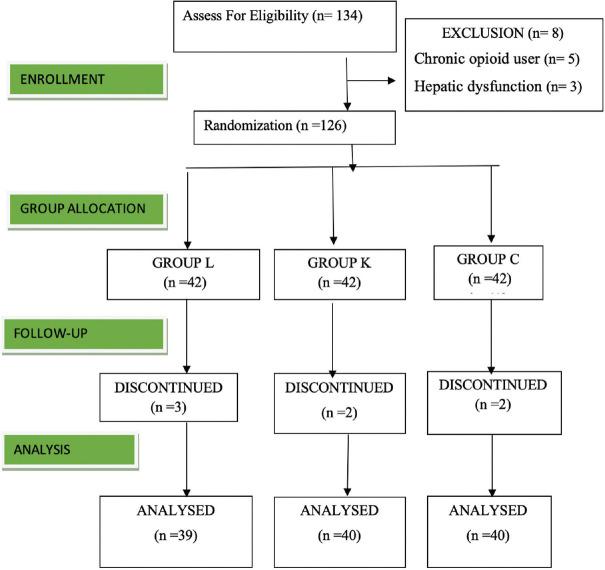
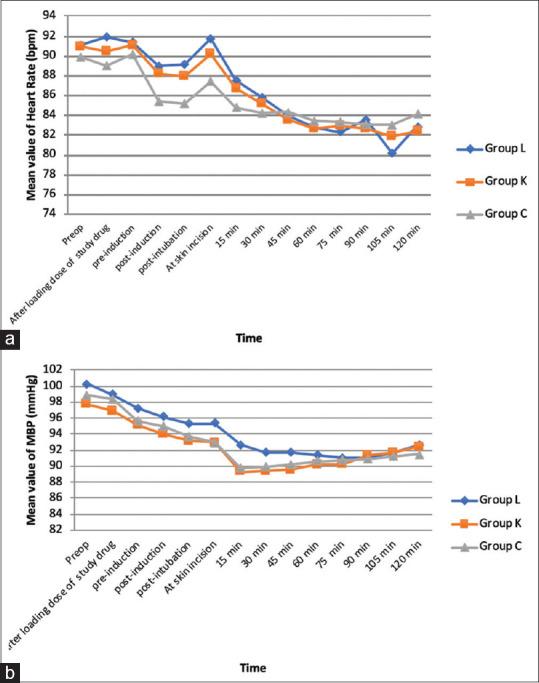
Total 126 patients, aged between18 to 60 years, American Society of Anesthesiologists (ASA) physical status I and II, were randomly allocated into lignocaine (Group L), ketamine (Group K), or control (Group C). We assessed the mean fentanyl consumption 24 hours postoperatively, visual analogue score (VAS), time to first rescue analgesia, haemodynamic parameters, postoperative complications patient satisfaction score, and duration of hospital stay among three groups.
RESULTS
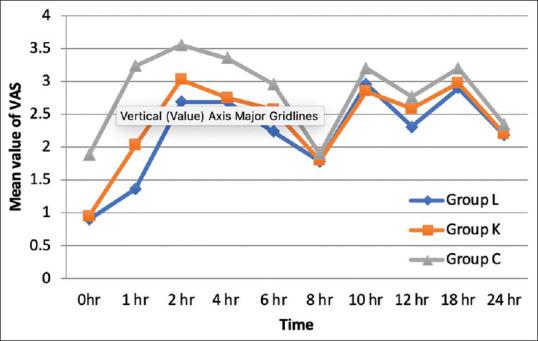
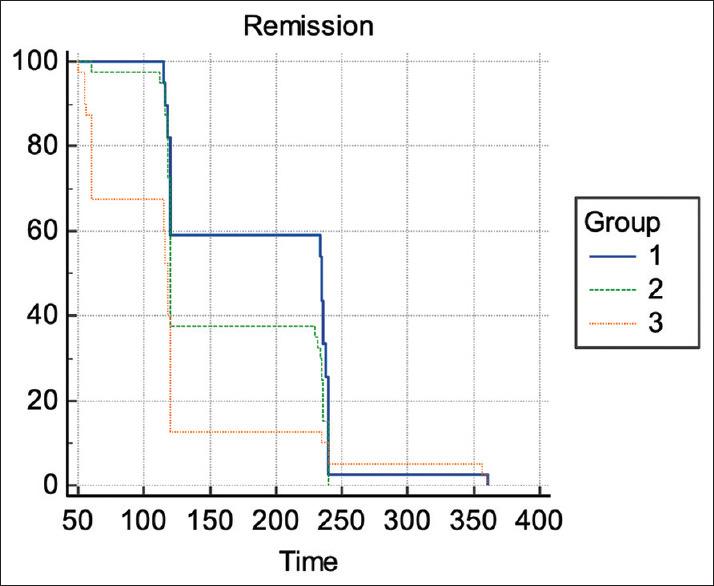
The mean fentanyl consumption in first 24 hours postoperatively was higher in group C (194.65 ± 48.48 μg) compared to group L (139.69 ± 46.96 μg) and group K (161.37 ± 46.31 μg) ( < 0.05). The VAS pain scores were lower in group L and group K compared to group C ( < 0.05). The time to first rescue analgesia was prolonged in group L and group K as compared to group C ( < 0.05). The patients were more satisfied in group L and group K as compared to group C ( < 0.05).
CONCLUSION
The mean fentanyl consumption in 24 hours postoperatively and pain intensity were less with intraoperative lignocaine and ketamine infusion with improved patient satisfaction in patients undergoing lower abdominal surgery under general anaesthesia.
背景与目的
作为多模式镇痛的一个组成部分,全身应用利多卡因和氯胺酮是一种广为人知的技术。本研究旨在比较静脉注射利多卡因和氯胺酮对全身麻醉下接受下腹部手术患者术后疼痛的影响。
方法
总共126例年龄在18至60岁之间、美国麻醉医师协会(ASA)身体状况为I级和II级的患者,被随机分为利多卡因组(L组)、氯胺酮组(K组)或对照组(C组)。我们评估了三组患者术后24小时的芬太尼平均用量、视觉模拟评分(VAS)、首次补救镇痛时间、血流动力学参数、术后并发症、患者满意度评分以及住院时间。
结果
与L组(139.69±46.96μg)和K组(161.37±46.31μg)相比,C组术后24小时内的芬太尼平均用量更高(194.65±48.48μg)(P<0.05)。与C组相比,L组和K组的VAS疼痛评分更低(P<0.05)。与C组相比,L组和K组的首次补救镇痛时间延长(P<0.05)。与C组相比,L组和K组的患者满意度更高(P<0.05)。
结论
全身麻醉下接受下腹部手术的患者术中输注利多卡因和氯胺酮,术后24小时内的芬太尼平均用量和疼痛强度更低,患者满意度提高。
 Zotero 插件