
用于通过发光或视觉检测水样中铝(III)的灵敏比率传感器。
Sensitive ratiometric sensor for Al(III) detection in water samples using luminescence or eye-vision.
作者信息
Khairy Gasser M, Amin Alaa S, Moalla Sayed M N, Medhat Ayman, Hassan Nader
机构信息
Chemistry Department, Faculty of Science, Suez Canal University, Ismailia, 41522, Egypt.
Chemistry Department, Faculty of Science, Benha University, Benha, 13518, Egypt.
出版信息
Anal Sci. 2023 Aug;39(8):1307-1316. doi: 10.1007/s44211-023-00340-6. Epub 2023 Apr 18.
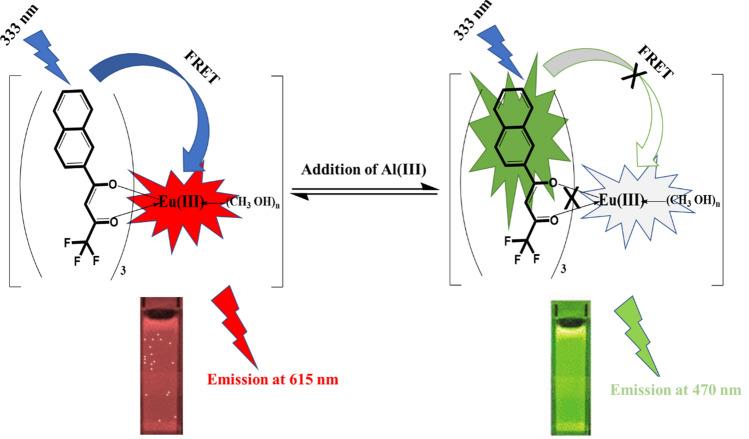
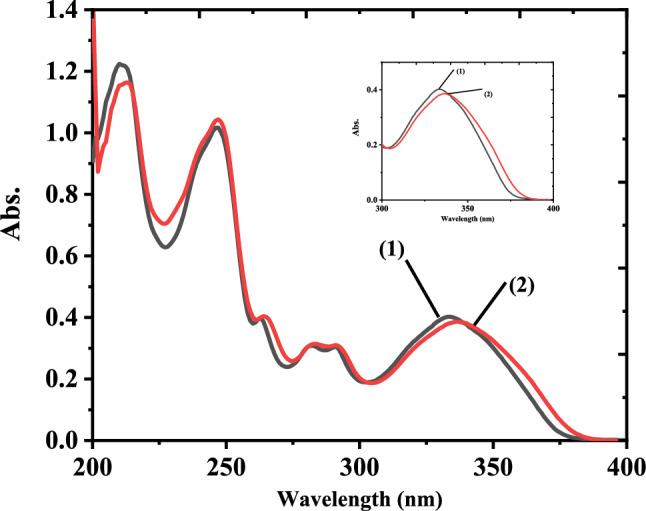
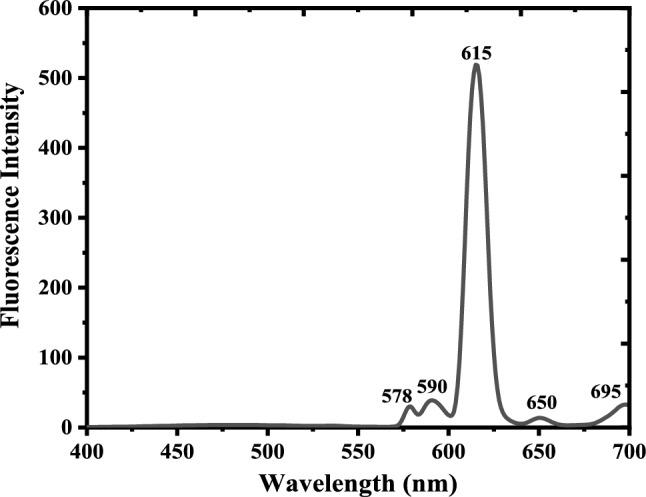
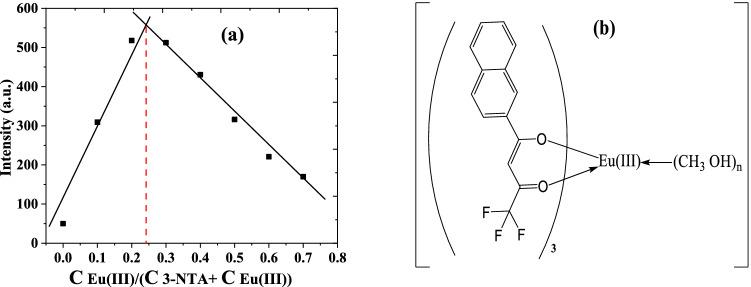
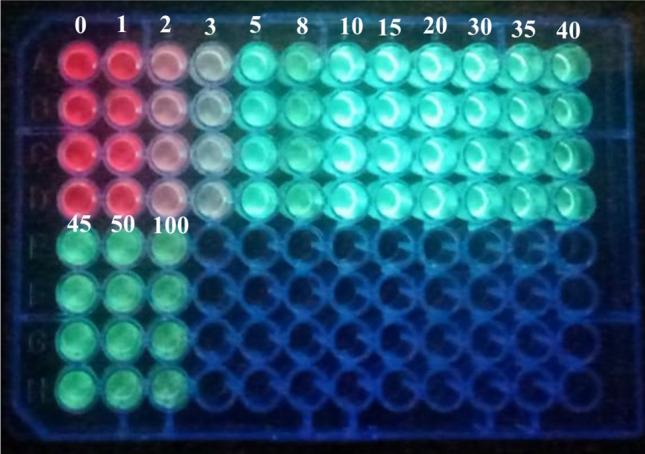
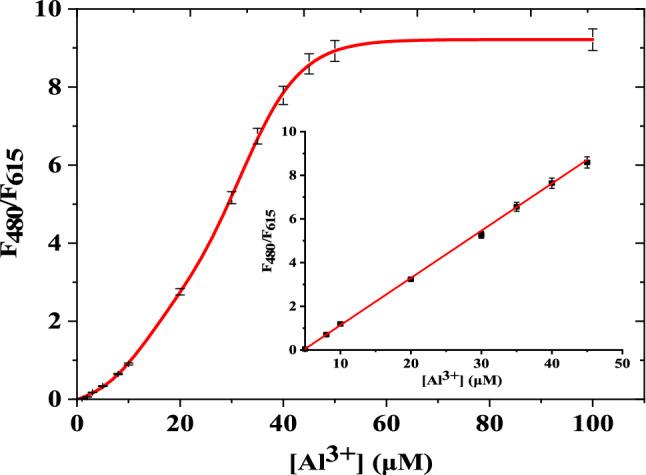
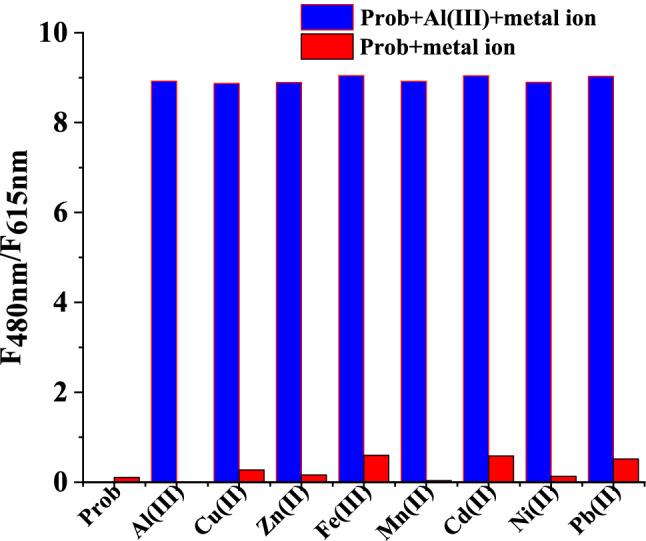
A facile, quick, and sensitive ratiometric luminescence sensor is designed for detection aluminum ions in water samples using luminescence or eye-vision. This approach relies on the emission change of the europium(III) complex with 3-(2-naphthoyl)-1,1,1,-trifluoro acetone (3-NTA) after interaction with various concentration of aluminum ions. The addition of aluminum ions suppressed the Eu(III) emission at 615 nm under 333 nm excitation, while simultaneously enhancing the ligand emission at 480 nm. Optimum detection was obtained in methanol. The quantification of aluminum ions using ratiometric method was determined by plotting the luminescence ratio (F/F) versus aluminum ions concentration. The calibration plot was obtained within the range 0.1-100 µM with LOD = 0.27 µM. Additionally, the concentration of aluminum ions can be estimated semi-quantitatively by visually observing the luminescence colour change of the probe from red to light green and then to dark green after being excited by a UV lamp with 365 nm. As far as we are aware, this is the first luminescent lanthanide complex-based ratiometric probe for the detection of aluminum ions. The probe showed remarkable aluminum ions selectivity relative to that of other metal ions. The suggested sensor was used effectively to identify aluminum ions in water samples with good results.
设计了一种简便、快速且灵敏的比率发光传感器,用于通过发光或肉眼视觉检测水样中的铝离子。该方法基于铕(III)与3-(2-萘甲酰基)-1,1,1-三氟丙酮(3-NTA)形成的配合物在与不同浓度铝离子相互作用后的发射变化。加入铝离子后,在333nm激发下,615nm处的铕(III)发射被抑制,同时480nm处的配体发射增强。在甲醇中可获得最佳检测效果。采用比率法对铝离子进行定量分析,通过绘制发光比率(F/F)与铝离子浓度的关系曲线来确定。校准曲线在0.1 - 100µM范围内获得,检测限为0.27µM。此外,在365nm紫外灯激发后,通过肉眼观察探针的发光颜色从红色变为浅绿色再变为深绿色,可半定量估计铝离子的浓度。据我们所知,这是首个基于发光镧系配合物的用于检测铝离子的比率探针。该探针相对于其他金属离子显示出显著的铝离子选择性。所提出的传感器有效地用于识别水样中的铝离子,结果良好。

 Zotero 插件