
靶向基底前脑 ATXN2 的反义寡核苷酸可增强空间记忆,并改善睡眠剥夺诱导的小鼠恐惧记忆障碍。
Antisense oligonucleotides targeting basal forebrain ATXN2 enhances spatial memory and ameliorates sleep deprivation-induced fear memory impairment in mice.
机构信息
Department of Anesthesiology, PLA Rocket Force Characteristic Medical Center, Beijing, China.
Department of Anesthesiology, PLA General Hospital of Hainan Hospital, Hainan, China.
出版信息
Brain Behav. 2023 Jun;13(6):e3013. doi: 10.1002/brb3.3013. Epub 2023 Apr 18.
INTRODUCTION
Regulation of brain-derived neurotrophic factor (BDNF) in the basal forebrain ameliorates sleep deprivation-induced fear memory impairments in rodents. Antisense oligonucleotides (ASOs) targeting ATXN2 was a potential therapy for spinocerebellar ataxia, whose pathogenic mechanism associates with reduced BDNF expression. We tested the hypothesis that ASO7 targeting ATXN2 could affect BDNF levels in mouse basal forebrain and ameliorate sleep deprivation-induced fear memory impairments.
METHODS
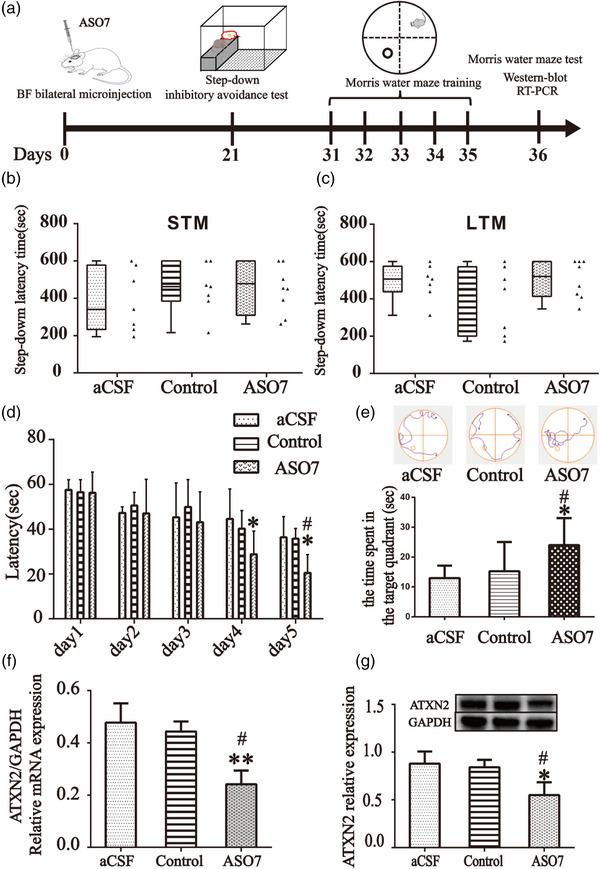
Adult male C57BL/6 mice were used to evaluate the effects of ASO7 targeting ATXN2 microinjected into the bilateral basal forebrain (1 μg, 0.5 μL, each side) on spatial memory, fear memory and sleep deprivation-induced fear memory impairments. Spatial memory and fear memory were detected by the Morris water maze and step-down inhibitory avoidance test, respectively. Immunohistochemistry, RT-PCR, and Western blot were used to evaluate the changes of levels of BDNF, ATXN2, and postsynaptic density 95 (PSD95) protein as well as ATXN2 mRNA. The morphological changes in neurons in the hippocampal CA1 region were detected by HE staining and Nissl staining.
RESULTS
ASO7 targeting ATXN2 microinjected into the basal forebrain could suppress ATXN2 mRNA and protein expression for more than 1 month and enhance spatial memory but not fear memory in mice. BDNF mRNA and protein expression in basal forebrain and hippocampus was increased by ASO7. Moreover, PSD95 expression and synapse formation were increased in the hippocampus. Furthermore, ASO7 microinjected into the basal forebrain increased BDNF and PSD95 protein expression in the basal forebrain of sleep-deprived mice and counteracted sleep deprivation-induced fear memory impairments.
CONCLUSION
ASOs targeting ATXN2 may provide effective interventions for sleep deprivation-induced cognitive impairments.
简介
调节基底前脑的脑源性神经营养因子(BDNF)可改善睡眠剥夺诱导的啮齿动物恐惧记忆障碍。靶向 ATXN2 的反义寡核苷酸(ASO)是治疗脊髓小脑共济失调的一种潜在疗法,其发病机制与 BDNF 表达降低有关。我们检验了这样一个假设,即靶向 ATXN2 的 ASO7 可以影响小鼠基底前脑的 BDNF 水平,并改善睡眠剥夺诱导的恐惧记忆障碍。
方法
使用成年雄性 C57BL/6 小鼠评估双侧基底前脑(1μg,0.5μL,每侧)注射靶向 ATXN2 的 ASO7 对空间记忆、恐惧记忆和睡眠剥夺诱导的恐惧记忆障碍的影响。空间记忆和恐惧记忆分别通过 Morris 水迷宫和跳下抑制回避测试来检测。免疫组织化学、RT-PCR 和 Western blot 用于评估 BDNF、ATXN2 和突触后密度 95(PSD95)蛋白以及 ATXN2 mRNA 水平的变化。通过 HE 染色和尼氏染色检测海马 CA1 区神经元的形态变化。
结果
靶向 ATXN2 的 ASO7 注射到基底前脑可抑制 ATXN2 mRNA 和蛋白表达超过 1 个月,并增强小鼠的空间记忆但不影响恐惧记忆。BDNF mRNA 和蛋白在基底前脑和海马中的表达增加。此外,海马中的 PSD95 表达和突触形成增加。此外,ASO7 注射到基底前脑增加了睡眠剥夺小鼠基底前脑的 BDNF 和 PSD95 蛋白表达,并对抗了睡眠剥夺诱导的恐惧记忆障碍。
结论
靶向 ATXN2 的 ASOs 可能为睡眠剥夺引起的认知障碍提供有效的干预措施。


 Zotero 插件