
在英国,使用不同的第三剂 COVID-19 疫苗接种方案进行同源和异源加强免疫后免疫应答的持久性:COV-BOOST 试验的 8 个月分析。
Persistence of immune responses after heterologous and homologous third COVID-19 vaccine dose schedules in the UK: eight-month analyses of the COV-BOOST trial.
机构信息
Oxford Vaccine Group, Department of Paediatrics, University of Oxford, Oxford, UK.
NIHR Southampton Clinical Research Facility and Biomedical Research Centre, University Hospital Southampton NHS Foundation Trust, Southampton, UK.
出版信息
J Infect. 2023 Jul;87(1):18-26. doi: 10.1016/j.jinf.2023.04.012. Epub 2023 Apr 20.
BACKGROUND
COV-BOOST is a multicentre, randomised, controlled, phase 2 trial of seven COVID-19 vaccines used as a third booster dose in June 2021. Monovalent messenger RNA (mRNA) COVID-19 vaccines were subsequently widely used for the third and fourth-dose vaccination campaigns in high-income countries. Real-world vaccine effectiveness against symptomatic infections following third doses declined during the Omicron wave. This report compares the immunogenicity and kinetics of responses to third doses of vaccines from day (D) 28 to D242 following third doses in seven study arms.
METHODS
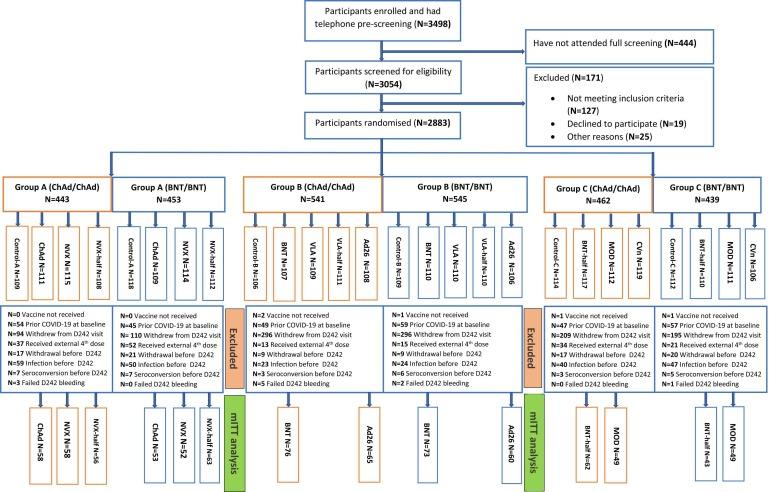
The trial initially included ten experimental vaccine arms (seven full-dose, three half-dose) delivered at three groups of six sites. Participants in each site group were randomised to three or four experimental vaccines, or MenACWY control. The trial was stratified such that half of participants had previously received two primary doses of ChAdOx1 nCov-19 (Oxford-AstraZeneca; hereafter referred to as ChAd) and half had received two doses of BNT162b2 (Pfizer-BioNtech, hereafter referred to as BNT). The D242 follow-up was done in seven arms (five full-dose, two half-dose). The BNT vaccine was used as the reference as it was the most commonly deployed third-dose vaccine in clinical practice in high-income countries. The primary analysis was conducted using all randomised and baseline seronegative participants who were SARS-CoV-2 naïve during the study and who had not received a further COVID-19 vaccine for any reason since third dose randomisation.
RESULTS
Among the 817 participants included in this report, the median age was 72 years (IQR: 55-78) with 50.7% being female. The decay rates of anti-spike IgG between vaccines are different among both populations who received initial doses of ChAd/ChAd and BNT/BNT. In the population that previously received ChAd/ChAd, mRNA vaccines had the highest titre at D242 following their vaccine dose although Ad26. COV2. S (Janssen; hereafter referred to as Ad26) showed slower decay. For people who received BNT/BNT as their initial doses, a slower decay was also seen in the Ad26 and ChAd arms. The anti-spike IgG became significantly higher in the Ad26 arm compared to the BNT arm as early as 3 months following vaccination. Similar decay rates were seen between BNT and half-BNT; the geometric mean ratios ranged from 0.76 to 0.94 at different time points. The difference in decay rates between vaccines was similar for wild-type live virus-neutralising antibodies and that seen for anti-spike IgG. For cellular responses, the persistence was similar between study arms.
CONCLUSIONS
Heterologous third doses with viral vector vaccines following two doses of mRNA achieve more durable humoral responses compared with three doses of mRNA vaccines. Lower doses of mRNA vaccines could be considered for future booster campaigns.
背景
COV-BOOST 是一项多中心、随机、对照、2 期试验,于 2021 年 6 月使用七种 COVID-19 疫苗作为第三剂加强针。单价信使 RNA(mRNA)COVID-19 疫苗随后在高收入国家广泛用于第三和第四剂疫苗接种活动。在奥密克戎浪潮期间,第三剂后针对症状性感染的实际疫苗有效性下降。本报告比较了在七个研究臂中,第三剂后第 28 天至第 242 天,七种疫苗第三剂后免疫原性和反应动力学。
方法
该试验最初包括十个实验疫苗组(七种全剂量、三种半剂量),在六组三个地点进行。每组的参与者被随机分配到三种或四种实验疫苗,或 MenACWY 对照。该试验分层,以便一半参与者以前接受过两剂 ChAdOx1 nCov-19(牛津-阿斯利康;以下简称 ChAd)的初级剂量,一半接受过两剂 BNT162b2(辉瑞-生物技术,以下简称 BNT)。D242 随访在七个臂(五全剂量,两半剂量)中进行。BNT 疫苗被用作参考,因为它是高收入国家临床实践中最常用的第三剂疫苗。主要分析使用所有随机和基线血清阴性参与者进行,这些参与者在研究期间对 SARS-CoV-2 均为阴性,并且自第三剂随机分组以来,由于任何原因均未接受进一步的 COVID-19 疫苗接种。
结果
在本报告纳入的 817 名参与者中,中位年龄为 72 岁(IQR:55-78),50.7%为女性。在接受初始剂量 ChAd/ChAd 和 BNT/BNT 的人群中,抗刺突 IgG 之间的衰减率不同。在先前接受 ChAd/ChAd 的人群中,mRNA 疫苗在第三剂后 D242 时的滴度最高,尽管 Ad26.COv2.S(杨森;以下简称 Ad26)显示出较慢的衰减。对于初始剂量接受 BNT/BNT 的人,Ad26 和 ChAd 组也观察到较慢的衰减。与 BNT 组相比,Ad26 组的抗刺突 IgG 在接种后 3 个月时明显升高。在不同时间点,抗刺突 IgG 与半剂量 BNT 之间的几何平均比值范围为 0.76 至 0.94。疫苗之间衰减率的差异与野生型活病毒中和抗体和抗刺突 IgG 相似。对于细胞反应,研究臂之间的持久性相似。
结论
与三剂 mRNA 疫苗相比,两剂 mRNA 疫苗后使用病毒载体疫苗进行异源第三剂可实现更持久的体液反应。未来的加强针活动可以考虑使用低剂量的 mRNA 疫苗。



 Zotero 插件