
蛋白稳态失衡加剧阿尔茨海默病中神经元回路功能障碍和睡眠障碍。
Proteostasis failure exacerbates neuronal circuit dysfunction and sleep impairments in Alzheimer's disease.
机构信息
Brain Health Imaging Centre, Centre for Addiction and Mental Health, 250 College St., Toronto, ON, M5T 1R8, Canada.
Taub Institute, Columbia University Irving Medical Center, 630W 168th Street, New York, NY, 10032, USA.
出版信息
Mol Neurodegener. 2023 Apr 21;18(1):27. doi: 10.1186/s13024-023-00617-4.
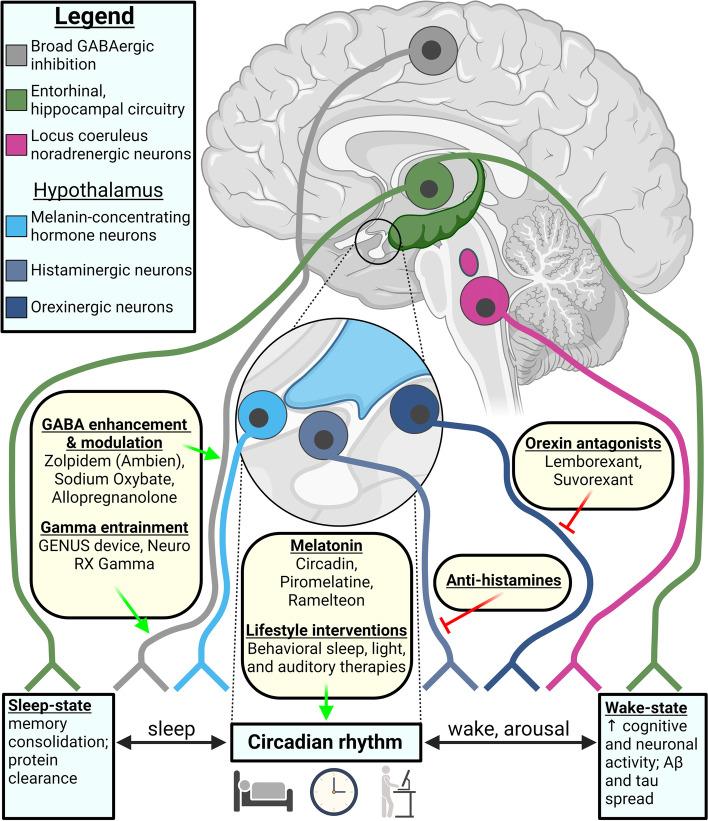
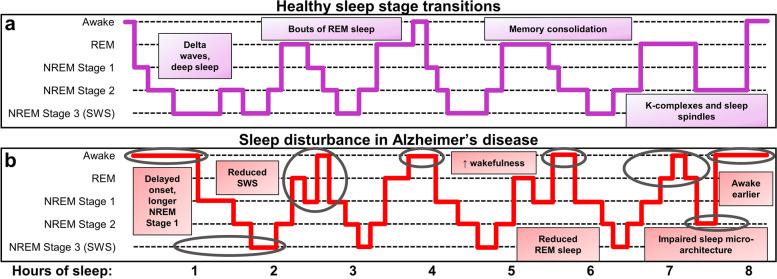
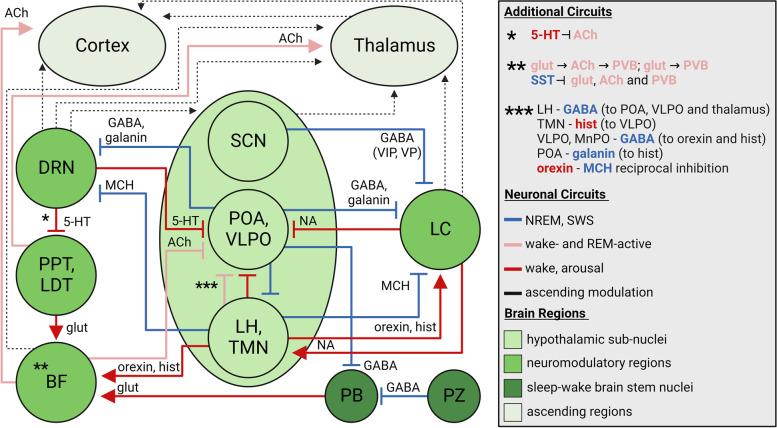
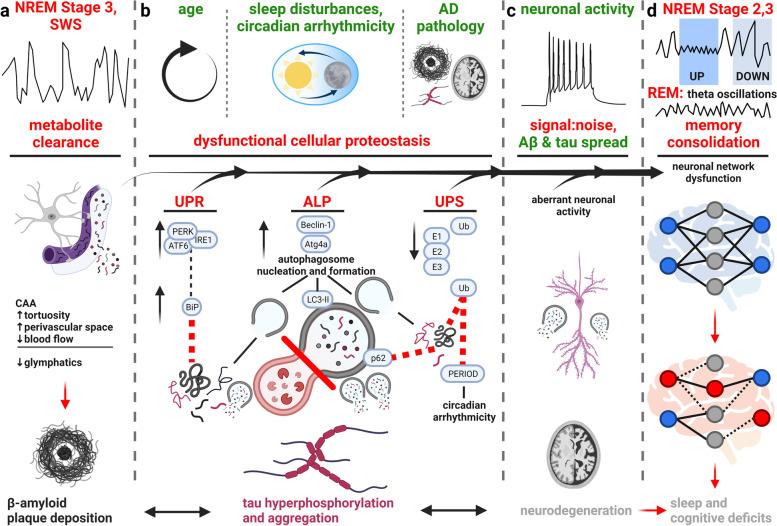
Failed proteostasis is a well-documented feature of Alzheimer's disease, particularly, reduced protein degradation and clearance. However, the contribution of failed proteostasis to neuronal circuit dysfunction is an emerging concept in neurodegenerative research and will prove critical in understanding cognitive decline. Our objective is to convey Alzheimer's disease progression with the growing evidence for a bidirectional relationship of sleep disruption and proteostasis failure. Proteostasis dysfunction and tauopathy in Alzheimer's disease disrupts neurons that regulate the sleep-wake cycle, which presents behavior as impaired slow wave and rapid eye movement sleep patterns. Subsequent sleep loss further impairs protein clearance. Sleep loss is a defined feature seen early in many neurodegenerative disorders and contributes to memory impairments in Alzheimer's disease. Canonical pathological hallmarks, β-amyloid, and tau, directly disrupt sleep, and neurodegeneration of locus coeruleus, hippocampal and hypothalamic neurons from tau proteinopathy causes disruption of the neuronal circuitry of sleep. Acting in a positive-feedback-loop, sleep loss and circadian rhythm disruption then increase spread of β-amyloid and tau, through impairments of proteasome, autophagy, unfolded protein response and glymphatic clearance. This phenomenon extends beyond β-amyloid and tau, with interactions of sleep impairment with the homeostasis of TDP-43, α-synuclein, FUS, and huntingtin proteins, implicating sleep loss as an important consideration in an array of neurodegenerative diseases and in cases of mixed neuropathology. Critically, the dynamics of this interaction in the neurodegenerative environment are not fully elucidated and are deserving of further discussion and research. Finally, we propose sleep-enhancing therapeutics as potential interventions for promoting healthy proteostasis, including β-amyloid and tau clearance, mechanistically linking these processes. With further clinical and preclinical research, we propose this dynamic interaction as a diagnostic and therapeutic framework, informing precise single- and combinatorial-treatments for Alzheimer's disease and other brain disorders.
蛋白质稳态的失败是阿尔茨海默病的一个有充分记录的特征,特别是蛋白质降解和清除的减少。然而,蛋白质稳态的失败对神经元回路功能障碍的贡献是神经退行性研究中的一个新兴概念,并将证明对理解认知能力下降至关重要。我们的目标是传达阿尔茨海默病的进展,以及睡眠中断和蛋白质稳态失败之间的双向关系的证据越来越多。阿尔茨海默病中的蛋白质稳态功能障碍和 tau 病会破坏调节睡眠-觉醒周期的神经元,这表现为睡眠慢波和快速眼动睡眠模式受损。随后的睡眠不足进一步损害蛋白质清除。睡眠不足是许多神经退行性疾病早期的一个明确特征,并导致阿尔茨海默病的记忆障碍。经典的病理特征β-淀粉样蛋白和 tau 直接扰乱睡眠,tau 蛋白病引起蓝斑、海马和下丘脑神经元的神经退行性变,导致睡眠神经元回路的破坏。在正反馈循环中,睡眠不足和昼夜节律紊乱通过损害蛋白酶体、自噬、未折叠蛋白反应和糖质清除来增加β-淀粉样蛋白和 tau 的传播。这种现象不仅限于β-淀粉样蛋白和 tau,睡眠障碍与 TDP-43、α-突触核蛋白、FUS 和亨廷顿蛋白的内稳态相互作用,表明睡眠不足是多种神经退行性疾病和混合神经病理学病例中的一个重要考虑因素。至关重要的是,这种相互作用在神经退行性环境中的动态尚未完全阐明,值得进一步讨论和研究。最后,我们提出了增强睡眠的治疗方法作为促进健康蛋白质稳态的潜在干预措施,包括β-淀粉样蛋白和 tau 的清除,从机制上联系这些过程。随着进一步的临床和临床前研究,我们提出了这种动态相互作用作为诊断和治疗框架,为阿尔茨海默病和其他大脑疾病的单一和组合治疗提供信息。
 Zotero 插件