
针对澳大利亚成年2型糖尿病患者的手机短信干预措施的经济学评估。
Economic evaluation of a mobile phone text-message intervention for Australian adults with type 2 diabetes.
作者信息
Waller Karen A, Killedar Anagha A, Furber Susan E, Tan Eng J, Gibson Alice A, Bauman Adrian E, Hayes Alison J
机构信息
Health Promotion Service, Illawarra Shoalhaven Local Health District, Wollongong, NSW, Australia.
School of Health and Society, University of Wollongong, Wollongong, NSW, Australia.
出版信息
Mhealth. 2023 Mar 2;9:12. doi: 10.21037/mhealth-22-26. eCollection 2023.
BACKGROUND
The rising prevalence of type 2 diabetes in Australia is a public health concern, contributing to significant disease burden and economic costs. Text-message programs have been shown to improve health outcomes for people with type 2 diabetes, however they remain underutilized, and no evidence exists on their cost-effectiveness or costs of scale up to a population level in Australia. This study aimed to determine the cost-effectiveness and cost-utility of a 6-month text-message intervention (DTEXT) to improve glycated hemoglobin (HbA1c) and self-management behaviors for Australian adults with type 2 diabetes.
METHODS
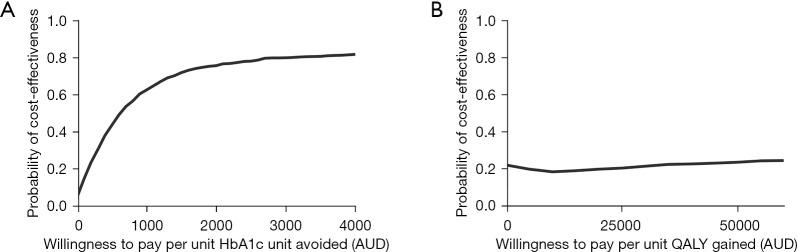
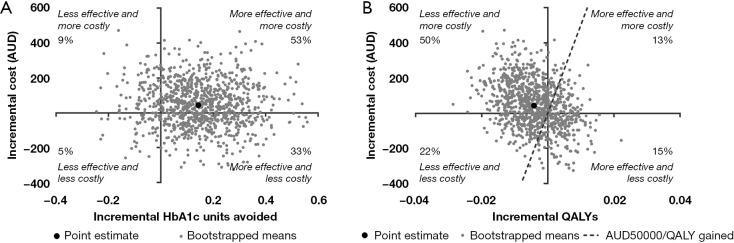
A within-trial economic evaluation was conducted on the DTEXT randomized controlled trial. Incremental cost-effectiveness ratios (ICERs) were determined per 11 mmol/mol (1%) reduced HbA1c and per quality adjusted life year (QALY) gained, compared to usual care. Cost-effectiveness acceptability curves (CEAC) determined the probability of the intervention being cost-effective over a range of willingness to pay thresholds. A scenario analysis was conducted to determine how cost-effectiveness was impacted by using current implementation costs.
RESULTS
The DTEXT intervention cost AU$36 (INT$24) per participant, with an ICER of AU$311 (INT$211) per 11 mmol/mol (1%) reduced HbA1c. Based on HbA1c outcomes, DTEXT had a 33% probability of being effective and cost-saving. Based on the QALY outcomes, the intervention had only a 24% probability of being cost-effective. Scenario analysis indicated costs per participant of AU$13 (INT$9) to deliver the intervention, with a reduced incremental cost effectiveness ratio of AU$151 (INT$103) per 11 mmol/mol (1%) reduced HbA1c and a 38% probability of being effective and cost-saving.
CONCLUSIONS
DTEXT was low cost and potentially scalable, but only had a low to moderate probability of being effective and cost saving. Further research should determine more targeted approaches that may improve cost-effectiveness.
TRIAL REGISTRATION
ACTRN12617000416392.
背景
澳大利亚2型糖尿病患病率不断上升,这是一个公共卫生问题,会导致重大的疾病负担和经济成本。短信干预项目已被证明能改善2型糖尿病患者的健康状况,然而其使用率仍然较低,且在澳大利亚,尚无证据表明其成本效益或扩大至人群层面的成本情况。本研究旨在确定一项为期6个月的短信干预措施(DTEXT)对改善澳大利亚2型糖尿病成年患者糖化血红蛋白(HbA1c)及自我管理行为的成本效益和成本效用。
方法
对DTEXT随机对照试验进行试验内经济评估。与常规护理相比,计算每降低11 mmol/mol(1%)的HbA1c以及每获得一个质量调整生命年(QALY)的增量成本效益比(ICER)。成本效益可接受性曲线(CEAC)确定了在一系列支付意愿阈值范围内干预措施具有成本效益的概率。进行了情景分析,以确定使用当前实施成本对成本效益的影响。
结果
DTEXT干预措施每位参与者的成本为36澳元(24美元),每降低11 mmol/mol(1%)的HbA1c的ICER为311澳元(211美元)。基于HbA1c结果,DTEXT有33%的概率既有效又能节省成本。基于QALY结果,该干预措施具有成本效益的概率仅为24%。情景分析表明,实施干预措施每位参与者的成本为13澳元(9美元),每降低11 mmol/mol(1%)的HbA1c的增量成本效益比降低至151澳元(103美元),且有38%的概率既有效又能节省成本。
结论
DTEXT成本较低且可能具有可扩展性,但仅具有较低至中等的概率既有效又能节省成本。进一步的研究应确定可能提高成本效益的更具针对性的方法。
试验注册号
ACTRN12617000416392。
 Zotero 插件