
tau 失调在亨廷顿病中的意义及新疗法的潜力
Implications of Tau Dysregulation in Huntington's Disease and Potential for New Therapeutics.
机构信息
Florey Institute of Neuroscience and Mental Health, Melbourne Brain Centre, University of Melbourne, Parkville, Australia.
Faculty of Medicine, Dentistry and Health Sciences, University of Melbourne, Parkville, Australia.
出版信息
J Huntingtons Dis. 2023;12(1):1-13. doi: 10.3233/JHD-230569.
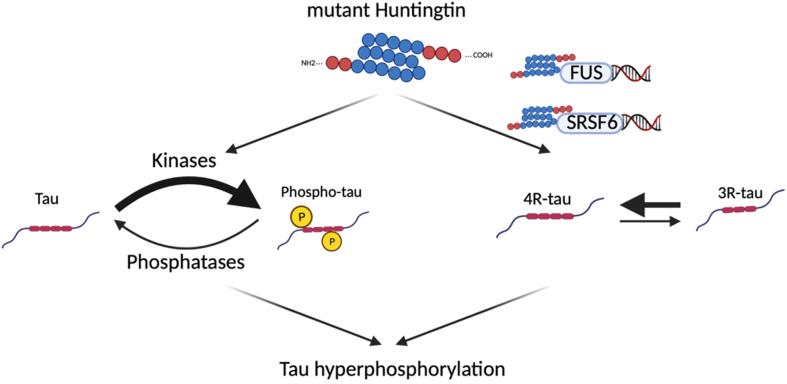
Huntington's disease (HD) is an autosomal dominant neurodegenerative disorder. The disease, characterized by motor, cognitive, and psychiatric impairments, is caused by the expansion of a CAG repeat in the huntingtin gene. Despite the discovery of the mutation in 1993, no disease-modifying treatments are yet available. Understanding the molecular and cellular mechanisms involved in HD is therefore crucial for the development of novel treatments. Emerging research has found that HD might be classified as a secondary tauopathy, with the presence of tau insoluble aggregates in late HD. Increased total tau protein levels have been observed in both HD patients and animal models of HD. Tau hyperphosphorylation, the main feature of tau pathology, has also been investigated and our own published results suggest that the protein phosphorylation machinery is dysregulated in the early stages of HD in R6/1 transgenic mice, primarily in the cortex and striatum. Protein phosphorylation, catalysed by kinases, regulates numerous cellular mechanisms and has been shown to be dysregulated in other neurodegenerative disorders, including Alzheimer's disease. While it is still unclear how the mutation in the huntingtin gene leads to tau dysregulation in HD, several hypotheses have been explored. Evidence suggests that the mutant huntingtin does not directly interact with tau, but instead interacts with tau kinases, phosphatases, and proteins involved in tau alternative splicing, which could result in tau dysregulation as observed in HD. Altogether, there is increasing evidence that tau is undergoing pathological changes in HD and may be a good therapeutic target.
亨廷顿病(HD)是一种常染色体显性神经退行性疾病。该疾病的特征是运动、认知和精神障碍,由亨廷顿基因中的 CAG 重复扩展引起。尽管该突变于 1993 年被发现,但目前尚无疾病修饰治疗方法。因此,了解 HD 中涉及的分子和细胞机制对于开发新的治疗方法至关重要。新兴研究发现,HD 可能被归类为继发性 tau 病,在晚期 HD 中存在 tau 不溶性聚集体。在 HD 患者和 HD 动物模型中均观察到总 tau 蛋白水平升高。tau 过度磷酸化是 tau 病理学的主要特征,也进行了研究,我们自己的发表结果表明,在 R6/1 转基因小鼠的 HD 早期,蛋白磷酸化机制主要在皮质和纹状体中失调。蛋白磷酸化由激酶催化,调节许多细胞机制,并已在其他神经退行性疾病中显示出失调,包括阿尔茨海默病。虽然目前尚不清楚亨廷顿基因中的突变如何导致 HD 中的 tau 失调,但已经探索了几种假设。有证据表明,突变型亨廷顿蛋白不会直接与 tau 相互作用,而是与 tau 激酶、磷酸酶以及参与 tau 选择性剪接的蛋白相互作用,这可能导致如在 HD 中观察到的 tau 失调。总之,越来越多的证据表明 tau 在 HD 中发生病理性变化,可能是一个很好的治疗靶点。
 Zotero 插件