
群体增强是面对环境不稳定时复杂社会性进化的基础。
Group augmentation underlies the evolution of complex sociality in the face of environmental instability.
机构信息
Department of Ecology, Evolution, and Environmental Biology, Columbia University, New York, NY 10027.
Center for Integrative Animal Behavior, Columbia University, New York, NY 10027.
出版信息
Proc Natl Acad Sci U S A. 2023 May 2;120(18):e2212211120. doi: 10.1073/pnas.2212211120. Epub 2023 Apr 24.
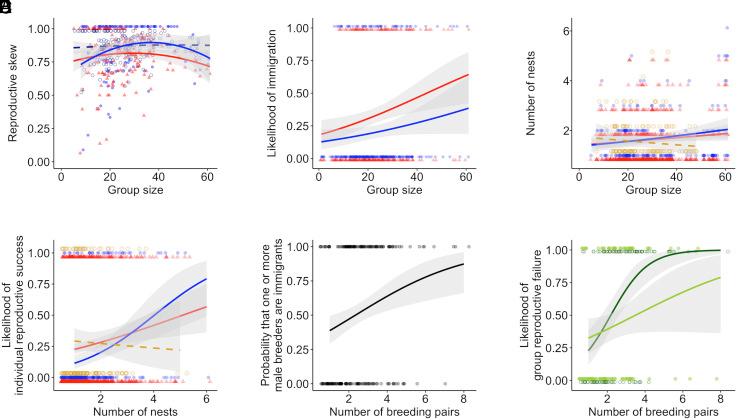
Although kin selection is assumed to underlie the evolution of sociality, many vertebrates-including nearly half of all cooperatively breeding birds-form groups that also include unrelated individuals. Theory predicts that despite reducing kin structure, immigration of unrelated individuals into groups can provide direct, group augmentation benefits, particularly when offspring recruitment is insufficient for group persistence. Using population dynamic modeling and analysis of long-term data, we provide clear empirical evidence of group augmentation benefits favoring the evolution and maintenance of complex societies with low kin structure and multiple reproductives. We show that in the superb starling ()-a plural cooperative breeder that forms large groups with multiple breeding pairs, and related and unrelated nonbreeders of both sexes-offspring recruitment alone cannot prevent group extinction, especially in smaller groups. Further, smaller groups, which stand to benefit more from immigration, exhibit lower reproductive skew for immigrants, suggesting that reproductive opportunities as joining incentives lead to plural breeding. Yet, despite a greater likelihood of becoming a breeder in smaller groups, immigrants are more likely to join larger groups where they experience increased survivorship and greater reproductive success as breeders. Moreover, immigrants form additional breeding pairs, increasing future offspring recruitment into the group and guarding against complete reproductive failure in the face of environmental instability and high nest predation. Thus, plural breeding likely evolves because the benefits of group augmentation by immigrants generate a positive feedback loop that maintains societies with low and mixed kinship, large group sizes, and multiple reproductives.
尽管亲属选择被认为是社会性进化的基础,但许多脊椎动物——包括近一半的所有合作繁殖的鸟类——形成的群体中也包括无亲缘关系的个体。理论预测,尽管减少了亲缘结构,但无亲缘关系的个体向群体的移民可以提供直接的、群体增强的利益,特别是当后代招募不足以维持群体生存时。我们使用群体动态建模和长期数据分析,为具有低亲缘结构和多个繁殖者的复杂社会的进化和维持提供了明确的实证证据,表明群体增强的利益有利于这种进化和维持。我们表明,在超级八哥()——一种形成具有多个繁殖对的大型群体的多元合作繁殖者,以及具有两性相关和无关的非繁殖者——仅靠后代招募无法防止群体灭绝,特别是在较小的群体中。此外,较小的群体从移民中获益更多,因此对移民的繁殖优势较低,这表明繁殖机会作为加入的激励因素导致了多元繁殖。然而,尽管在较小的群体中更有可能成为繁殖者,但移民更有可能加入更大的群体,在那里他们作为繁殖者获得更高的存活率和更大的繁殖成功。此外,移民会形成额外的繁殖对,增加未来进入群体的后代招募,并在面对环境不稳定和巢捕食率高时防止繁殖完全失败。因此,多元繁殖可能是因为移民的群体增强的好处产生了正反馈循环,从而维持了具有低和混合亲缘关系、大群体规模和多个繁殖者的社会。


 Zotero 插件