
人工关节置换术前阿片类药物处方和开具者有何变化?一项大型全国注册研究。
What Changes Have Occurred in Opioid Prescriptions and the Prescribers of Opioids Before TKA and THA? A Large National Registry Study.
机构信息
Department of Orthopaedics, Leiden University Medical Center, Leiden, the Netherlands.
Department of Clinical Epidemiology, Leiden University Medical Center, Leiden, the Netherlands.
出版信息
Clin Orthop Relat Res. 2023 Sep 1;481(9):1716-1728. doi: 10.1097/CORR.0000000000002653. Epub 2023 Apr 26.
BACKGROUND
Opioid use before TKA or THA is linked to a higher risk of revision surgery and less functional improvement. In Western countries, the frequency of preoperative opioid use has varied, and robust information on temporal changes in opioid prescriptions over time (in the months before surgery as well as annual changes) and among prescribers is necessary to pinpoint opportunities to improve on low-value care patterns, and when they are recognized, to target physician populations for intervention strategies.
QUESTIONS/PURPOSES: (1) What proportion of patients undergoing arthroplasties receive an opioid prescription in the year before TKA or THA, and what were the preoperative opioid prescription rates over time between 2013 and 2018? (2) Does the preoperative prescription rate vary between 12 and 10 months and between 3 and 1 months in the year before TKA or THA, and did it change between 2013 and 2018? (3) Which medical professionals were the main prescribers of preoperative opioids 1 year before TKA or THA?
METHODS
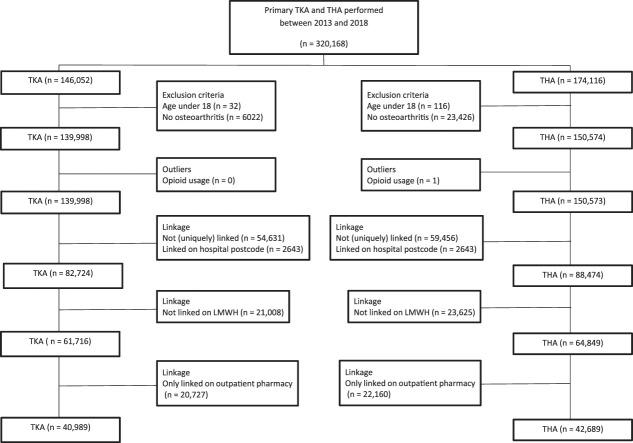
This was a large-database study drawn from longitudinally maintained national registry sources in the Netherlands. The Dutch Foundation for Pharmaceutical Statistics was linked to the Dutch Arthroplasty Register from 2013 to 2018. TKAs and THAs performed because of osteoarthritis in patients older than 18 years, which were also uniquely linked by age, gender, patient postcode, and low-molecular weight heparin use, were eligible. Between 2013 and 2018, 146,052 TKAs were performed: 96% (139,998) of the TKAs were performed for osteoarthritis in patients older than 18 years; of them, 56% (78,282) were excluded because of our linkage criteria. Some of the linked arthroplasties could not be linked to a community pharmacy, which was necessary to follow patients over time, leaving 28% (40,989) of the initial TKAs as our study population. Between 2013 and 2018, 174,116 THAs were performed: 86% (150,574) were performed for osteoarthritis in patients older than 18 years, one arthroplasty was excluded because of an outlier opioid dose, and a further 57% (85,724 of 150,574) were excluded because of our linkage criteria. Some of the linked arthroplasties could not be linked to a community pharmacy, leaving 28% (42,689 of 150,574) of THAs, which were performed between 2013 and 2018. For both TKA and THA, the mean age before surgery was 68 years, and roughly 60% of the population were women. We calculated the proportion of patients undergoing arthroplasties who had at least one opioid prescription in the year before arthroplasty and compared data from 2013 to 2018. Opioid prescription rates are given as defined daily dosages and morphine milligram equivalents (MMEs) per arthroplasty. Opioid prescriptions were assessed by preoperative quarter and by operation year. Possible changes over time in opioid exposure were investigated using linear regression, adjusted for age and gender, in which the month of operation since January 2013 was used as the determinant and MME as the outcome. This was done for all opioids combined and per opioid type. Possible changes in opioid prescription rates in the year before arthroplasty were assessed by comparing the time period of 1 to 3 months before surgery with the other quarters. Additionally, preoperative prescriptions per operation year were assessed per prescriber category: general practitioners, orthopaedic surgeons, rheumatologists, and others. All analyses were stratified by TKA or THA.
RESULTS
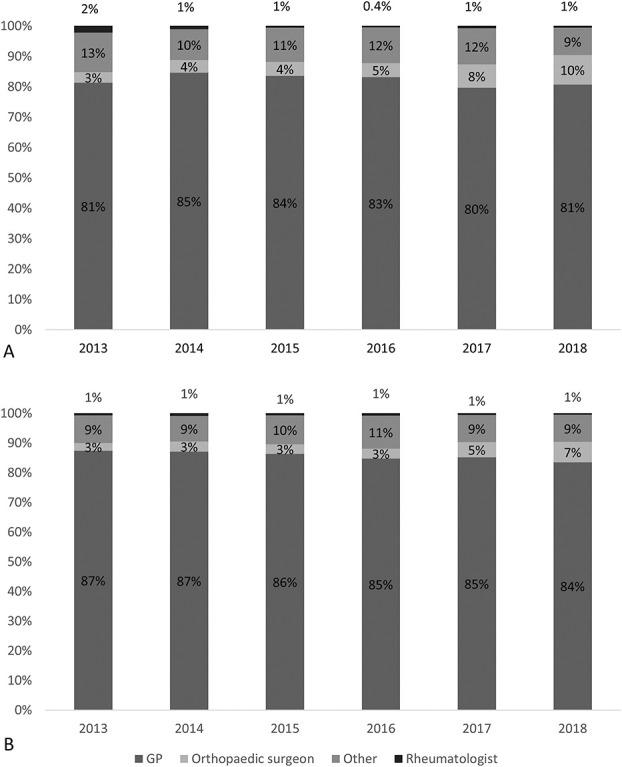
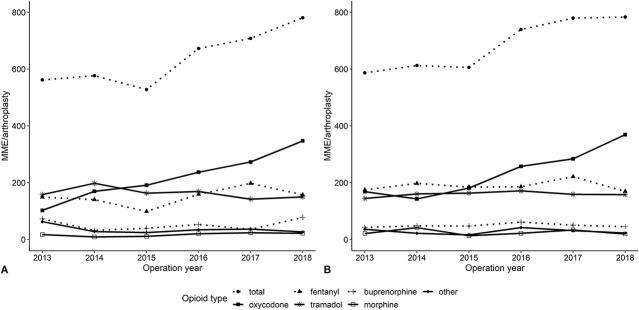
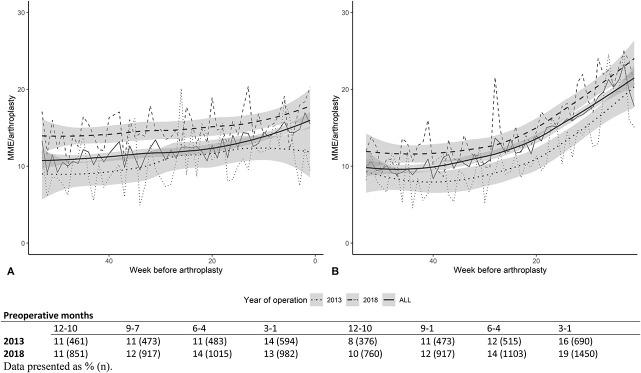
The proportion of patients undergoing arthroplasties who had an opioid prescription before TKA increased from 25% (1079 of 4298) in 2013 to 28% (2097 of 7460) in 2018 (difference 3% [95% CI 1.35% to 4.65%]; p < 0.001), and before THA increased from 25% (1111 to 4451) to 30% (2323 to 7625) (difference 5% [95% CI 3.8% to 7.2%]; p < 0.001). The mean preoperative opioid prescription rate increased over time between 2013 and 2018 for both TKA and THA. For TKA, an adjusted monthly increase of 3.96 MME was observed (95% CI 1.8 to 6.1 MME; p < 0.001). For THA, the monthly increase was 3.8 MME (95% CI 1.5 to 6.0; p = 0.001. For both TKA and THA, there was a monthly increase in the preoperative oxycodone rate (3.8 MME [95% CI 2.5 to 5.1]; p < 0.001 and 3.6 [95% CI 2.6 to 4.7]; p < 0.001, respectively). For TKA, but not for THA, there was a monthly decrease in tramadol prescriptions (-0.6 MME [95% CI -1.0 to -0.2]; p = 0.006). Regarding the opioids prescribed in the year before surgery, there was a mean increase of 48 MME (95% CI 39.3 to 56.7 MME; p < 0.001) for TKA between 10 and 12 months and the last 3 months before surgery. For THA, this increase was 121 MME (95% CI 110 to 131 MME; p < 0.001). Regarding possible differences between 2013 and 2018, we only found differences in the period 10 to 12 months before TKA (mean difference 61 MME [95% CI 19.2 to 103.3]; p = 0.004) and the period 7 to 9 months before TKA (mean difference 66 MME [95% CI 22.0 to 110.9]; p = 0.003). For THA, there was an increase in the MMEs prescribed between 2013 and 2018 for all four quarters, with mean differences ranging from 43.9 to 55.4 MME (p < 0.05). The average proportion of preoperative opioid prescriptions prescribed by general practitioners ranged between 82% and 86% (41,037 of 49,855 for TKA and 49,137 of 57,289 for THA), between 4% and 6% (2924 of 49,855 for TKA and 2461 of 57,289 for THA), by orthopaedic surgeons, 1% by rheumatologists (409 of 49,855 for TKA and 370 of 57,289 for THA), and between 9% and 11% by other physicians (5485 of 49,855 for TKA and 5321 of 57,289 for THA). Prescriptions by orthopaedic surgeons increased over time, from 3% to 7% for THA (difference 4% [95% CI 3.6 to 4.9]) and 4% to 10% for TKA (difference 6% [95% CI 5% to 7%]; p < 0.001).
CONCLUSION
Between 2013 and 2018, preoperative opioid prescriptions increased in the Netherlands, mainly because of a shift to more oxycodone prescriptions. We also observed an increase in opioid prescriptions in the year before surgery. Although general practitioners were the main prescribers of preoperative oxycodone, prescriptions by orthopaedic surgeons also increased during the study period. Orthopaedic surgeons should address opioid use and its associated negative effects in preoperative consultations. More intradisciplinary collaboration seems important to limit the prescribing of preoperative opioids. Additionally, research is necessary to assess whether opioid cessation before surgery reduces the risk of adverse outcomes.
LEVEL OF EVIDENCE
Level III, therapeutic study.
背景
在接受 TKA 或 THA 之前使用阿片类药物与更高的翻修手术风险和较少的功能改善相关。在西方国家,术前阿片类药物的使用频率各不相同,因此需要了解有关随时间变化的术前阿片类药物处方(包括手术前几个月和每年的变化)以及处方医师的详细信息,以便发现改善低价值护理模式的机会,并在发现机会时针对干预策略的医师人群。
问题/目的:(1)在 TKA 或 THA 前的一年中,接受关节置换术的患者中有多少比例接受了阿片类药物处方,以及 2013 年至 2018 年期间的术前阿片类药物处方率随时间变化情况如何?(2)术前处方率在 TKA 或 THA 前的 12 至 10 个月和 3 至 1 个月之间是否存在差异,以及 2013 年至 2018 年期间是否存在变化?(3)在 TKA 或 THA 前一年中,哪些医疗专业人员是主要的术前阿片类药物开方者?
方法
这是一项来自荷兰纵向维护的国家登记处数据源的大型数据库研究。荷兰药物统计基金会与荷兰关节置换登记处从 2013 年至 2018 年进行了链接。符合条件的是年龄在 18 岁以上且因骨关节炎而接受 TKA 或 THA 的患者,且患者的年龄、性别、患者邮政编码和低分子肝素使用情况也通过链接进行了唯一匹配。在 2013 年至 2018 年期间,进行了 146,052 例 TKA:96%(139,998 例)的 TKA 是为年龄在 18 岁以上且因骨关节炎而接受治疗的患者进行的;其中 56%(78,282 例)因我们的链接标准而被排除在外。一些链接的关节置换术无法链接到社区药房,这对于随时间跟踪患者是必要的,因此,最初的 40,989 例 TKA 作为我们的研究人群。在 2013 年至 2018 年期间,进行了 174,116 例 THA:86%(150,574 例)是为年龄在 18 岁以上且因骨关节炎而接受治疗的患者进行的,由于阿片类药物剂量异常,排除了 1 例,另外 57%(85,724 例)因我们的链接标准而被排除在外。一些链接的关节置换术无法链接到社区药房,因此,在 2013 年至 2018 年期间,作为我们的研究人群,进行了 42,689 例 THA。对于 TKA 和 THA,手术前的平均年龄均为 68 岁,且大约 60%的患者为女性。我们计算了在关节置换术前至少有一次阿片类药物处方的患者比例,并比较了 2013 年至 2018 年的数据。阿片类药物处方率以定义日剂量和吗啡毫克当量(MME)表示,每例关节置换术。阿片类药物处方通过术前四分之一和手术年度进行评估。使用线性回归调查了随时间变化的阿片类药物暴露情况,调整了年龄和性别,将手术以来的月份作为自变量,MME 作为因变量。这是对所有阿片类药物合并以及每种阿片类药物类型分别进行的。通过比较手术前 3 个月与其他季度的时间,评估了关节置换术前一年的阿片类药物处方率的变化。另外,还根据每个手术年度的每个处方医师类别(全科医生、矫形外科医生、风湿病医生和其他医生)评估了每个手术年度的术前阿片类药物处方。所有分析均按 TKA 或 THA 进行分层。
结果
接受 TKA 的患者中,在 2013 年有 25%(1079 例)接受阿片类药物处方,而在 2018 年增加到 28%(2097 例)(差异 3%[95%CI 1.35%至 4.65%];p<0.001),接受 THA 的患者中,在 2013 年有 25%(1111 例)接受阿片类药物处方,而在 2018 年增加到 30%(2323 例)(差异 5%[95%CI 3.8%至 7.2%];p<0.001)。TKA 和 THA 的术前阿片类药物处方率均随时间增加。对于 TKA,每月观察到 3.96 MME 的调整后增加(95%CI 1.8 至 6.1 MME;p<0.001)。对于 THA,每月增加 3.8 MME(95%CI 1.5 至 6.0;p=0.001)。对于 TKA 和 THA,术前羟考酮的月处方率均增加(3.8 MME[95%CI 2.5 至 5.1];p<0.001 和 3.6 [95%CI 2.6 至 4.7];p<0.001,分别)。对于 TKA,但不是 THA,曲马多的处方每月减少(-0.6 MME[95%CI -1.0 至 -0.2];p=0.006)。关于手术前一年开具的阿片类药物,TKA 患者在手术前 10 至 12 个月和最后 3 个月之间的 MME 增加了 48(95%CI 39.3 至 56.7 MME;p<0.001),THA 患者的 MME 增加了 121(95%CI 110 至 131 MME;p<0.001)。关于 2013 年至 2018 年之间的差异,我们仅在 TKA 前 10 至 12 个月(平均差异 61 MME[95%CI 19.2 至 103.3];p=0.004)和 TKA 前 7 至 9 个月(平均差异 66 MME[95%CI 22.0 至 110.9];p=0.003)期间发现差异。对于 THA,在 2013 年至 2018 年期间,所有四个季度的 MME 处方均增加,平均差异范围从 43.9 至 55.4 MME(p<0.05)。术前开阿片类药物处方的全科医生的平均比例在 TKA 为 82%至 86%(41,037 例/49,855 例),在 THA 为 4%至 6%(2924 例/57,289 例),矫形外科医生为 1%(409 例/49,855 例),风湿病医生为 9%至 11%(5485 例/49,855 例)。在 TKA 和 THA 中,开阿片类药物处方的比例随时间增加,矫形外科医生的比例从 3%增加到 7%(差异 4%[95%CI 3.6 至 4.9]),从 4%增加到 10%(差异 6%[95%CI 5%至 7%]);p<0.001)。
结论
在 2013 年至 2018 年期间,荷兰的术前阿片类药物处方增加,主要是由于更倾向于开羟考酮处方。我们还观察到手术前一年的阿片类药物处方增加。尽管全科医生是主要的术前开羟考酮处方者,但在研究期间,矫形外科医生的处方也有所增加。矫形外科医生应该在术前咨询中关注阿片类药物的使用及其相关的负面影响。更多的跨学科合作似乎对于限制术前阿片类药物的开具很重要。此外,还需要研究是否在术前停用阿片类药物可以降低不良结局的风险。
证据水平
三级,治疗性研究。
 Zotero 插件