
年龄相关的肠道黏液屏障功能障碍与结肠 Muc2 黏蛋白的变化有关。
Age-Related Mucus Barrier Dysfunction in Mice Is Related to the Changes in Muc2 Mucin in the Colon.
机构信息
College of Food Science and Engineering, Gansu Agricultural University, Lanzhou 730070, China.
The Key Laboratory of Geriatrics, Beijing Institute of Geriatrics, Institute of Geriatric Medicine, Chinese Academy of Medical Sciences, Beijing Hospital/National Center of Gerontology of National Health Commission, Beijing 100730, China.
出版信息
Nutrients. 2023 Apr 11;15(8):1830. doi: 10.3390/nu15081830.
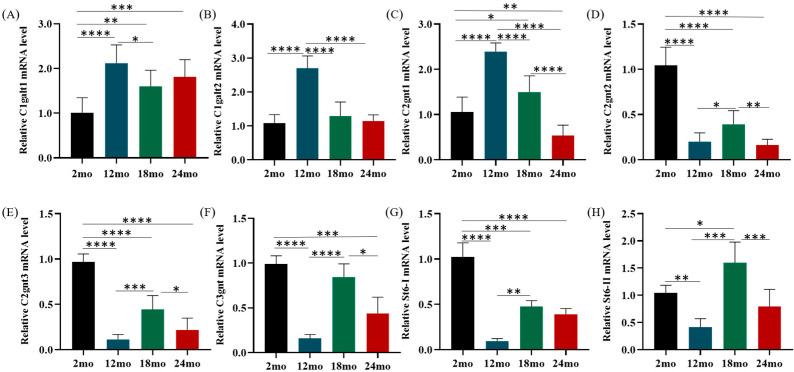
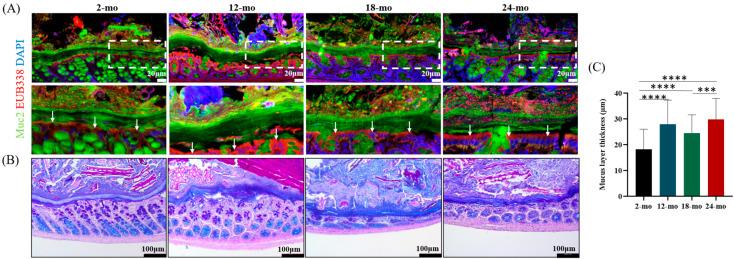
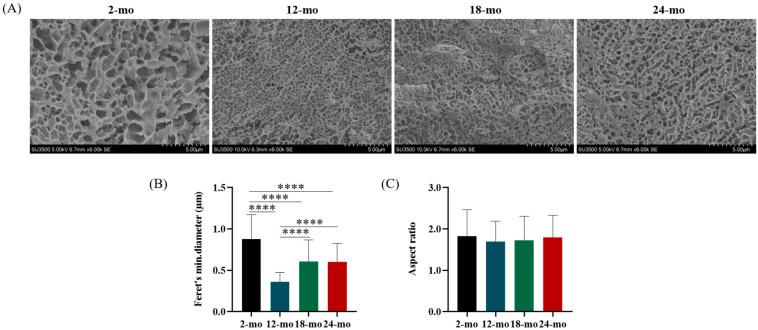
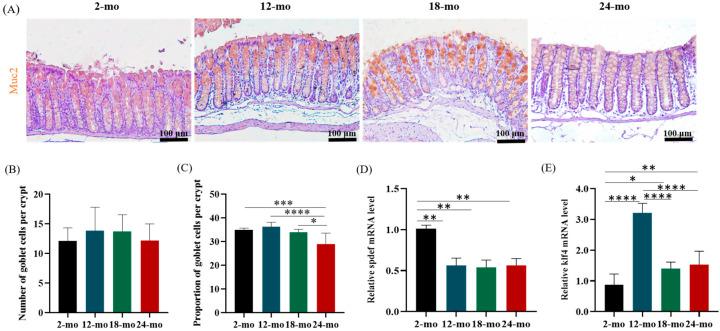
During aging, the protective function of mucus barrier is significantly reduced among which changes in colonic mucus barrier function received the most attention. Additionally, the incidence of colon-related diseases increases significantly in adulthood, posing a threat to the health of the elderly. However, the specific changes in colonic mucus barrier with aging and the underlying mechanisms have not been fully elucidated. To understand the effects of aging on the colonic mucus barrier, changes in the colonic mucus layer were evaluated in mice aged 2, 12, 18, and 24 months. Microbial invasion, thickness, and structure of colonic mucus in mice at different months of age were analyzed by in situ hybridization fluorescence staining, AB/PAS staining, and cryo-scanning electron microscopy. Results showed that the aged colon exhibited intestinal mucus barrier dys-function and altered mucus properties. During aging, microorganisms invaded the mucus layer to reach epithelial cells. Compared with young mice, the thickness of mucus layer in aged mice in-creased by 11.66 μm. And the contents of the main components and glycosylation structure of colon changed. Among them, the proportion of goblet cells decreased significantly in older mice, and the expression of spdef genes that regulate goblet cell differentiation decreased. Further, the expression of key enzymes involved in mucin core structure formation and glycan modification also changed with aging. The expression of core 1 β1,3-galactosyltransferase (C1GalT1) which is the key enzyme forming the main core structure increased by one time, while core 2 β1,6 N-acetylglucosaminyltransferase (C2GnT) and core 3 β1,3 N-acetylglucosaminyltransferase (C3GnT) decreased 2 to 6- and 2-fold, respectively. Also, the expression of sialyltransferase, one of the mucin-glycan modifying enzymes, was decreased by 1-fold. Overall, our results indicate that the goblet cells/glycosyltransferase/O-glycan axis plays an important role in maintaining the physicochemical properties of colonic mucus and the stability of intestinal environment.
随着衰老的发生,黏液屏障的保护功能显著降低,其中结肠黏液屏障功能的变化受到了最多的关注。此外,成年后与结肠相关的疾病的发病率显著增加,对老年人的健康构成威胁。然而,衰老对结肠黏液屏障的具体影响及其潜在机制尚未完全阐明。为了了解衰老对结肠黏液屏障的影响,评估了 2、12、18 和 24 月龄的小鼠结肠黏液层的变化。通过原位杂交荧光染色、AB/PAS 染色和冷冻扫描电子显微镜分析了不同月龄小鼠结肠黏液的微生物入侵、厚度和结构。结果表明,衰老的结肠表现出肠道黏液屏障功能障碍和黏液特性改变。随着衰老,微生物侵入黏液层到达上皮细胞。与年轻小鼠相比,老年小鼠的黏液层厚度增加了 11.66μm。并且结肠的主要成分和糖基化结构的含量发生了变化。其中,老年小鼠的杯状细胞比例显著下降,调节杯状细胞分化的 spdef 基因表达下降。此外,参与黏蛋白核心结构形成和聚糖修饰的关键酶的表达也随着衰老而改变。形成主要核心结构的关键酶核心 1β1,3-半乳糖基转移酶(C1GalT1)的表达增加了 1 倍,而核心 2β1,6-N-乙酰氨基葡萄糖基转移酶(C2GnT)和核心 3β1,3-N-乙酰氨基葡萄糖基转移酶(C3GnT)则分别减少了 2 至 6 倍和 2 倍。同样,黏蛋白糖基化修饰酶之一唾液酸转移酶的表达减少了 1 倍。总的来说,我们的研究结果表明,杯状细胞/糖基转移酶/O-聚糖轴在维持结肠黏液的理化性质和肠道环境的稳定性方面起着重要作用。


 Zotero 插件