
PD-1/PD-L1抑制剂联合化疗与单纯化疗治疗晚期胃或胃食管交界腺癌的疗效和安全性:一项系统评价和荟萃分析
Efficacy and safety of PD-1/PD-L1 inhibitor combined with chemotherapy versus chemotherapy alone in the treatment of advanced gastric or gastroesophageal junction adenocarcinoma: a systematic review and meta-analysis.
作者信息
Liu Bo-Wei, Shang Qi-Xing, Yang Yu-Shang, Chen Long-Qi
机构信息
Department of Thoracic Surgery, West China Hospital of Sichuan University, Chengdu, Sichuan, China.
出版信息
Front Oncol. 2023 Apr 11;13:1077675. doi: 10.3389/fonc.2023.1077675. eCollection 2023.
BACKGROUND
There is increasing evidence that immunotherapy (programmed cell death-1 (PD-1) inhibitor) combined with chemotherapy is superior to chemotherapy alone in neoadjuvant therapy for patients with previously untreated, unresectable advanced, or metastatic esophageal adenocarcinoma (EAC)/gastric/gastroesophageal junction adenocarcinoma (GEA). However, the results of recent studies have been contradictory. Therefore, the aim of this article is to evaluate the efficacy and safety of PD-1 inhibitors combined with chemotherapy in neoadjuvant therapy through meta-analysis.
METHOD
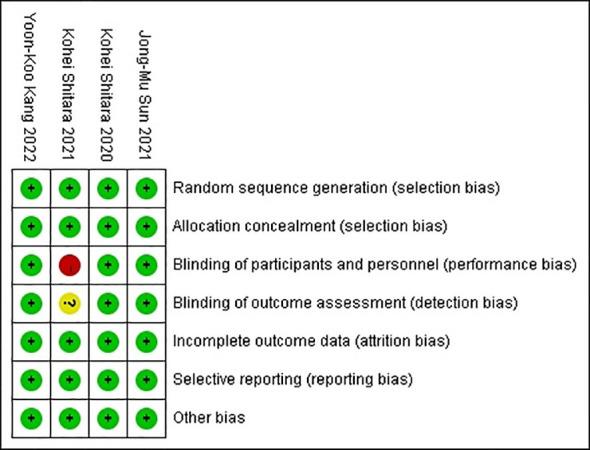
We comprehensively reviewed the literature and clinical randomized controlled trials (RCTs) by February 2022 by searching Medical Subject Headings (MeSH) and keywords such as "esophageal adenocarcinoma" or "immunotherapy" in several databases, including the Embase, Cochrane, PubMed, and ClinicalTrials.gov websites. Two authors independently selected studies, extracted data, and assessed the risk of bias and quality of evidence by using standardized Cochrane Methods procedures. The primary outcomes were 1-year overall survival (OS) and 1-year progression-free survival (PFS), estimated by calculating the 95% confidence interval (CI) for the combined odds ratio (OR) and hazard ratio (HR). Secondary outcomes estimated using OR were disease objective response rate (DORR) and incidence of adverse events.
RESULTS
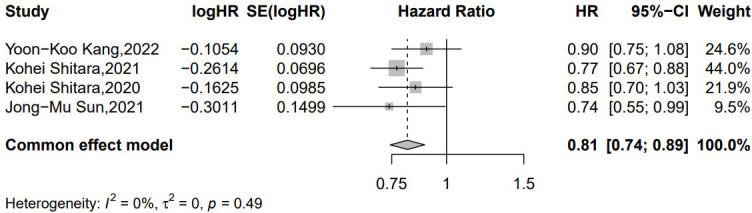
Four RCTs with a total of 3,013 patients researching the efficacy of immunotherapy plus chemotherapy versus chemotherapy alone on gastrointestinal cancer were included in this meta-analysis. The results showed that immune checkpoint inhibitor plus chemotherapy treatment was associated with an increased risk of PFS (HR = 0.76 [95% CI: 0.70-0.83]; p < 0.001), OS (HR = 0.81 [95% CI: 0.74-0.89]; p < 0.001), and DORR (relative ratio (RR) = 1.31 [95% CI: 1.19-1.44]; p < 0.0001) when compared with chemotherapy alone in advanced, unresectable, and metastatic EAC/GEA. However, immunotherapy combined with chemotherapy increased the incidence of adverse reactions such as alanine aminotransferase elevation (OR = 1.55 [95% CI: 1.17-2.07]; p = 0.003) and palmar-plantar erythrodysesthesia (PPE) syndrome (OR = 1.30 [95% CI: 1.05-1.63]; p = 0.02). Nausea (OR = 1.24 [95% CI: 1.07-1.44]; p = 0.005) and white blood cell count decreased (OR = 1.40 [95% CI: 1.13-1.73]; p = 0.002), and so on. Fortunately, toxicities were within acceptable limits. Meanwhile, for patients with a combined positive score (CPS) ≥1, compared with chemotherapy alone, immunotherapy combined with chemotherapy had a better overall survival rate (HR = 0.81 [95% CI: 0.73-0.90]; p = 0.0001).
CONCLUSION
Our study shows that immunotherapy plus chemotherapy has an obvious benefit for patients with previously untreated, unresectable advanced, or metastatic EAC/GEA when compared with chemotherapy alone. However, a high risk of adverse reactions may occur during immunotherapy plus chemotherapy, and more studies focusing on the treatment strategies of untreated, unresectable advanced, or metastatic EAC/GEA are warranted.
SYSTEMATIC REVIEW REGISTRATION
www.crd.york.ac.uk, identifier CRD42022319434.
背景
越来越多的证据表明,在新辅助治疗中,免疫疗法(程序性细胞死亡蛋白1(PD-1)抑制剂)联合化疗优于单纯化疗,适用于既往未治疗、不可切除的晚期或转移性食管腺癌(EAC)/胃癌/胃食管交界腺癌(GEA)患者。然而,近期研究结果相互矛盾。因此,本文旨在通过荟萃分析评估PD-1抑制剂联合化疗在新辅助治疗中的疗效和安全性。
方法
我们通过在多个数据库(包括Embase、Cochrane、PubMed和ClinicalTrials.gov网站)中检索医学主题词(MeSH)以及“食管腺癌”或“免疫疗法”等关键词,全面回顾了截至2022年2月的文献和临床随机对照试验(RCT)。两位作者独立选择研究、提取数据,并使用标准化的Cochrane方法程序评估偏倚风险和证据质量。主要结局为1年总生存期(OS)和1年无进展生存期(PFS),通过计算合并比值比(OR)和风险比(HR)的95%置信区间(CI)进行估计。使用OR估计的次要结局为疾病客观缓解率(DORR)和不良事件发生率。
结果
本荟萃分析纳入了四项共3013例患者的RCT,研究免疫疗法联合化疗与单纯化疗在胃肠道癌中的疗效。结果显示,与单纯化疗相比,免疫检查点抑制剂联合化疗治疗晚期、不可切除和转移性EAC/GEA时,PFS(HR = 0.76 [95% CI:0.70 - 0.83];p < 0.001)、OS(HR = 0.81 [95% CI:0.74 - 0.89];p < 0.001)和DORR(相对比(RR) = 1.31 [95% CI:1.19 - 1.44];p < 0.0001)的风险增加。然而,免疫疗法联合化疗增加了不良反应的发生率,如丙氨酸转氨酶升高(OR = 1.55 [95% CI:1.17 - 2.07];p = 0.003)和手足红斑感觉异常(PPE)综合征(OR = 1.30 [95% CI:1.05 - 1.63];p = 0.02)。恶心(OR = 1.24 [95% CI:1.07 - 1.44];p = 0.005)和白细胞计数降低(OR = 1.40 [95% CI:1.13 - 1.73];p = 0.002)等。幸运的是,毒性在可接受范围内。同时,对于联合阳性评分(CPS)≥1的患者,与单纯化疗相比,免疫疗法联合化疗的总生存率更高(HR = 0.81 [95% CI:0.73 - 0.90];p = 0.0001)。
结论
我们的研究表明,与单纯化疗相比,免疫疗法联合化疗对既往未治疗、不可切除的晚期或转移性EAC/GEA患者有明显益处。然而,免疫疗法联合化疗期间可能会出现较高的不良反应风险,因此有必要开展更多针对未治疗、不可切除的晚期或转移性EAC/GEA治疗策略的研究。
系统评价注册




 Zotero 插件