
社会经济差异与口腔 DNA 甲基化生物老化测量指标的关联。
Associations of socioeconomic disparities with buccal DNA-methylation measures of biological aging.
机构信息
Max Planck Research Group Biosocial - Biology, Social Disparities, and Development, Max Planck Institute for Human Development, Lentzeallee 94, 14195, Berlin, Germany.
Department of Psychology, The University of Texas at Austin, Austin, TX, USA.
出版信息
Clin Epigenetics. 2023 Apr 28;15(1):70. doi: 10.1186/s13148-023-01489-7.
BACKGROUND
Individuals who are socioeconomically disadvantaged are at increased risk for aging-related diseases and perform less well on tests of cognitive function. The weathering hypothesis proposes that these disparities in physical and cognitive health arise from an acceleration of biological processes of aging. Theories of how life adversity is biologically embedded identify epigenetic alterations, including DNA methylation (DNAm), as a mechanistic interface between the environment and health. Consistent with the weathering hypothesis and theories of biological embedding, recently developed DNAm algorithms have revealed profiles reflective of more advanced aging and lower cognitive function among socioeconomically-at-risk groups. These DNAm algorithms were developed using blood-DNA, but social and behavioral science research commonly collect saliva or cheek-swab DNA. This discrepancy is a potential barrier to research to elucidate mechanisms through which socioeconomic disadvantage affects aging and cognition. We therefore tested if social gradients observed in blood DNAm measures could be reproduced using buccal-cell DNA obtained from cheek swabs.
RESULTS
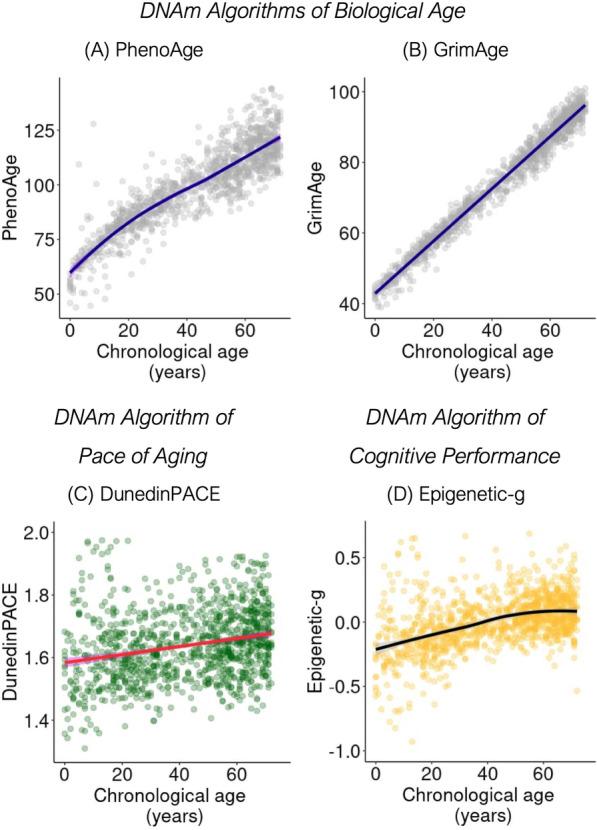
We analyzed three DNAm measures of biological aging and one DNAm measure of cognitive performance, all of which showed socioeconomic gradients in previous studies: the PhenoAge and GrimAge DNAm clocks, DunedinPACE, and Epigenetic-g. We first computed blood-buccal cross-tissue correlations in n = 21 adults (GEO111165). Cross-tissue correlations were low-to-moderate (r = .25 to r = .48). We next conducted analyses of socioeconomic gradients using buccal DNAm data from SOEP-G (n = 1128, 57% female; age mean = 42 yrs, SD = 21.56, range 0-72). Associations of socioeconomic status with DNAm measures of aging were in the expected direction, but were smaller as compared to reports from blood DNAm datasets (r = - .08 to r = - .13).
CONCLUSIONS
Our findings are consistent with the hypothesis that socioeconomic disadvantage is associated with DNAm indicators of worse physical health. However, relatively low cross-tissue correlations and attenuated effect sizes for socioeconomic gradients in buccal DNAm compared with reports from analysis of blood DNAm suggest that in order to take full advantage of buccal DNA samples, DNAm algorithms customized to buccal DNAm are needed.
背景
在与年龄相关的疾病方面,社会经济地位处于不利地位的个体风险增加,并且在认知功能测试中的表现也较差。 风化假说提出,这些身体和认知健康方面的差异源于衰老生物学过程的加速。 关于生活逆境如何在生物学上扎根的理论确定了表观遗传改变,包括 DNA 甲基化(DNAm),作为环境与健康之间的机制接口。 与风化假说和生物嵌入理论一致,最近开发的 DNAm 算法揭示了反映社会经济风险群体中衰老程度更高和认知功能更低的特征。 这些 DNAm 算法是使用血液-DNA 开发的,但是社会和行为科学研究通常会收集唾液或脸颊拭子 DNA。 这种差异可能是研究阐明社会经济劣势影响衰老和认知的机制的障碍。 因此,我们测试了是否可以使用从脸颊拭子获得的颊细胞 DNA 复制血液 DNAm 测量中观察到的社会梯度。
结果
我们分析了三种生物衰老的 DNAm 测量值和一种认知表现的 DNAm 测量值,所有这些都在前一项研究中显示出社会经济梯度:PhenoAge 和 GrimAge DNAm 时钟,DunedinPACE 和 Epigenetic-g。 我们首先在 n = 21 名成年人(GEO111165)中计算了血液-颊细胞组织间的相关性。组织间相关性为低至中度(r =.25 至 r =.48)。 接下来,我们使用 SOEP-G 的颊 DNAm 数据(n = 1128,女性占 57%;年龄平均值 = 42 岁,标准差 = 21.56,范围 0-72)进行了社会经济梯度分析。 社会经济地位与衰老的 DNAm 测量值之间的关联呈预期方向,但与血液 DNAm 数据集的报告相比,关联较小(r =.08 至 r =.13)。
结论
我们的发现与社会经济劣势与较差的身体健康的 DNAm 指标相关的假设一致。 但是,与血液 DNAm 分析报告相比,颊部 DNAm 中社会经济梯度的相对较低的组织间相关性和减弱的效应大小表明,为了充分利用颊部 DNA 样本,需要针对颊部 DNAm 定制的 DNAm 算法。

 Zotero 插件