
COVID-19 中的 B 淋巴细胞:一个和谐与失调的故事。
B lymphocytes in COVID-19: a tale of harmony and discordance.
机构信息
Department of Immunology, School of medicine, Tehran University of Medical Sciences, Tehran, Iran.
Immunogenetics Research Network (IgReN), Universal Scientific Education and Research Network (USERN), Tehran, Iran.
出版信息
Arch Virol. 2023 Apr 29;168(5):148. doi: 10.1007/s00705-023-05773-y.
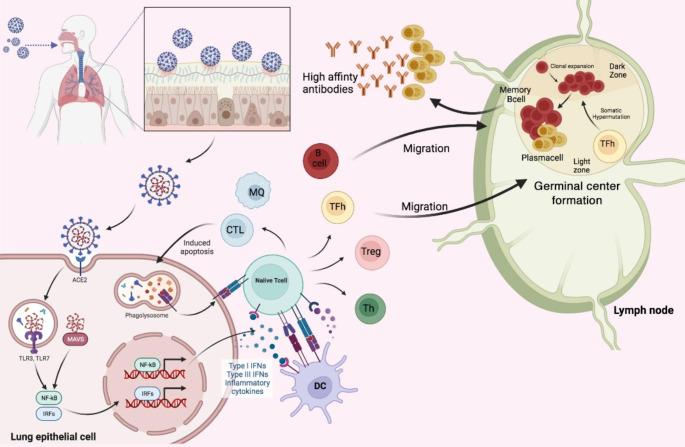
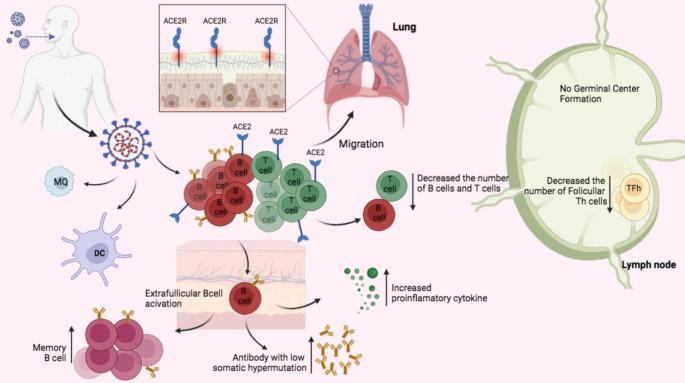
B lymphocytes play a vital role in the human defense against viral infections by producing specific antibodies. They are also critical for the prevention of infectious diseases by vaccination, and their activation influences the efficacy of the vaccination. Since the beginning of coronavirus disease 2019 (COVID-19), which became the main concern of the world health system, many efforts have been made to treat and prevent the disease. However, for the development of successful therapeutics and vaccines, it is necessary to understand the interplay between severe acute respiratory syndrome coronavirus 2 (SARS-CoV-2), the causative agent of COVID-19, and the immune system. The innate immune system provides primary and nonspecific defense against the virus, but within several days after infection, a virus-specific immune response is provided first by antibody-producing B cells, which are converted after the resolution of disease to memory B cells, which provide long-term immunity. Although a failure in B cell activation or B cell dysfunction can cause a severe form of the disease and also lead to vaccination inefficiency, some individuals with B cell immunodeficiency have shown less production of the cytokine IL-6, resulting in a better disease outcome. In this review, we present the latest findings on the interaction between SARS-CoV-2 and B lymphocytes during COVID-19 infection.
B 淋巴细胞通过产生特异性抗体,在人体抵御病毒感染中发挥着至关重要的作用。它们对于通过接种疫苗预防传染病也至关重要,并且它们的激活会影响疫苗的效果。自 2019 年冠状病毒病(COVID-19)开始,它成为了世界卫生系统的主要关注点以来,人们已经做出了许多努力来治疗和预防这种疾病。然而,为了开发成功的治疗方法和疫苗,有必要了解严重急性呼吸综合征冠状病毒 2(SARS-CoV-2),即 COVID-19 的病原体,与免疫系统之间的相互作用。先天免疫系统为病毒提供了主要的非特异性防御,但在感染后的几天内,首先由产生抗体的 B 细胞提供针对病毒的特异性免疫反应,这些 B 细胞在疾病缓解后转化为记忆 B 细胞,从而提供长期免疫。尽管 B 细胞激活失败或 B 细胞功能障碍会导致疾病的严重形式,并且也会导致疫苗接种效率低下,但一些具有 B 细胞免疫缺陷的个体表现出较少的细胞因子 IL-6 产生,从而导致更好的疾病结局。在这篇综述中,我们介绍了 COVID-19 感染期间 SARS-CoV-2 与 B 淋巴细胞相互作用的最新发现。
 Zotero 插件