
新冠疫情封锁前至封锁期间普通人群睡眠质量的变化及睡眠障碍:一项系统评价与荟萃分析
Changes in sleep quality and sleep disturbances in the general population from before to during the COVID-19 lockdown: A systematic review and meta-analysis.
作者信息
Limongi Federica, Siviero Paola, Trevisan Caterina, Noale Marianna, Catalani Filippo, Ceolin Chiara, Conti Silvia, di Rosa Elisa, Perdixi Elena, Remelli Francesca, Prinelli Federica, Maggi Stefania
机构信息
Aging Branch, Neuroscience Institute, National Research Council, Padova, Italy.
Department of Medical Sciences, University of Ferrara, Ferrara, Italy.
出版信息
Front Psychiatry. 2023 Apr 13;14:1166815. doi: 10.3389/fpsyt.2023.1166815. eCollection 2023.
INTRODUCTION
This systematic review and meta-analysis aims to explore changes in sleep quality and sleep disturbances in the general population from before to during the COVID-19 lockdown.
METHODS
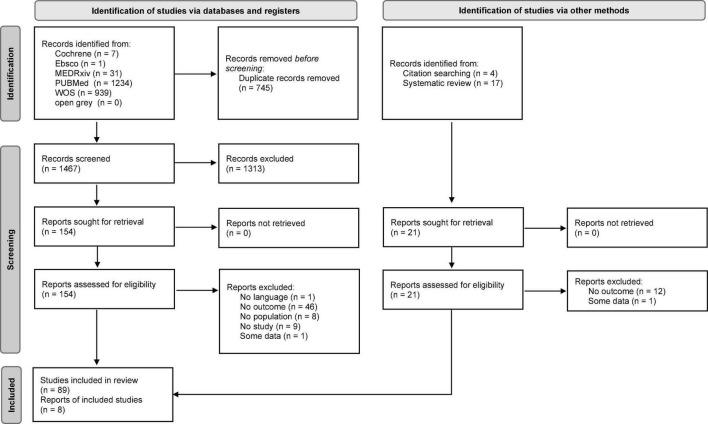
The protocol was registered in PROSPERO (CRD42021256378) and the PRISMA guidelines were followed. The major databases and gray literature were systematically searched from inception to 28/05/2021 to identify observational studies evaluating sleep changes in the general population during the lockdown with respect to the pre-lockdown period. A random effects meta-analysis was undertaken for studies reporting (a) the means of the Pittsburgh Sleep Quality Index (PSQI) global scores or the means of the sleep onset latency (SOL) times (minutes - min) before and during the lockdown, (b) the percentages of poor sleep quality before and during the lockdown, or (c) the percentages of changes in sleep quality. Subgroup analysis by risk of bias and measurement tool utilized was carried out. A narrative synthesis on sleep efficiency, sleep disturbances, insomnia and sleep medication consumption was also performed.
RESULTS
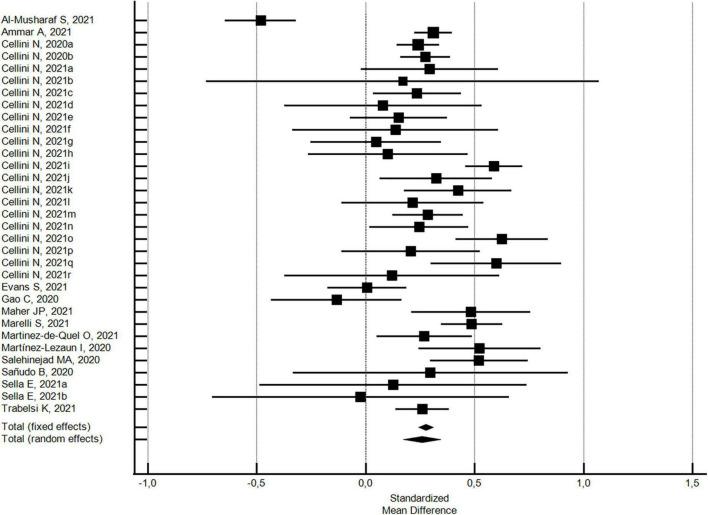
Sixty-three studies were included. A decline in sleep quality, reflected in a pooled increase in the PSQI global scores (standardized mean difference (SMD) = 0.26; 95% CI 0.17-0.34) and in SOL (SMD = 0.38 min; 95% CI 0.30-0.45) were found. The percentage of individuals with poor sleep quality increased during the lockdown (pooled relative risk 1.4; 95% CI 1.24-1.61). Moreover, 57.3% (95% CI 50.01-61.55) of the individuals reported a change in sleep quality; in 37.3% (95% CI 34.27-40.39) of these, it was a worsening. The studies included in the systematic review reported a decrease in sleep efficiency and an increase in sleep disturbances, insomnia, and in sleep medication consumption.
DISCUSSION
Timely interventions are warranted in view of the decline in sleep quality and the increase in sleep disturbances uncovered and their potentially negative impact on health. Further research and in particular longitudinal studies using validated instruments examining the long-term impact of the lockdown on sleep variables is needed.
SYSTEMATIC REVIEW REGISTRATION
https://www.crd.york.ac.uk/prospero/display_record.php?ID=CRD42021256378, identifier CRD42021256378.
引言
本系统评价和荟萃分析旨在探讨新冠疫情封锁前至封锁期间普通人群睡眠质量和睡眠障碍的变化。
方法
该方案已在国际前瞻性系统评价注册库(PROSPERO,注册号:CRD42021256378)注册,并遵循了系统评价和荟萃分析的首选报告项目(PRISMA)指南。从数据库建库至2021年5月28日,系统检索了主要数据库和灰色文献,以识别评估封锁期间普通人群相对于封锁前睡眠变化的观察性研究。对报告以下内容的研究进行随机效应荟萃分析:(a)匹兹堡睡眠质量指数(PSQI)全球得分的均值或封锁前和封锁期间入睡潜伏期(SOL)时间(分钟)的均值;(b)封锁前和封锁期间睡眠质量差的百分比;或(c)睡眠质量变化的百分比。按偏倚风险和所使用的测量工具进行亚组分析。还对睡眠效率、睡眠障碍、失眠和睡眠药物消费进行了叙述性综合分析。
结果
纳入63项研究。发现睡眠质量下降,表现为PSQI全球得分汇总增加(标准化均差(SMD)=0.26;95%置信区间0.17 - 0.34)以及SOL增加(SMD = 0.38分钟;95%置信区间0.30 - 0.45)。封锁期间睡眠质量差的个体百分比增加(汇总相对风险1.4;95%置信区间1.24 - 1.61)。此外,57.3%(95%置信区间50.01 - 61.55)的个体报告睡眠质量有变化;其中37.3%(95%置信区间34.27 - 40.39)的个体睡眠质量变差。系统评价中纳入的研究报告睡眠效率下降,睡眠障碍、失眠及睡眠药物消费增加。
讨论
鉴于发现睡眠质量下降和睡眠障碍增加及其对健康的潜在负面影响,有必要及时进行干预。需要进一步开展研究,特别是使用经过验证的工具进行的纵向研究,以考察封锁对睡眠变量的长期影响。
系统评价注册信息
https://www.crd.york.ac.uk/prospero/display_record.php?ID=CRD42021256378,标识符CRD42021256378 。



 Zotero 插件