
导航碳青霉烯类耐药鲍曼不动杆菌-醋酸钙不动杆菌复合体感染的可用治疗选择。
Navigating Available Treatment Options for Carbapenem-Resistant Acinetobacter baumannii-calcoaceticus Complex Infections.
机构信息
Department of Medicine, University of Pittsburgh, Pittsburgh, Pennsylvania, USA.
ADVANCE-ID, Saw Swee Hock School of Public Health, National University of Singapore, Singapore.
出版信息
Clin Infect Dis. 2023 May 1;76(Suppl 2):S179-S193. doi: 10.1093/cid/ciad094.
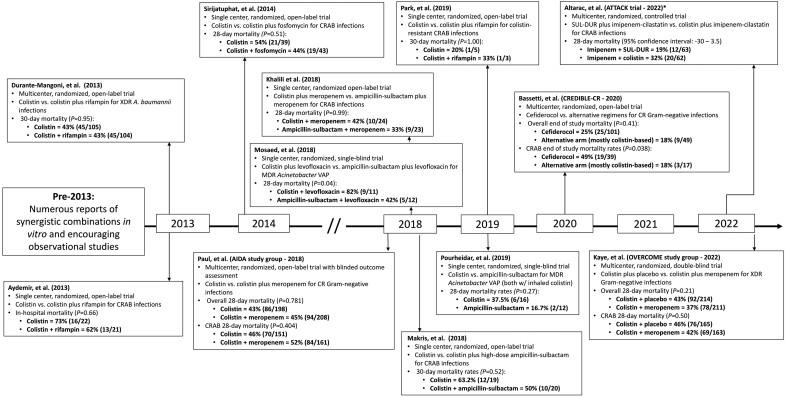
Carbapenem-resistant Acinetobacter baumannii-calcoaceticus complex (CRAB) is one of the top-priority pathogens for new antibiotic development. Unlike other antibiotic-resistant threats, none of the available therapies have been shown to consistently reduce mortality or improve patient outcomes in clinical trials. Antibiotic combination therapy is routinely used in clinical practice; however, the preferred combination has not been defined. This narrative review focuses on evidence-based solutions for the treatment of invasive CRAB infections. We dissect the promise and perils of traditional agents used in combination, such as colistin, sulbactam, and the tetracyclines, and offer clinical pearls based on our interpretation of the available data. Next, we investigate the merits of newly developed β-lactam agents like cefiderocol and sulbactam-durlobactam, which have demonstrated contrasting results in recent randomized clinical trials. The review concludes with the authors' perspective on the evolving treatment landscape for CRAB infections, which is complicated by limited clinical data, imperfect treatment options, and a need for future clinical trials. We propose that effective treatment for CRAB infections requires a personalized approach that incorporates host factors, the site of infection, pharmacokinetic-pharmacodynamic principles, local molecular epidemiology of CRAB isolates, and careful interpretation of antibiotic susceptibility testing results. In most clinical scenarios, a dose-optimized, sulbactam-based regimen is recommended with the addition of at least one other in vitro active agent. Should sulbactam-durlobactam receive regulatory approval, recommendations will need to be re-evaluated with the most recent evidence.
耐碳青霉烯鲍曼不动杆菌-醋酸钙不动杆菌复合体(CRAB)是新抗生素开发的首要重点病原体之一。与其他抗生素耐药威胁不同,在临床试验中,没有一种可用的疗法被证明能持续降低死亡率或改善患者预后。抗生素联合治疗在临床实践中常规使用;然而,尚未确定首选的联合方案。本综述重点介绍了治疗侵袭性 CRAB 感染的基于证据的解决方案。我们剖析了联合使用的传统药物(如多粘菌素、舒巴坦和四环素)的优缺点,并根据我们对现有数据的解释提供了临床要点。接下来,我们研究了新开发的β-内酰胺药物(如头孢地尔和舒巴坦-他唑巴坦)的优点,这些药物在最近的随机临床试验中取得了截然不同的结果。综述最后是作者对 CRAB 感染治疗领域的看法,由于临床数据有限、治疗选择不完美以及需要未来的临床试验,这一领域变得复杂。我们认为,有效的 CRAB 感染治疗需要一种个性化的方法,其中包括宿主因素、感染部位、药代动力学-药效学原则、CRAB 分离株的局部分子流行病学以及对抗生素药敏试验结果的仔细解读。在大多数临床情况下,建议使用剂量优化的、基于舒巴坦的方案,并添加至少一种其他体外活性药物。如果舒巴坦-他唑巴坦获得监管批准,需要根据最新证据重新评估建议。
 Zotero 插件