
SARS-CoV-2 大流行不同阶段流感和 COVID-19 住院患者的结局:一项单中心回顾性病例对照研究。
Outcomes of influenza and COVID-19 inpatients in different phases of the SARS-CoV-2 pandemic: a single-centre retrospective case-control study.
机构信息
Department of Medical Microbiology and Infection Control, Otto-von-Guericke University Magdeburg, Magdeburg, Germany.
Department of Medical Microbiology and Infection Control, Otto-von-Guericke University Magdeburg, Magdeburg, Germany.
出版信息
J Hosp Infect. 2023 Aug;138:1-7. doi: 10.1016/j.jhin.2023.04.014. Epub 2023 Apr 29.
BACKGROUND
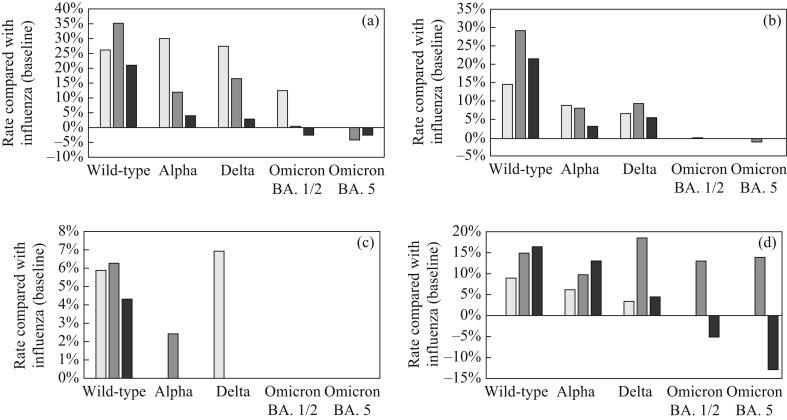
The virulence of severe acute respiratory syndrome coronavirus-2 (SARS-CoV-2) changed during the pandemic. In order to provide a rationale for treatment priorities of respiratory infections and the adaption of in-house infection control strategies, this study evaluated treatment on an intensive care unit (ICU), requirement for mechanical ventilation (MV), requirement for extracorporeal membrane oxygenation (ECMO) and death for inpatients infected with the influenza virus or SARS-CoV-2 during the wild-type, Alpha, Delta, Omicron BA.1/2 and Omicron BA.5 waves of the pandemic.
DESIGN
Single-centre retrospective case-control study.
SETTING
Tertiary hospital in Germany.
PARTICIPANTS
One thousand three hundred and sixteen adult inpatients infected with SARS-CoV-2 and 218 adult inpatients infected with influenza virus.
METHODS
Demographic data, outcome parameters and underlying comorbidities of patients were obtained from the hospital information system. Multi-variate regression analysis was performed for the assessment of significant associations between risk factors and outcome variables.
RESULTS
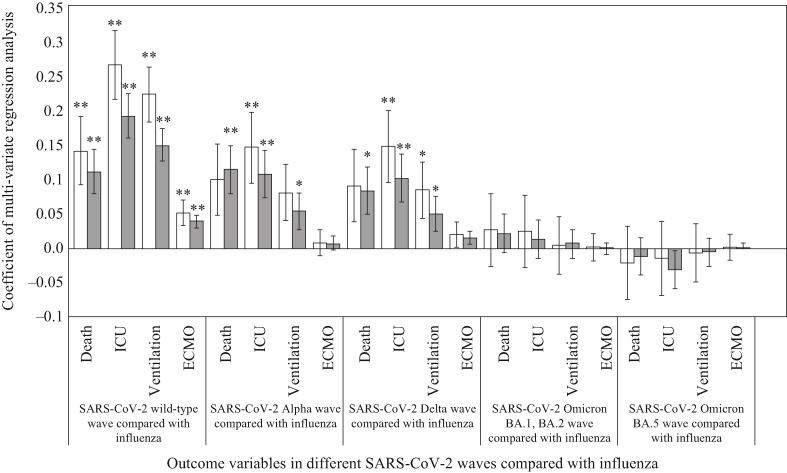
Compared with inpatients infected with influenza virus, patients infected with SARS-CoV-2 showed significantly higher rates for in-hospital mortality, admission to ICU and requirement for MV in the wild-type, Alpha and Delta waves, and a significantly higher rate for requirement for ECMO in the wild-type wave. In the Omicron BA.1/BA.2 and Omicron BA.5 waves, patients infected with SARS-CoV-2 did not show significantly higher risk of in-hospital mortality, admission to ICU, or requirement for MV or ECMO compared with patients infected with influenza virus. The length of hospital stay of patients infected with SARS-CoV-2 decreased from 10.8 to 6.2 days, which was less than that of patients infected with influenza virus (8.3 days).
CONCLUSIONS
Treatment capacities should be shared equally between SARS-CoV-2 and influenza virus infections. Similar levels of infection control could be applied, at least regarding the severity of infection.
背景
严重急性呼吸综合征冠状病毒 2(SARS-CoV-2)的毒力在大流行期间发生了变化。为了为呼吸道感染的治疗优先级提供依据,并调整内部感染控制策略,本研究评估了在大流行的野生型、Alpha、Delta、Omicron BA.1/2 和 Omicron BA.5 波期间,入住重症监护病房(ICU)、需要机械通气(MV)、需要体外膜氧合(ECMO)和死亡的流感病毒或 SARS-CoV-2 感染住院患者的治疗情况。
设计
单中心回顾性病例对照研究。
地点
德国的一家三级医院。
参与者
1316 名成年 SARS-CoV-2 感染住院患者和 218 名成年流感病毒感染住院患者。
方法
从医院信息系统中获取患者的人口统计学数据、结局参数和基础合并症数据。采用多变量回归分析评估危险因素与结局变量之间的显著关联。
结果
与流感病毒感染患者相比,在野生型、Alpha 和 Delta 波期间,SARS-CoV-2 感染患者的院内死亡率、入住 ICU 和需要 MV 的比例明显更高,在野生型波期间需要 ECMO 的比例明显更高。在 Omicron BA.1/BA.2 和 Omicron BA.5 波期间,与流感病毒感染患者相比,SARS-CoV-2 感染患者的院内死亡率、入住 ICU 或需要 MV 或 ECMO 的风险无明显增加。SARS-CoV-2 感染患者的住院时间从 10.8 天缩短至 6.2 天,短于流感病毒感染患者(8.3 天)。
结论
SARS-CoV-2 和流感病毒感染的治疗能力应平等分配。至少在感染严重程度方面,可以应用类似的感染控制水平。
 Zotero 插件