
非小细胞肺癌患者的诊断前戒烟与总生存。
Prediagnosis Smoking Cessation and Overall Survival Among Patients With Non-Small Cell Lung Cancer.
机构信息
Department of Environmental Health, Harvard T.H. Chan School of Public Health, Harvard University, Boston, Massachusetts.
Pulmonary and Critical Care Division, Department of Medicine, Massachusetts General Hospital, Harvard Medical School, Boston.
出版信息
JAMA Netw Open. 2023 May 1;6(5):e2311966. doi: 10.1001/jamanetworkopen.2023.11966.
IMPORTANCE
Lung cancer remains the leading cause of cancer-related death globally; non-small cell lung cancer (NSCLC) accounts for 85% of all lung cancer cases, and cigarette smoking is the factor most significantly associated with its risk. However, little is known about the association of years since prediagnosis smoking cessation and cumulative smoking with overall survival (OS) following a lung cancer diagnosis.
OBJECTIVE
To characterize the association of years since smoking cessation before diagnosis and cumulative smoking pack-years with OS in patients with NSCLC in a lung cancer survivor cohort.
DESIGN, SETTING, AND PARTICIPANTS: The cohort study involved patients with NSCLC who were recruited to the Boston Lung Cancer Survival Cohort at Massachusetts General Hospital (Boston, Massachusetts) between 1992 and 2022. Patients' smoking history and baseline clinicopathological characteristics were prospectively collected through questionnaires, and OS following lung cancer diagnosis was regularly updated.
EXPOSURES
Duration of smoking cessation before a lung cancer diagnosis.
MAIN OUTCOMES AND MEASURES
The primary outcome was the association of detailed smoking history with OS following a lung cancer diagnosis.
RESULTS
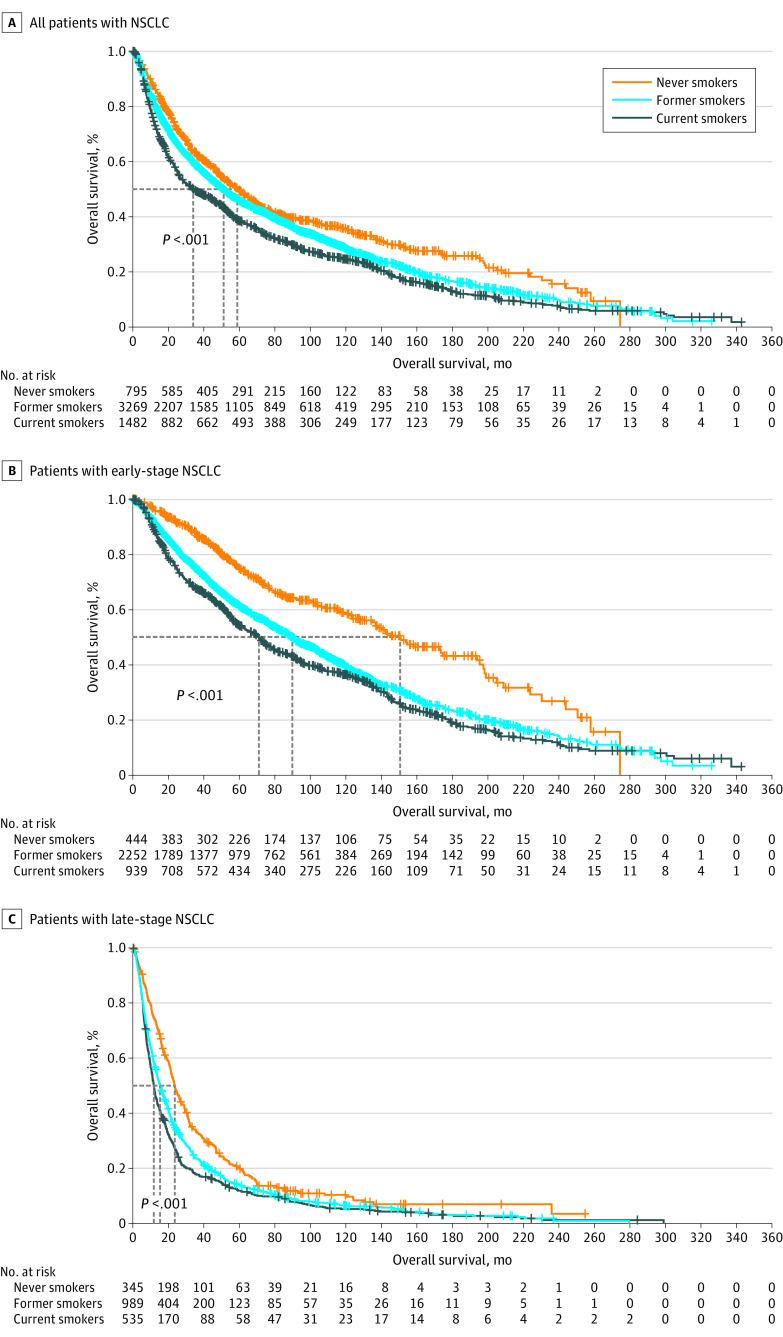
Of 5594 patients with NSCLC (mean [SD] age, 65.6 [10.8] years; 2987 men [53.4%]), 795 (14.2%) were never smokers, 3308 (59.1%) were former smokers, and 1491 (26.7%) were current smokers. Cox regression analysis suggested that former smokers had 26% higher mortality (hazard ratio [HR], 1.26; 95% CI, 1.13-1.40; P < .001) and current smokers had 68% higher mortality (HR, 1.68; 95% CI, 1.50-1.89; P < .001) compared with never smokers. Log2-transformed years since smoking cessation before diagnosis were associated with significantly lower mortality among ever smokers (HR, 0.96; 95% CI, 0.93-0.99; P = .003). Subgroup analysis, stratified by clinical stage at diagnosis, revealed that former and current smokers had even shorter OS among patients with early-stage disease.
CONCLUSIONS AND RELEVANCE
In this cohort study of patients with NSCLC, quitting smoking early was associated with lower mortality following a lung cancer diagnosis, and the association of smoking history with OS may have varied depending on clinical stage at diagnosis, potentially owing to the differing treatment regimens and efficacy associated with smoking exposure following diagnosis. Detailed smoking history collection should be incorporated into future epidemiological and clinical studies to improve lung cancer prognosis and treatment selection.
重要性
肺癌仍然是全球癌症相关死亡的主要原因;非小细胞肺癌(NSCLC)占所有肺癌病例的 85%,吸烟是与其风险最显著相关的因素。然而,对于戒烟前吸烟年数和累计吸烟包年数与肺癌诊断后总生存期(OS)的关系,人们知之甚少。
目的
在肺癌幸存者队列中,描述 NSCLC 患者诊断前戒烟年数和累计吸烟包年数与 OS 的关系。
设计、地点和参与者:该队列研究纳入了 1992 年至 2022 年期间在马萨诸塞州总医院(波士顿,马萨诸塞州)招募的波士顿肺癌生存队列中的 NSCLC 患者。通过问卷前瞻性收集患者的吸烟史和基线临床病理特征,定期更新肺癌诊断后的 OS。
暴露
诊断前吸烟停止的持续时间。
主要结果和测量
主要结局是详细的吸烟史与肺癌诊断后 OS 的关系。
结果
在 5594 例 NSCLC 患者中(平均[SD]年龄,65.6[10.8]岁;男性 2987 例[53.4%]),795 例(14.2%)为从不吸烟者,3308 例(59.1%)为曾经吸烟者,1491 例(26.7%)为当前吸烟者。Cox 回归分析表明,与从不吸烟者相比,曾经吸烟者的死亡率高出 26%(风险比[HR],1.26;95%CI,1.13-1.40;P<.001),而当前吸烟者的死亡率高出 68%(HR,1.68;95%CI,1.50-1.89;P<.001)。曾吸烟者的 log2 转换后诊断前戒烟年数与死亡率显著降低相关(HR,0.96;95%CI,0.93-0.99;P=.003)。按诊断时临床分期分层的亚组分析显示,早期疾病患者中,曾经和现在的吸烟者的 OS 更短。
结论和相关性
在这项 NSCLC 患者的队列研究中,早期戒烟与肺癌诊断后的死亡率降低相关,而吸烟史与 OS 的关系可能因诊断时的临床分期而异,这可能是由于与诊断后吸烟暴露相关的不同治疗方案和疗效所致。在未来的流行病学和临床研究中应纳入详细的吸烟史采集,以改善肺癌预后和治疗选择。
 Zotero 插件