
3% 地夸磷索四钠滴眼液与透明质酸钠联合治疗:飞秒激光制瓣准分子原位角膜磨镶术后干眼症患者的有效治疗方法
Combination therapy with 3% diquafosol tetrasodium ophthalmic solution and sodium hyaluronate: an effective therapy for patients with dry eye after femtosecond laser-assisted keratomileusis.
作者信息
Wang Tianjiao, Di Yu, Li Ying
机构信息
4+4 Medical Doctor Program, Chinese Academy of Medical Sciences, Peking Union Medical College, Beijing, China.
Department of Ophthalmology, Peking Union Medical College Hospital, Chinese Academy of Medical Sciences, Beijing, China.
出版信息
Front Med (Lausanne). 2023 Apr 20;10:1160499. doi: 10.3389/fmed.2023.1160499. eCollection 2023.
PURPOSE
To assess the effect of combination therapy with 3% diquafosol tetrasodium (DQS) and sodium hyaluronate (HA) for dry eye after femtosecond laser-assisted keratomileusis (FS-LASIK).
DESIGN
Prospective nonrandomized comparative trial.
METHODS
The prospective study included 80 eyes of 40 patients who underwent FS-LASIK with or without preoperative dry eye. Patients were divided into a combination group and a HA group according to their willingness and the doctor's advice. The combination group was treated with DQS six times a day and HA four times a day, and the HA group was treated with HA four times a day after FS-LASIK. Ocular surface disease index (OSDI), ocular symptom score, vision-related score, environmental score, tear meniscus height (TMH), first non-invasive tear breakup time (NIBUT-First), average non-invasive tear breakup time (NIBUT-Ave), tear breakup time (TBUT), Schirmer I test (SIT), corneal fluorescein staining score (CFS), bulbar redness score, limbal redness score, lipid layer grade (LLG), meiboscore, lid margin abnormality, corneal sensitivity, and corneal nerve parameters were examined before surgery and at 1 week and 1 month after surgery. Surface regularity index (SRI) was also examined before surgery and at 1 month postoperatively.
RESULTS
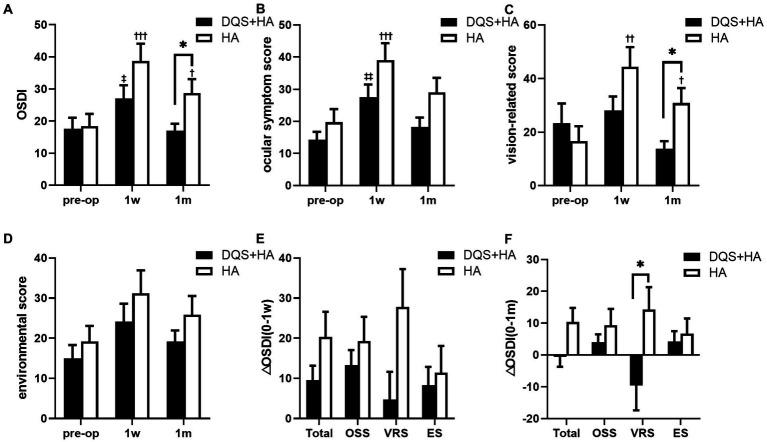
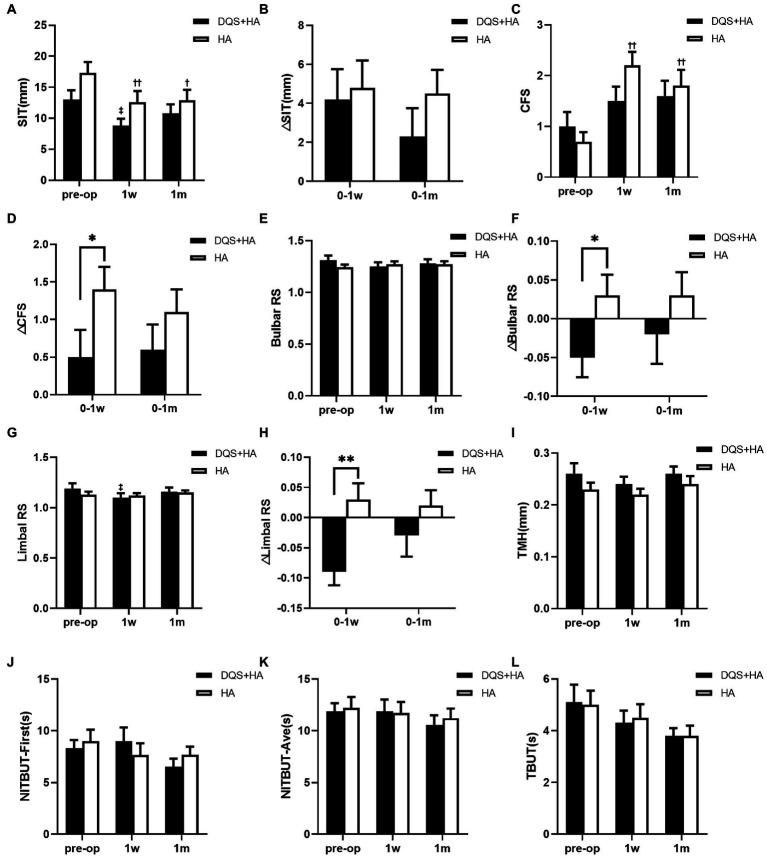
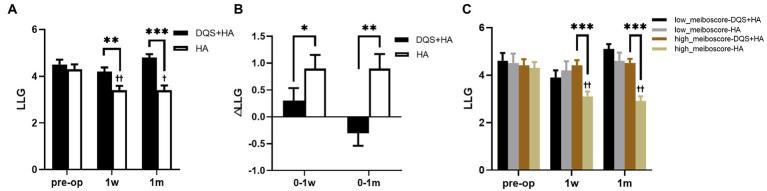
OSDI score ( = 0.024) and vision-related score ( = 0.026) were significantly lower in the combination group than in the HA group at 1 month after FS-LASIK, especially in patients with preoperative dry eye symptoms. The increasements of CFS ( = 0.018), bulbar redness score ( = 0.021), and limbal redness score ( = 0.009) were significantly lower in the combination group than in the HA group at 1 week after FS-LASIK. But other ocular surface parameters showed no difference between both groups at 1 week and 1 month after FS-LASIK. LLG was significantly higher in the combination group than in the HA group at 1 week ( = 0.004) and 1 month ( < 0.001) after surgery, especially in patients with high meiboscore. Additional DQS significantly improved corneal sensitivity in patients without preoperative dry eye symptoms at 1 month after FS-LASIK ( = 0.041).
CONCLUSION
The combination therapy with DQS and HA significantly relieved subjective symptoms, improved ocular surface status, and had the potential to promote corneal nerve growth in patients after FS-LASIK.
目的
评估3%四水二喹富罗(DQS)联合透明质酸钠(HA)治疗飞秒激光制瓣准分子原位角膜磨镶术(FS-LASIK)后干眼的效果。
设计
前瞻性非随机对照试验。
方法
该前瞻性研究纳入了40例接受FS-LASIK手术的患者的80只眼,这些患者术前有或无干眼症状。根据患者意愿及医生建议将患者分为联合治疗组和HA组。联合治疗组术后每天使用DQS 6次、HA 4次,HA组术后每天使用HA 4次。分别于术前、术后1周和1个月检查眼表疾病指数(OSDI)、眼部症状评分、视力相关评分、环境评分、泪河高度(TMH)、首次非侵入性泪膜破裂时间(NIBUT-First)、平均非侵入性泪膜破裂时间(NIBUT-Ave)、泪膜破裂时间(TBUT)、泪液分泌试验(SIT)、角膜荧光素染色评分(CFS)、球结膜充血评分、角膜缘充血评分、脂质层分级(LLG)、睑板腺功能评分、睑缘异常、角膜敏感性及角膜神经参数。术前及术后1个月检查表面规则性指数(SRI)。
结果
FS-LASIK术后1个月,联合治疗组的OSDI评分(P = 0.024)和视力相关评分(P = 0.026)显著低于HA组,尤其是术前有干眼症状的患者。FS-LASIK术后1周,联合治疗组的CFS增加量(P = 0.018)、球结膜充血评分增加量(P = 0.021)和角膜缘充血评分增加量(P = 0.009)显著低于HA组。但FS-LASIK术后1周和1个月时,两组的其他眼表参数无差异。术后1周(P = 0.004)和1个月(P < 0.001)时,联合治疗组的LLG显著高于HA组,尤其是睑板腺功能评分高的患者。FS-LASIK术后1个月,额外使用DQS可显著改善术前无干眼症状患者的角膜敏感性(P = 0.041)。
结论
DQS联合HA治疗可显著缓解FS-LASIK术后患者的主观症状,改善眼表状态,并有可能促进角膜神经生长。

 Zotero 插件