
亚洲、亚洲各区域及伊朗出生时预期寿命的六十年趋势分析:一项Joinpoint分析
Six-Decade Trend Analysis of Life Expectancy at Birth in Asia, Regions of Asia and Iran: A Joinpoint Analysis.
作者信息
Salehi Masoud, Aziz-Mohammdlooha Mehdi, Masaebi Fatemeh, Zayeri Farid
机构信息
Health Management and Economics Research Center, Department of Biostatistics, School of Public Health, Iran University of Medical Sciences, Tehran, Iran.
Department of Biostatistics, School of Allied Medical Sciences, Shahid Beheshti University of Medical Sciences, Tehran, Iran.
出版信息
Med J Islam Repub Iran. 2022 Dec 23;36:166. doi: 10.47176/mjiri.36.166. eCollection 2022.
BACKGROUND
Life expectancy is one of the key indicators for investigating the overall health status of a population. Thus, analyzing the trend of this demographic measure is of great importance for planning health and social services in different societies. In this study, we aimed to model the trends of life expectancy in Asia, regions of Asia, and Iran over the past six decades.
METHODS
The annual life expectancy at birth data sets were extracted for Iran and the total Asia population between 1960 and 2020 from the database provided by the Our World in Data website. The trend analysis was performed using the joinpoint regression model.
RESULTS
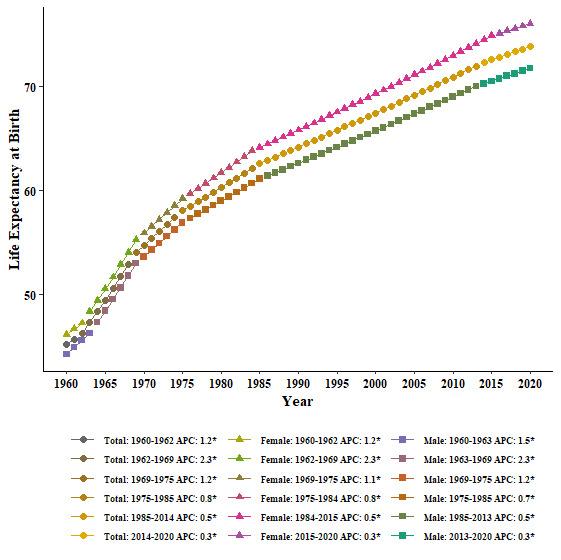
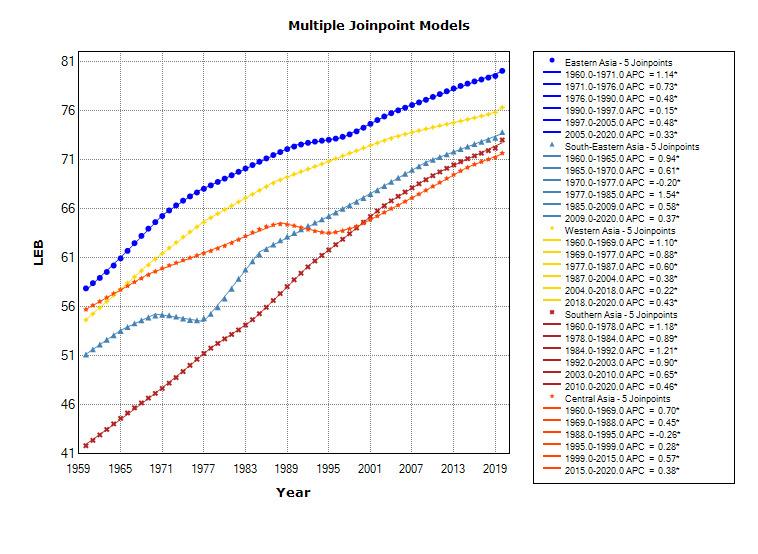
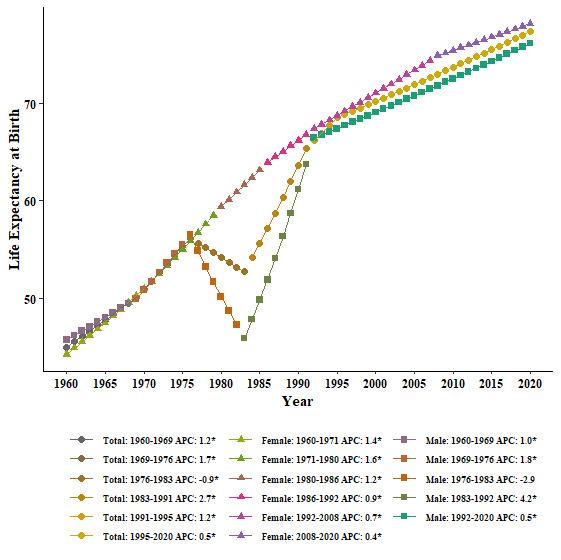
During the study period, Iranians and Asians have, respectively, experienced about 32 and 28.6 years increase in life expectancy. The results from joinpoint regression showed that the average annual percent change (AAPC) of life expectancy was positive for all regions of Asia, and ranged from 0.4% for Central Asia to 0.9% for Southern Asia. In addition, the estimated AAPC in Iranian people was about 0.1 higher than the total Asian population (0.9% vs. 0.8%).
CONCLUSION
Despite protracted wars, poverty, and social inequality in some parts of Asia, life expectancy has drastically increased in this continent over the last decades. However, life expectancy in Asia (and Iran) is still remarkably lower than in more developed parts of the world. To elevate life expectancy to a higher level, the policymakers in Asian countries should put more effort into improving the standards of living and access to health facilities in their societies.
背景
预期寿命是调查人口总体健康状况的关键指标之一。因此,分析这一人口指标的趋势对于不同社会规划卫生和社会服务至关重要。在本研究中,我们旨在模拟过去六十年来亚洲、亚洲各地区以及伊朗的预期寿命趋势。
方法
从“Our World in Data”网站提供的数据库中提取了1960年至2020年期间伊朗和亚洲总人口的出生时预期寿命年度数据集。使用连接点回归模型进行趋势分析。
结果
在研究期间,伊朗人和亚洲人的预期寿命分别增加了约32岁和28.6岁。连接点回归结果表明,亚洲所有地区预期寿命的平均年度百分比变化(AAPC)均为正值,从中亚的0.4%到南亚的0.9%不等。此外,伊朗人的估计AAPC比亚洲总人口高约0.1(0.9%对0.8%)。
结论
尽管亚洲部分地区长期存在战争、贫困和社会不平等,但在过去几十年里,该大陆的预期寿命仍大幅提高。然而,亚洲(以及伊朗)的预期寿命仍显著低于世界上更发达的地区。为了将预期寿命提高到更高水平,亚洲国家的政策制定者应更加努力地提高其社会的生活水平和获得医疗设施的机会。
 Zotero 插件