
CANDOR 研究中卡非佐米、地塞米松和达雷妥尤单抗与卡非佐米和地塞米松的最终分析。
Final analysis of carfilzomib, dexamethasone, and daratumumab vs carfilzomib and dexamethasone in the CANDOR study.
机构信息
Memorial Sloan Kettering Cancer Center, New York, NY.
University of Melbourne, St Vincent's Hospital, Melbourne, VIC, Australia.
出版信息
Blood Adv. 2023 Jul 25;7(14):3739-3748. doi: 10.1182/bloodadvances.2023010026.
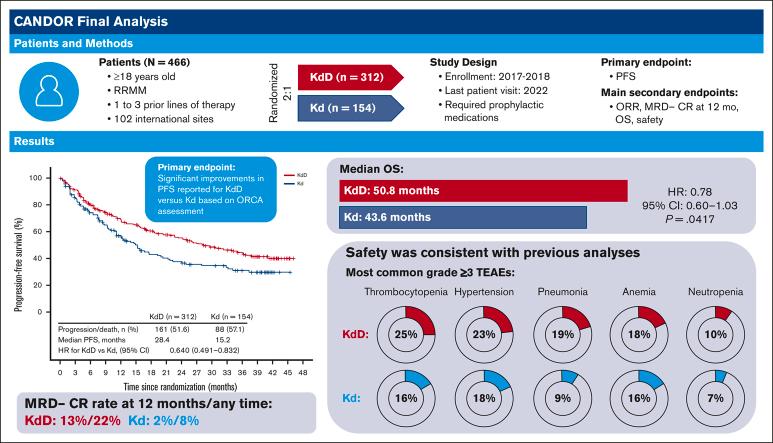
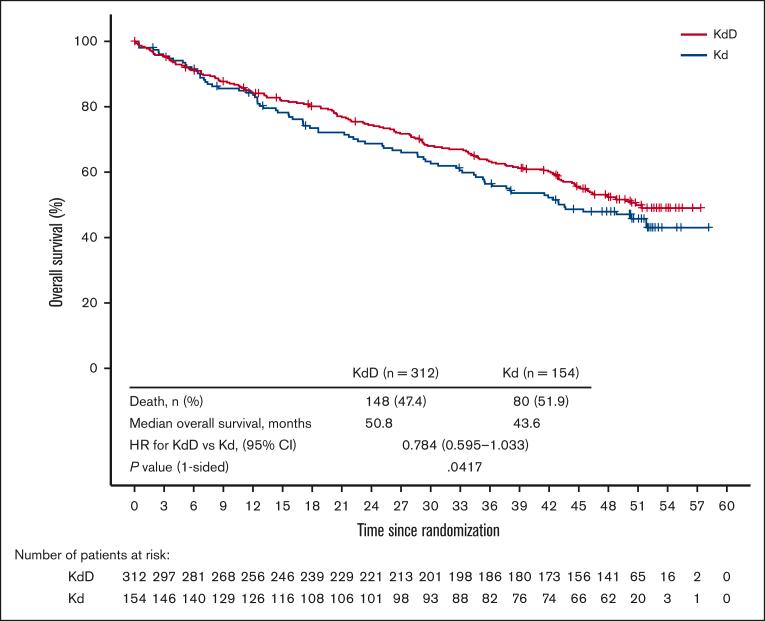
CANDOR (NCT03158688) is a phase 3, randomized, open-label trial comparing carfilzomib, daratumumab, and dexamethasone (KdD) vs carfilzomib and dexamethasone (Kd) in adults with relapsed/refectory multiple myeloma (RRMM) with 1 to 3 prior therapies. The CANDOR study met its primary end point of progression-free survival (PFS) in the primary analysis. Here, we report the final analysis of the study, including secondary end points and subgroup analyses thereof. The median follow-up was 50 months. Patients treated with KdD had higher minimal residual disease-negative (MRD-) achievement rates (28% vs 9%; odds ratio [OR], 4.22; 95% confidence interval [95% CI], 2.28-7.83) and MRD- complete response rates (22% vs 8%; OR, 3.55; 95% CI, 1.83-6.88) than those treated with Kd. Median PFS was 28.4 months for KdD vs 15.2 months for Kd (hazard ratio [HR], 0.64; 95% CI, 0.49-0.83). Median overall survival (OS) for KdD was 50.8 months vs 43.6 months for Kd (HR, 0.78 [0.60-1.03]; P = .042). Trends toward improved OS occurred in predefined subgroups, including patients refractory to lenalidomide (KdD, not reached vs Kd, 38.2 months; HR, 0.69 [0.43-1.11]) and refractory to proteasome inhibitor (KdD, 43.2 months vs Kd, 30.0 months; HR, 0.70 [0.45-1.09]), and there was significant improvement in patients with high-risk cytogenetics (KdD, 34.3 months vs Kd: 17.1 months; HR, 0.52 [0.29-0.94]). No new safety signals were identified. In summary, the final analysis of CANDOR confirmed the PFS benefit and showed a trend in OS benefit with KdD vs Kd. These findings reinforce KdD as a standard of care for RRMM, especially in clinically relevant patient subgroups. This trial was registered at www.clinicaltrials.gov as #NCT03158688.
CANDOR(NCT03158688)是一项 3 期、随机、开放性试验,比较了卡非佐米、达雷妥尤单抗和地塞米松(KdD)与卡非佐米和地塞米松(Kd)在既往接受过 1 至 3 线治疗的复发/难治性多发性骨髓瘤(RRMM)成人患者中的疗效。CANDOR 研究在主要分析中达到了无进展生存期(PFS)的主要终点。在此,我们报告了该研究的最终分析结果,包括次要终点及其亚组分析。中位随访时间为 50 个月。与 Kd 治疗组相比,KdD 治疗组的微小残留病灶阴性(MRD-)缓解率更高(28% vs 9%;优势比[OR],4.22;95%置信区间[95%CI],2.28-7.83)和 MRD-完全缓解率更高(22% vs 8%;OR,3.55;95%CI,1.83-6.88)。KdD 组的中位 PFS 为 28.4 个月,Kd 组为 15.2 个月(HR,0.64;95%CI,0.49-0.83)。KdD 组的中位总生存期(OS)为 50.8 个月,Kd 组为 43.6 个月(HR,0.78 [0.60-1.03];P=0.042)。在预先设定的亚组中,OS 有改善趋势,包括对来那度胺耐药的患者(KdD,未达到 vs Kd,38.2 个月;HR,0.69 [0.43-1.11])和对蛋白酶体抑制剂耐药的患者(KdD,43.2 个月 vs Kd,30.0 个月;HR,0.70 [0.45-1.09]),高危细胞遗传学患者的 OS 显著改善(KdD,34.3 个月 vs Kd,17.1 个月;HR,0.52 [0.29-0.94])。未发现新的安全性信号。总之,CANDOR 的最终分析结果证实了 KdD 与 Kd 相比在 PFS 方面的获益,并显示出在 OS 方面的获益趋势。这些发现强化了 KdD 作为 RRMM 治疗标准的地位,特别是在有临床意义的患者亚组中。该试验在 www.clinicaltrials.gov 上注册,编号为 #NCT03158688。

 Zotero 插件