
单细胞下一代测序监测造血干细胞移植:当前应用与未来展望
Single-Cell Next-Generation Sequencing to Monitor Hematopoietic Stem-Cell Transplantation: Current Applications and Future Perspectives.
作者信息
Ogbue Olisaemeka, Unlu Serhan, Ibodeng Gogo-Ogute, Singh Abhay, Durmaz Arda, Visconte Valeria, Molina John C
机构信息
Internal Medicine, Cleveland Clinic Fairview Hospital, Cleveland, OH 44111, USA.
Internal Medicine, Infirmary Health's Thomas Hospital, Fairhope, AL 36607, USA.
出版信息
Cancers (Basel). 2023 Apr 26;15(9):2477. doi: 10.3390/cancers15092477.
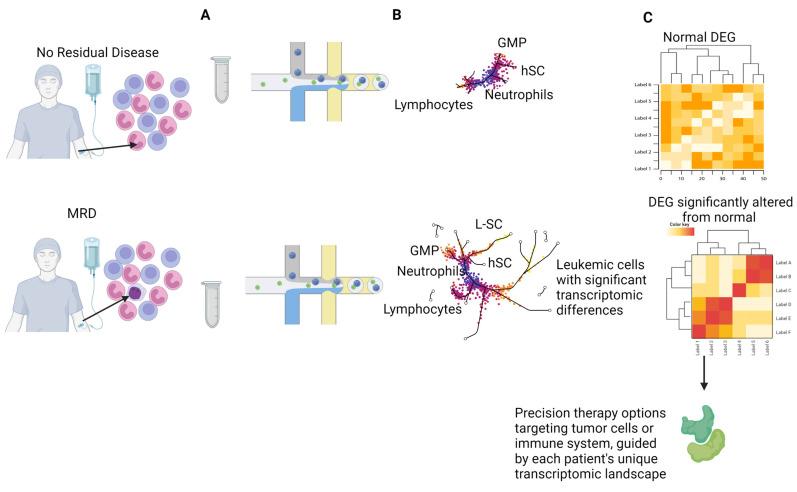
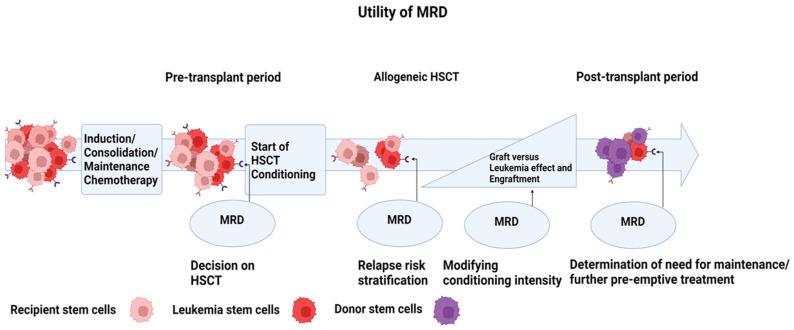
Acute myeloid leukemia (AML) and myelodysplastic syndrome (MDS) are genetically complex and diverse diseases. Such complexity makes challenging the monitoring of response to treatment. Measurable residual disease (MRD) assessment is a powerful tool for monitoring response and guiding therapeutic interventions. This is accomplished through targeted next-generation sequencing (NGS), as well as polymerase chain reaction and multiparameter flow cytometry, to detect genomic aberrations at a previously challenging leukemic cell concentration. A major shortcoming of NGS techniques is the inability to discriminate nonleukemic clonal hematopoiesis. In addition, risk assessment and prognostication become more complicated after hematopoietic stem-cell transplantation (HSCT) due to genotypic drift. To address this, newer sequencing techniques have been developed, leading to more prospective and randomized clinical trials aiming to demonstrate the prognostic utility of single-cell next-generation sequencing in predicting patient outcomes following HSCT. This review discusses the use of single-cell DNA genomics in MRD assessment for AML/MDS, with an emphasis on the HSCT time period, including the challenges with current technologies. We also touch on the potential benefits of single-cell RNA sequencing and analysis of accessible chromatin, which generate high-dimensional data at the cellular resolution for investigational purposes, but not currently used in the clinical setting.
急性髓系白血病(AML)和骨髓增生异常综合征(MDS)是基因复杂且多样的疾病。这种复杂性使得监测治疗反应具有挑战性。可测量残留病(MRD)评估是监测反应和指导治疗干预的有力工具。这是通过靶向新一代测序(NGS)以及聚合酶链反应和多参数流式细胞术来实现的,以在先前具有挑战性的白血病细胞浓度下检测基因组畸变。NGS技术的一个主要缺点是无法区分非白血病性克隆造血。此外,由于基因型漂移,造血干细胞移植(HSCT)后风险评估和预后变得更加复杂。为了解决这个问题,已经开发了更新的测序技术,从而导致更多前瞻性和随机临床试验,旨在证明单细胞新一代测序在预测HSCT后患者预后方面的预后效用。本综述讨论了单细胞DNA基因组学在AML/MDS的MRD评估中的应用,重点是HSCT时期,包括当前技术面临的挑战。我们还探讨了单细胞RNA测序和可及染色质分析的潜在益处,它们以细胞分辨率生成高维数据用于研究目的,但目前尚未用于临床环境。


 Zotero 插件