
Rho 相关激酶(Rock)抑制剂(替代 Y-27632)对原代人角膜内皮细胞的影响。
Effects of Rho-Associated Kinase (Rock) Inhibitors (Alternative to Y-27632) on Primary Human Corneal Endothelial Cells.
机构信息
Tissue Engineering and Cell Therapy Group, Singapore Eye Research Institute, Singapore 169856, Singapore.
Singhealth Duke-NUS Ophthalmology & Visual Sciences Academic Clinical Programme , Duke-NUS Graduate Medical School, Singapore 169857, Singapore.
出版信息
Cells. 2023 May 3;12(9):1307. doi: 10.3390/cells12091307.
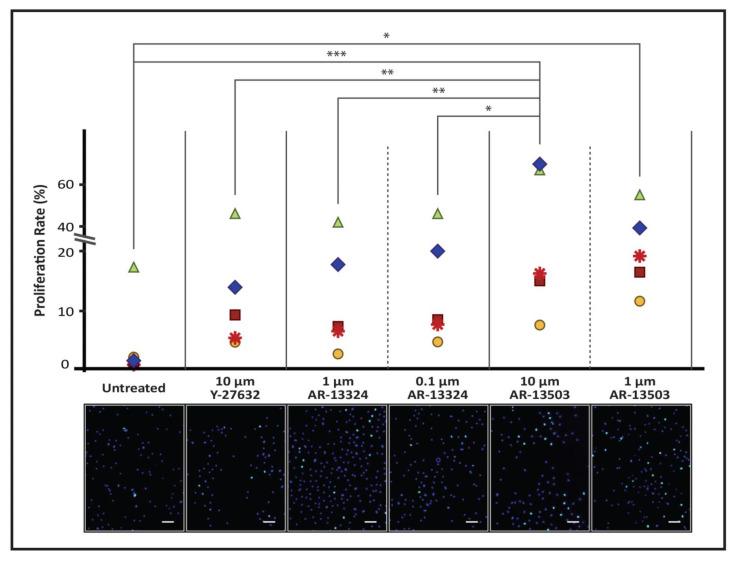
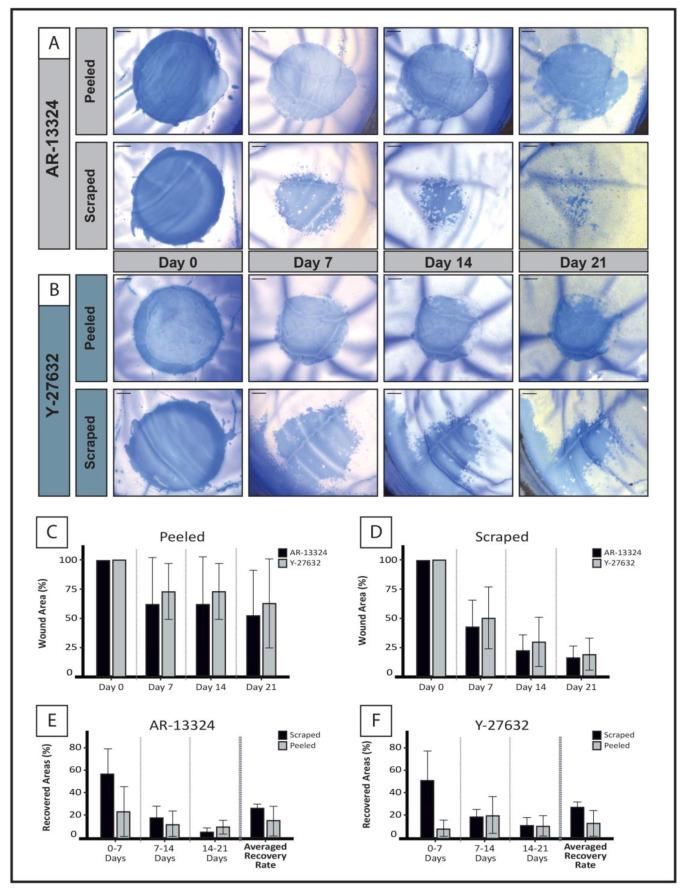
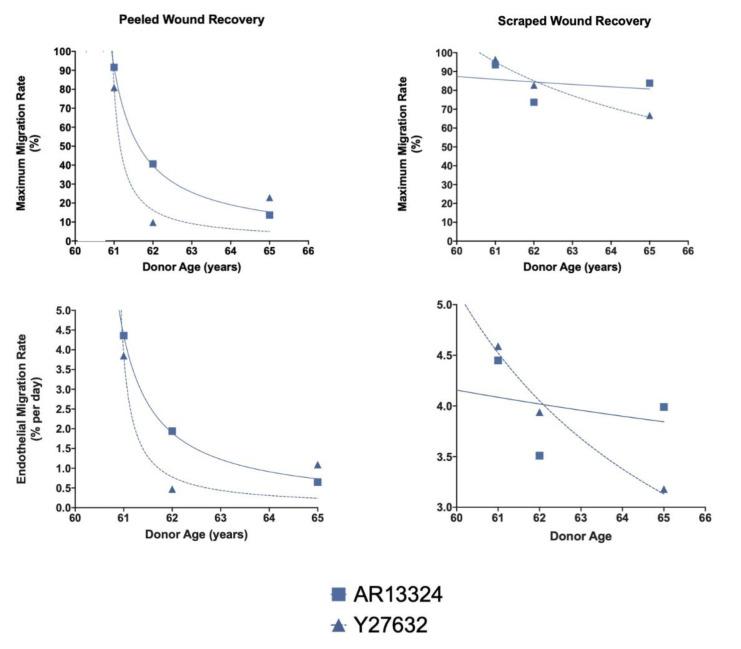
(1) Rho-associated coiled-coil protein kinase (ROCK) signaling cascade impacts a wide array of cellular events. For cellular therapeutics, scalable expansion of primary human corneal endothelial cells (CECs) is crucial, and the inhibition of ROCK signaling using a well characterized ROCK inhibitor (ROCKi) Y-27632 had been shown to enhance overall endothelial cell yield. (2) In this study, we compared several classes of ROCK inhibitors to both ROCK-I and ROCK-II, using in silico binding simulation. We then evaluated nine ROCK inhibitors for their effects on primary CECs, before narrowing it down to the two most efficacious compounds-AR-13324 (Netarsudil) and its active metabolite, AR-13503-and assessed their impact on cellular proliferation in vitro. Finally, we evaluated the use of AR-13324 on the regenerative capacity of donor cornea with an ex vivo corneal wound closure model. Donor-matched control groups supplemented with Y-27632 were used for comparative analyses. (3) Our in silico simulation revealed that most of the compounds had stronger binding strength than Y-27632. Most of the nine ROCK inhibitors assessed worked within the concentrations of between 100 nM to 30 µM, with comparable adherence to that of Y-27632. Of note, both AR-13324 and AR-13503 showed better cellular adherence when compared to Y-27632. Similarly, the proliferation rates of CECs exposed to AR-13324 were comparable to those of Y-27632. Interestingly, CECs expanded in a medium supplemented with AR-13503 were significantly more proliferative in (i) untreated vs. AR-13503 (1 μM; * < 0.05); (ii) untreated vs. AR-13503 (10 μM; *** < 0.001); (iii) Y-27632 vs. AR-13503 (10 μM; ** < 0.005); (iv) AR-13324 (1 μM) vs. AR-13503 (10 μM; ** < 0.005); and (v) AR-13324 (0.1 μM) vs. AR-13503 (10 μM; * < 0.05). Lastly, an ex vivo corneal wound healing study showed a comparable wound healing rate for the final healed area in corneas exposed to Y-27632 or AR-13324. (4) In conclusion, we were able to demonstrate that various classes of ROCKi compounds other than Y-27632 were able to exert positive effects on primary CECs, and systematic donor-match controlled comparisons revealed that the FDA-approved ROCK inhibitor, AR-13324, is a potential candidate for cellular therapeutics or as an adjunct drug in regenerative treatment for corneal endothelial diseases in humans.
(1) Rho 相关卷曲螺旋蛋白激酶 (ROCK) 信号级联反应影响广泛的细胞事件。对于细胞治疗,原代人角膜内皮细胞 (CEC) 的可扩展扩增至关重要,使用经过充分表征的 ROCK 抑制剂 (ROCKi) Y-27632 抑制 ROCK 信号已被证明可以提高整体内皮细胞产量。(2)在这项研究中,我们使用计算机模拟结合比较了几类 ROCK 抑制剂对 ROCK-I 和 ROCK-II 的作用。然后,我们评估了九种 ROCK 抑制剂对原代 CEC 的影响,然后将其缩小到两种最有效的化合物-AR-13324(奈塔舒迪尔)及其活性代谢物 AR-13503-并评估它们对细胞增殖的影响体外。最后,我们评估了在体外角膜伤口闭合模型中使用 AR-13324 对供体角膜再生能力的影响。使用 Y-27632 补充的供体匹配对照组用于比较分析。(3)我们的计算机模拟表明,大多数化合物的结合强度都强于 Y-27632。在所评估的九种 ROCK 抑制剂中,大多数在 100 nM 至 30 μM 之间的浓度下起作用,与 Y-27632 的作用相似。值得注意的是,与 Y-27632 相比,AR-13324 和 AR-13503 都显示出更好的细胞粘附性。同样,暴露于 AR-13324 的 CEC 的增殖率与 Y-27632 相当。有趣的是,在用 AR-13503 补充的培养基中扩增的 CEC 在以下情况下的增殖率明显更高:(i)未处理 vs. AR-13503(1 μM; * < 0.05);(ii)未处理 vs. AR-13503(10 μM; *** < 0.001);(iii)Y-27632 vs. AR-13503(10 μM; ** < 0.005);(iv)AR-13324(1 μM) vs. AR-13503(10 μM; ** < 0.005);以及 (v)AR-13324(0.1 μM) vs. AR-13503(10 μM; * < 0.05)。最后,体外角膜伤口愈合研究表明,Y-27632 或 AR-13324 处理的角膜最终愈合区域的愈合速度相当。(4)总之,我们能够证明 Y-27632 以外的各种 ROCKi 化合物能够对原代 CEC 产生积极影响,系统的供体匹配对照比较表明,已批准用于治疗的 ROCK 抑制剂 AR-13324 可能是一种用于细胞治疗的候选药物,或作为人类角膜内皮疾病再生治疗的辅助药物。


 Zotero 插件