
免疫衰老:分子机制与疾病。
Immunosenescence: molecular mechanisms and diseases.
机构信息
Department of Interventional Radiology, The First Affiliated Hospital of Zhengzhou University, 450052, Zhengzhou, Henan, China.
Interventional Institute of Zhengzhou University, 450052, Zhengzhou, Henan, China.
出版信息
Signal Transduct Target Ther. 2023 May 13;8(1):200. doi: 10.1038/s41392-023-01451-2.
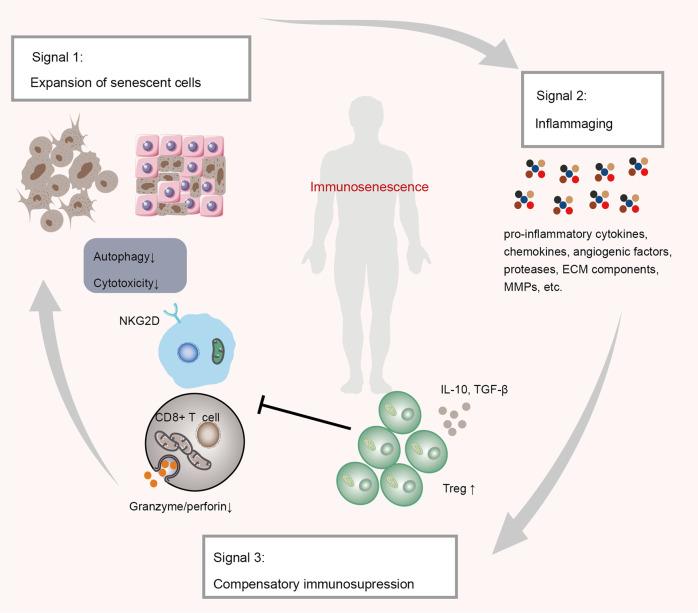
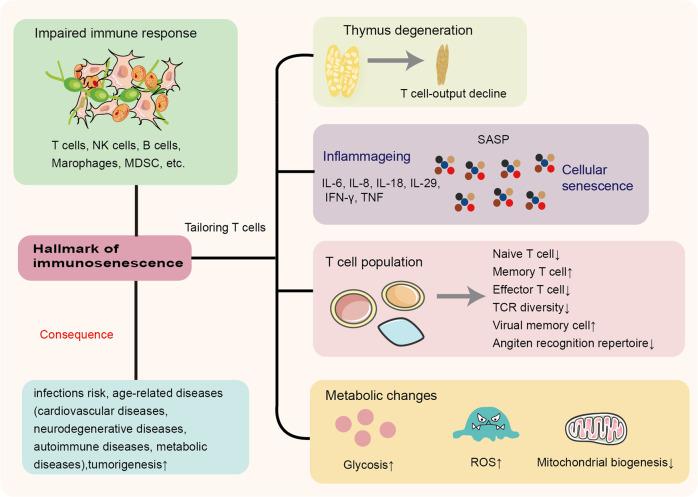
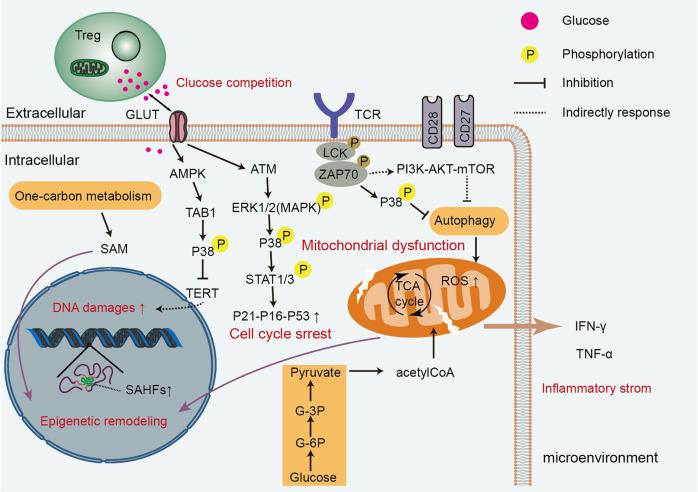
Infection susceptibility, poor vaccination efficacy, age-related disease onset, and neoplasms are linked to innate and adaptive immune dysfunction that accompanies aging (known as immunosenescence). During aging, organisms tend to develop a characteristic inflammatory state that expresses high levels of pro-inflammatory markers, termed inflammaging. This chronic inflammation is a typical phenomenon linked to immunosenescence and it is considered the major risk factor for age-related diseases. Thymic involution, naïve/memory cell ratio imbalance, dysregulated metabolism, and epigenetic alterations are striking features of immunosenescence. Disturbed T-cell pools and chronic antigen stimulation mediate premature senescence of immune cells, and senescent immune cells develop a proinflammatory senescence-associated secretory phenotype that exacerbates inflammaging. Although the underlying molecular mechanisms remain to be addressed, it is well documented that senescent T cells and inflammaging might be major driving forces in immunosenescence. Potential counteractive measures will be discussed, including intervention of cellular senescence and metabolic-epigenetic axes to mitigate immunosenescence. In recent years, immunosenescence has attracted increasing attention for its role in tumor development. As a result of the limited participation of elderly patients, the impact of immunosenescence on cancer immunotherapy is unclear. Despite some surprising results from clinical trials and drugs, it is necessary to investigate the role of immunosenescence in cancer and other age-related diseases.
易感性感染、疫苗效果不佳、与年龄相关的疾病发作和肿瘤与伴随衰老出现的固有和适应性免疫功能障碍有关(称为免疫衰老)。在衰老过程中,机体往往会发展出一种表达高水平促炎标志物的特征性炎症状态,称为炎症状况。这种慢性炎症是与免疫衰老相关的典型现象,被认为是与年龄相关疾病的主要风险因素。胸腺萎缩、幼稚/记忆细胞比例失衡、代谢失调和表观遗传改变是免疫衰老的显著特征。T 细胞池紊乱和慢性抗原刺激介导免疫细胞过早衰老,衰老的免疫细胞会产生促炎的衰老相关分泌表型,从而加剧炎症状况。尽管其潜在的分子机制仍有待解决,但有充分证据表明衰老的 T 细胞和炎症状况可能是免疫衰老的主要驱动因素。我们将讨论潜在的对抗措施,包括干预细胞衰老和代谢-表观遗传轴以减轻免疫衰老。近年来,免疫衰老因其在肿瘤发展中的作用而引起了越来越多的关注。由于老年患者的参与有限,免疫衰老对癌症免疫治疗的影响尚不清楚。尽管临床试验和药物有一些令人惊讶的结果,但有必要研究免疫衰老在癌症和其他与年龄相关的疾病中的作用。

 Zotero 插件